Blog
Back to blog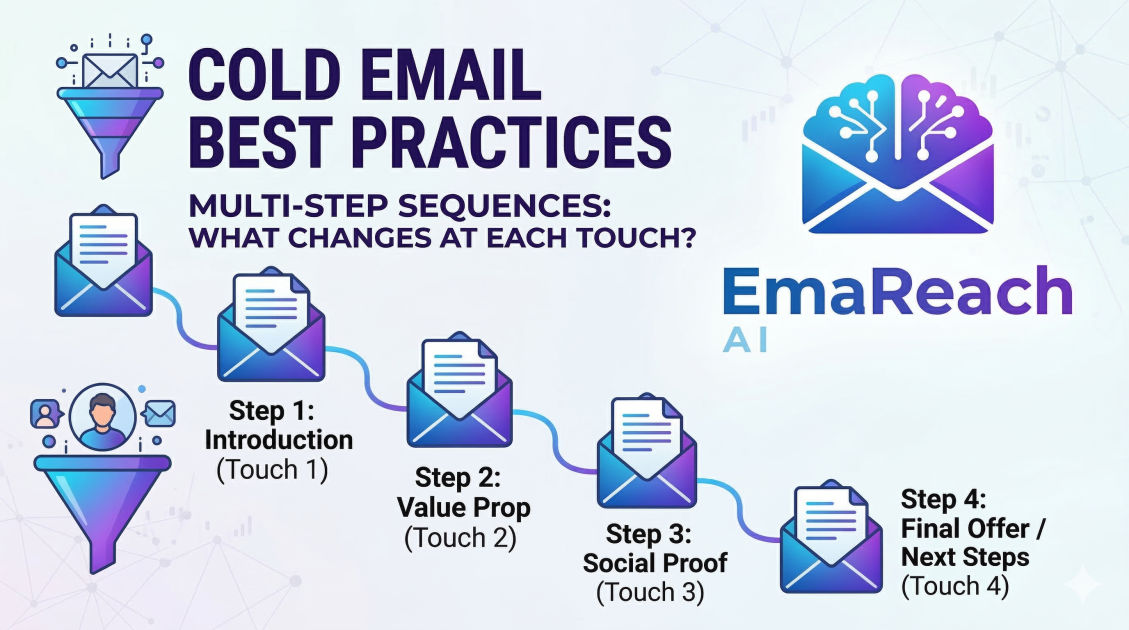
Cold Email Best Practices for Multi-Step Sequences: What Changes at Each Touch
cold emailsales outreachemail marketinglead generationB2B salesemail deliverability
Introduction
Cold email outreach is rarely a one-and-done affair. In the modern landscape of B2B sales and networking, the initial message is merely the opening gambit. Statistics consistently show that the majority of conversions happen after the fourth or fifth touchpoint, yet a staggering number of practitioners give up after just one or two attempts.
The secret to a high-performing cold email campaign lies not just in persistence, but in the evolution of the message. You cannot simply repeat the same pitch five times and expect a different result. Each touchpoint in a multi-step sequence serves a distinct psychological and tactical purpose. To master this, you must understand how your tone, value proposition, and call to action (CTA) should shift as the sequence progresses.
Effective sequences balance persistence with politeness, ensuring that you stay top-of-mind without becoming a nuisance. By leveraging sophisticated platforms like EmaReach, which combines AI-written outreach with inbox warm-up, you can ensure that these meticulously crafted touches actually reach the primary inbox and garner the replies they deserve.
The Psychology of the Multi-Step Sequence
Before diving into the specifics of each email, it is vital to understand the psychological journey of your prospect. When they receive your first email, they are a 'cold' lead—they likely have no idea who you are or why you are in their inbox.
As the sequence unfolds, the goal is to transition the prospect through four phases:
- Awareness: Recognizing your name and brand.
- Education: Understanding the specific problem you solve.
- Credibility: Believing that you are an authority who can actually deliver results.
- Action: Feeling enough trust or urgency to book a call or reply.
If your sequence treats every touchpoint as an 'Action' phase, you will see high unsubscribe rates. If you treat them all as 'Awareness,' you will never close a deal. The magic happens in the strategic shift between these phases.
Touch 1: The Foundation (The Hook and The Value)
The first email is your most important, but also the one most likely to be ignored. Its primary job is to establish relevance and earn the right to send a second email.
Key Characteristics of the First Touch
- Personalization: This is where deep research pays off. Mention a specific recent achievement, a shared connection, or a pain point unique to their industry.
- The 'Why Now': You must justify why you are reaching out today specifically.
- Brief Value Proposition: Don't list every feature. Focus on one primary outcome (e.g., 'We help SaaS companies reduce churn by 15%').
What to Avoid
Avoid the 'me-centric' approach. Phrases like 'I want to introduce my company' or 'I’d love to tell you about our services' are instant triggers for the delete folder. Instead, frame everything around the prospect’s world.
Touch 2: The Contextual Follow-Up (The Gentle Nudge)
Sent usually 2-3 days after the first email, the second touch should be a 'bump' of the first thread.
The Strategic Shift
In this stage, you aren't introducing new concepts yet. You are assuming the prospect is busy (which they are) and providing a convenient way for them to see your previous message.
Best Practices
- Keep it Short: Usually under three sentences.
- Threaded Replies: Always send this as a reply to the first email so the prospect can see the context without searching.
- The 'Thoughts?' Approach: A simple 'Hi [Name], I wanted to make sure this didn't get buried in your inbox. Any thoughts on the above?' works remarkably well because it requires low cognitive load to answer.
Touch 3: The Value Add (The 'Give before you Get')
By the third email (usually 4-7 days after the second), if they haven't replied, the 'I'm just following up' strategy starts to lose its effectiveness. It is time to change the angle.
The Strategic Shift
Instead of asking for a meeting, give them something of value. This builds social capital and proves you aren't just a solicitor; you are a resource.
Examples of Value Adds
- Relevant Content: A case study of a competitor or a similar company you helped.
- Insights: A quick tip or observation about their website, SEO, or social media presence that they can fix immediately.
- Industry Trends: A brief mention of a shift in their industry and how it might affect them.
This touchpoint changes the dynamic from 'salesperson' to 'consultant.'
Touch 4: The Social Proof (Building Trust)
If you reach the fourth touch, the prospect has seen your name three times. They might be thinking, 'Who is this person, and can they actually do what they say?'
The Strategic Shift
Shift the focus from what you do to who you have done it for. Use concrete numbers and recognizable names if possible.
How to Structure Social Proof
Don't just say 'We have many happy clients.' Use a structure like this:
"We recently worked with [Company X] who was struggling with [Problem]. By implementing [Your Solution], they saw a [Percentage/Dollar Amount] increase in [Metric] within 90 days."
This builds the necessary credibility to overcome the 'is this a scam?' hurdle that exists in cold outreach.
Touch 5: The Alternative Angle (The Pivot)
Sometimes, your initial value proposition simply doesn't resonate because you guessed the wrong pain point. The fifth email is your chance to pivot.
The Strategic Shift
If your first four emails focused on 'Cost Savings,' the fifth email might focus on 'Time Efficiency' or 'Risk Mitigation.'
Implementation
"Hi [Name], I’ve reached out a few times regarding [Topic A], but perhaps that isn't a priority for you right now. Many [Job Titles] I speak with are actually more concerned with [Topic B]. Is that something on your radar?"
This shows flexibility and intelligence, acknowledging that you don't have all the answers but are committed to being helpful.
Touch 6: The Break-Up (The Psychology of Loss)
This is often the highest-converting email in the entire sequence. Human beings are naturally wired to avoid loss more than they are to seek gain.
The Strategic Shift
You are 'taking the offer off the table.' You are signaling that you will stop reaching out, which removes the pressure from the prospect but also triggers a 'last chance' response.
Best Practices
- Professionalism: Never be snarky or passive-aggressive (e.g., 'I guess you don't care about growth').
- Clean Slate: State that you are closing their file for now but remain open to a future conversation.
- The 'Permission' Close: 'I haven't heard back, so I'll assume this isn't the right time. I’ll stop reaching out for now so I don't clutter your inbox. If things change in the future, feel free to reach out.'
Technical Considerations for Multi-Step Sequences
Executing a 6-step sequence across hundreds of leads manually is impossible. However, automation comes with risks—primarily the risk of landing in the spam folder. When sending multi-step sequences, your deliverability is under constant scrutiny by ISPs (Internet Service Providers).
Deliverability and Reputation
As you send more emails to the same recipient, if they don't engage, it can signal to email providers that your content is unwanted. This is why utilizing tools like EmaReach is critical. By using multi-account sending and automated warm-up, you protect your domain's reputation. EmaReach ensures that your cold emails land in the primary tab, where they can actually be read, rather than the promotions or spam folders.
Timing and Cadence
A common mistake is sending emails too close together. A standard effective cadence looks like this:
- Day 1: Touch 1
- Day 3: Touch 2
- Day 7: Touch 3
- Day 12: Touch 4
- Day 20: Touch 5
- Day 30: Touch 6
Spacing out the later touches prevents you from appearing desperate or intrusive.
Writing for the Inbox: Tone and Formatting
Regardless of which touchpoint you are on, the 'look and feel' of your email must remain consistent. In a multi-step sequence, the prospect will start to recognize your style.
Use Markdown for Clarity
While most cold emails are plain text, you can use formatting to make your value stand out:
- Bold key statistics.
- Use bullet points for lists of benefits.
- Keep paragraphs to 2-3 lines maximum.
The Call to Action (CTA) Evolution
Your CTA should also change as the sequence progresses:
- Early touches: Low-friction CTAs ('Worth a chat?', 'Open to a quick video?').
- Middle touches: Content-based CTAs ('Should I send over that PDF?', 'Can I share the link to that case study?').
- Late touches: Direct CTAs ('Do you have 10 minutes Tuesday at 2 PM?').
Measuring Success Beyond the Reply
In a multi-step sequence, success isn't just a 'Yes' to a meeting. You should track other metrics at each stage:
- Open Rates: If Touch 1 has a high open rate but Touch 4 doesn't, your subject lines for later touches might be getting stale.
- Click-Through Rates (CTR): If you are sending resources in Touch 3, are people actually clicking? If not, the resource isn't valuable enough.
- Positive vs. Negative Replies: A 'Not interested' is still data. It tells you that your targeting might be off, or that specific angle isn't hitting home.
Conclusion
Mastering the multi-step cold email sequence is a journey of refinement. It requires moving away from the mindset of 'pestering' and toward a mindset of 'persistent value.' By understanding that each touchpoint must offer something new—whether it's context, value, social proof, or a new perspective—you transform your outreach from a cold broadcast into a strategic conversation.
Remember that the technical side of the equation is just as important as the copy. Without high deliverability and professional inbox management, even the best sequence will go unseen. Strategic persistence, coupled with the right delivery technology, is the formula for predictable, scalable growth in any industry.
EmaReach AI
Ready to scale your cold email outreach?
Join thousands of teams using EmaReach AI for AI-powered campaigns, domain warmup, and 95%+ deliverability. Start free — no credit card required.
Related posts
- Read article
The Instantly Alternative That Works Better for Trigger-Based Campaigns
Discover why Instantly falls short for advanced, signal-driven outbound and explore the ultimate API-first alternatives optimized for high-converting, trigger-based cold email campaigns.
- Read article
The Instantly Alternative That Handles High Bounce Rates Without Panic
Discover how transitioning to an advanced Instantly alternative can safeguard your cold email infrastructure. Learn to handle high bounce rates effortlessly using real-time verification, smart mailbox rotation, and automated safety nets to protect your sender reputation and maintain consistent primary inbox placement.