Blog
Back to blog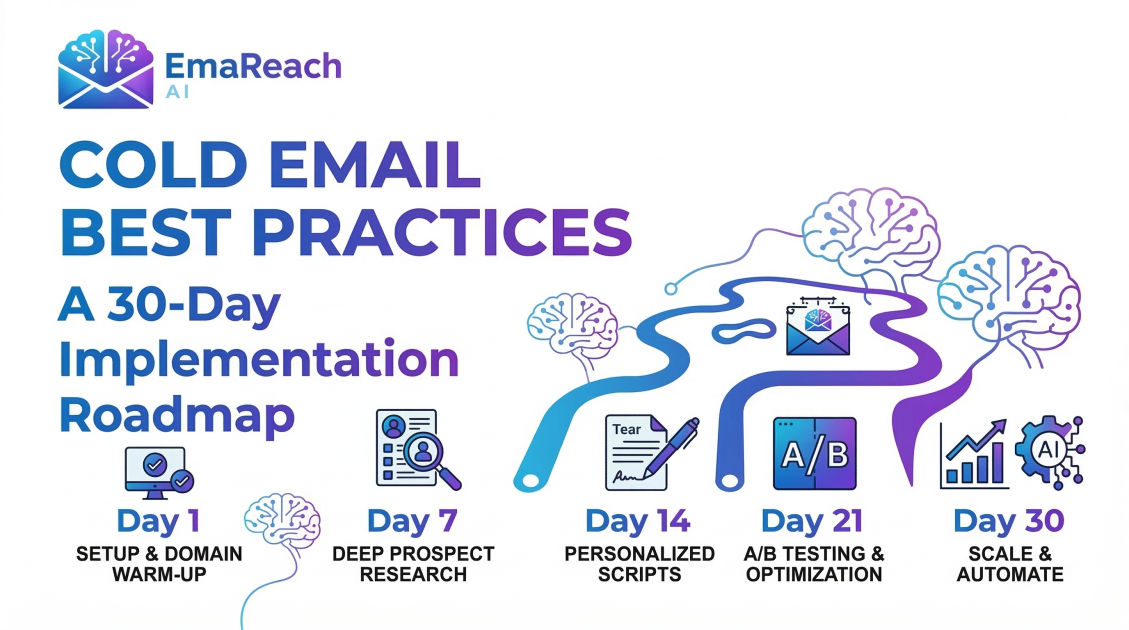
Cold Email Best Practices: A 30-Day Implementation Roadmap
cold emaillead generationemail marketingoutreach strategydeliverabilitysales automation
Introduction: The New Era of Cold Outreach
Cold email is not dead, but the version of cold email that involves mass-blasting generic templates to unverified lists certainly is. In today’s digital landscape, inbox providers have become incredibly sophisticated at filtering out noise. To succeed, businesses must shift from a quantity-first mindset to a quality-first strategy.
This 30-day roadmap is designed to take you from a standing start to a high-performing outreach machine. We will cover technical foundations, lead research, copywriting psychology, and the critical 'warm-up' period that ensures your messages actually reach their intended destination. By following this structured approach, you can build a sustainable outbound engine that generates predictable revenue without risking your domain reputation.
Phase 1: Foundations and Infrastructure (Days 1–7)
The biggest mistake most marketers make is hitting 'send' before their infrastructure is ready. If your technical setup is flawed, even the best copy in the world won't be read because it will be trapped in the spam folder.
Day 1: Domain Strategy and Setup
Never send cold emails from your primary company domain. If your primary domain gets blacklisted, your internal team won't be able to email clients, partners, or each other. Instead, purchase 'lookalike' domains (e.g., if your site is company.com, buy getcompany.com or trycompany.com).
Day 2: Authenticating Your Identity
You must prove to mailbox providers (Google, Outlook, etc.) that you are who you say you are. This requires setting up three key records in your DNS settings:
- SPF (Sender Policy Framework): Specifies which mail servers are authorized to send email on behalf of your domain.
- DKIM (DomainKeys Identified Mail): Adds a digital signature to your emails, ensuring the content hasn't been tampered with in transit.
- DMARC (Domain-based Message Authentication, Reporting, and Conformance): Tells receiving servers what to do if an email fails SPF or DKIM checks.
Day 3–7: Initiating the Warm-up Process
New domains have no sender reputation. If you suddenly send 100 emails a day, you will be flagged as a spammer. You must use a warm-up tool to gradually increase sending volume and generate positive engagement signals (opens, replies, and marking 'not spam'). This is where EmaReach becomes essential. EmaReach AI combines AI-written cold outreach with inbox warm-up and multi-account sending, ensuring your emails land in the primary tab and get replies rather than languishing in the junk folder.
Phase 2: Prospecting and List Building (Days 8–14)
With your technical foundation cooking in the background, it’s time to find the right people. A high-converting campaign is 40% targeting, 40% offer, and only 20% copy.
Day 8: Defining Your Ideal Customer Profile (ICP)
Go beyond basic demographics. Identify the specific 'pain points' your prospects are feeling. Are they struggling with inefficient workflows? Low lead flow? High churn? Knowing exactly who you are talking to allows you to speak their language.
Day 9–11: Sourcing High-Quality Data
Avoid buying 'stale' lists from shady brokers. Use reputable databases that allow for granular filtering based on job titles, industry, company size, and recent funding rounds. Focus on 'Trigger Events'—for example, if a company just hired a new Head of Sales, they are likely looking for new tools and processes.
Day 12: The Art of Segmentation
Divide your list into small, highly specific buckets. Instead of one list for 'Marketing Managers,' create sub-lists for 'Marketing Managers in SaaS' and 'Marketing Managers in E-commerce.' The more specific the segment, the more personalized your message can feel.
Day 13–14: Data Cleaning and Verification
Sending emails to non-existent addresses (bounces) is a fast track to the spam folder. Use a verification service to scrub your list of 'catch-all' addresses and invalid emails. Aim for a bounce rate of under 3%.
Phase 3: Copywriting and Psychology (Days 15–21)
Your goal is not to sell your product in the first email. Your goal is to sell a conversation.
Day 15: Mastering the Subject Line
The subject line has one job: get the email opened. Avoid 'salesy' language like "Free Consultation" or "Increase Revenue by 50%." Instead, use low-pressure, internal-sounding subject lines like "Question regarding [Department]" or "Quick idea for [Company]."
Day 16: The 'Hook' and Personalization
Start with the prospect, not yourself. Your first sentence should prove you’ve done your homework. Reference a recent LinkedIn post they wrote, a podcast they appeared on, or a specific achievement of their company. If you can’t personalize every email manually, use 'liquid syntax' to personalize at scale based on their industry or role.
Day 17: The Value Proposition (The Bridge)
Connect their current reality to a better future. Instead of listing features, talk about outcomes. Use the formula: "We help [ICP] achieve [Result] by [Method] without [Pain Point]."
Day 18: The Call to Action (CTA)
Don't ask for a 30-minute demo immediately. That’s a high-friction request. Use a 'Low-Friction CTA' like:
- "Do you have a roadmap for [Problem] yet?"
- "Would it make sense to share a 2-minute video on how we solved this for [Competitor]?"
- "Are you the right person to speak with about this?"
Day 19–21: Building the Follow-up Sequence
Persistence pays off, but only if it's polite. A standard 4-touchpoint sequence might look like this:
- Day 1: The Initial Outreach (Value-driven).
- Day 4: The 'Thoughts?' Follow-up (Brief nudge).
- Day 9: The Value-Add (Share a relevant case study or article).
- Day 15: The 'Break-up' Email (Professional closing of the loop).
Phase 4: Launch and Optimization (Days 22–30)
By Day 22, your domains should be warmed up and your copy should be polished. It’s time to go live.
Day 22: Small Batch Testing
Don't launch to your entire list at once. Send your sequence to a small batch of 50 prospects. Monitor the open rates and reply rates. If your open rate is below 50%, your subject line or deliverability needs work. If your reply rate is below 3%, your offer or targeting is likely off.
Day 23–25: Analyzing Deliverability Metrics
Check your technical health again. Are your emails landing in the primary tab? Tools like EmaReach help monitor this in real-time. If you notice a dip, pause your campaigns and increase your warm-up volume. Maintaining a healthy sender reputation is a marathon, not a sprint.
Day 26–28: A/B Testing Everything
Test one variable at a time. Try two different subject lines. Try a 'Question' CTA vs. a 'Resource' CTA. Let the data tell you what your audience prefers. Even a 1% increase in reply rates can lead to thousands of dollars in additional pipeline.
Day 29: Handling Objections and Replies
When the replies start coming in, speed is of the essence. Have 'canned responses' ready for common objections like "We already use a competitor" or "Check back in six months." The faster you respond to a positive inquiry, the higher the chance of booking the meeting.
Day 30: Review and Scale
Look at your results from the 30-day period. Identify which segments performed the best and which sequences had the highest engagement. Now, you can safely scale your volume by adding more 'lookalike' domains and increasing your daily send limits gradually.
Advanced Strategies for Long-Term Success
Once you have the basics of the 30-day roadmap mastered, you can look into more advanced tactics to stay ahead of the curve.
Multi-Channel Integration
Cold email works best when it isn't the only touchpoint. Try 'surrounding' your prospects by engaging with their LinkedIn content a few days before sending your first email. This creates 'familiarity'—when they see your name in their inbox, it won’t feel like a cold contact.
Intent-Based Outreach
Use tools to identify companies that are currently searching for keywords related to your service. If you know a company is actively looking for 'Cloud Security Solutions,' your email arrives as a helpful solution rather than an interruption.
Dynamic Content and AI Personalization
As you scale, manual personalization becomes difficult. Leveraging AI to analyze a prospect's website and generate a unique introductory sentence can maintain that 'human feel' at a much higher volume. This is a core feature of modern platforms like EmaReach, which bridges the gap between automation and authentic communication.
Conclusion
Building a successful cold email engine is a disciplined process of technical setup, deep audience research, and psychological copywriting. By following this 30-day roadmap, you move away from 'spray and pray' tactics and toward a sophisticated system that respects the prospect's inbox and your brand's reputation.
Remember that cold email is a conversation, not a broadcast. Focus on providing value, solving problems, and maintaining the highest standards of deliverability. With the right infrastructure and a commitment to testing, your outreach can become the most reliable growth channel in your business.
EmaReach AI
Ready to scale your cold email outreach?
Join thousands of teams using EmaReach AI for AI-powered campaigns, domain warmup, and 95%+ deliverability. Start free — no credit card required.
Related posts
- Read article
The Instantly Alternative That Works Better for Trigger-Based Campaigns
Discover why Instantly falls short for advanced, signal-driven outbound and explore the ultimate API-first alternatives optimized for high-converting, trigger-based cold email campaigns.
- Read article
The Instantly Alternative That Handles High Bounce Rates Without Panic
Discover how transitioning to an advanced Instantly alternative can safeguard your cold email infrastructure. Learn to handle high bounce rates effortlessly using real-time verification, smart mailbox rotation, and automated safety nets to protect your sender reputation and maintain consistent primary inbox placement.