Blog
Back to blog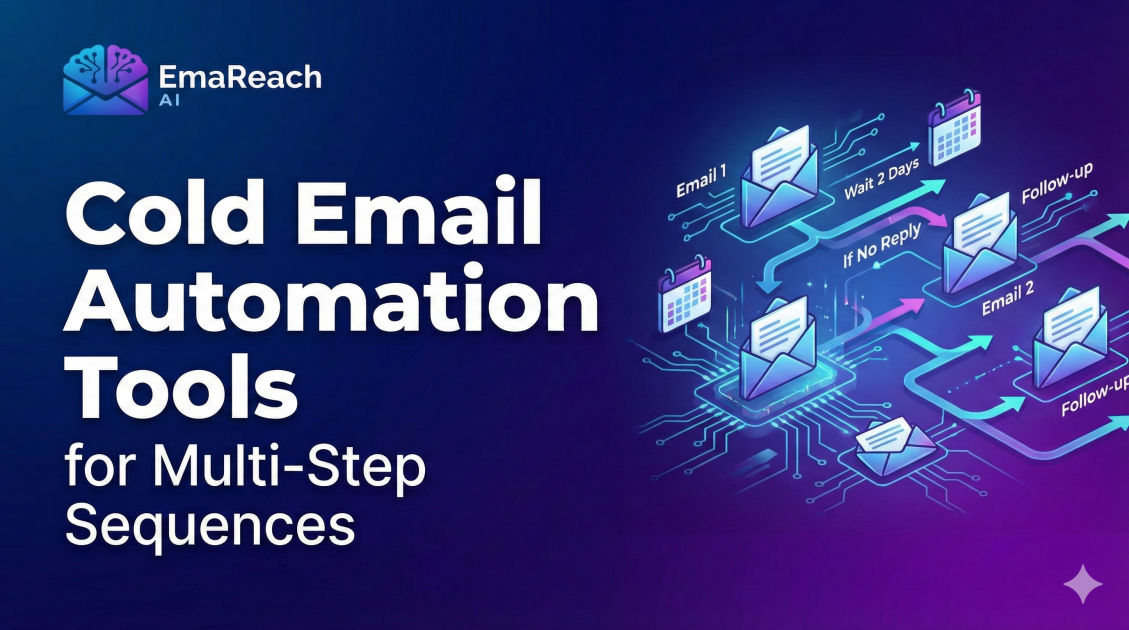
Cold Email Automation Tools for Multi-Step Sequences
cold email softwaresales automationemail deliverabilitylead generationoutreach strategyB2B sales
Introduction
The era of the "spray and pray" single-touch email blast is unequivocally over. In modern sales development, success lives in the follow-up. Statistics consistently show that the vast majority of responses come not from the initial contact, but from the second, third, or even fourth email in a sequence.
However, manually managing follow-ups for hundreds of prospects is impossible. This is where cold email automation tools come into play. These are not just standard email marketing platforms (like Mailchimp) designed for newsletters; they are specialized engines built to mimic one-to-one human communication at scale. They handle the heavy lifting of scheduling, personalization, and deliverability, allowing sales teams to focus on closing deals rather than admin work.
In this guide, we will explore the best tools for creating sophisticated multi-step sequences, the features that matter most, and the strategies to ensure your automated emails actually land in the primary inbox.
Why Multi-Step Sequences are Non-Negotiable
A multi-step sequence is a pre-programmed series of emails sent to a prospect over a specific period. If the prospect replies, the automation stops, and a human takes over. If they don't, the system continues to nurture them automatically.
Why is this structure essential?
- Combatting Inbox Noise: Prospects are busy. Your first email might have been relevant but arrived at the wrong time. A follow-up three days later brings you back to the top of the inbox.
- Building Narrative: You cannot fit your entire value proposition into one email without overwhelming the reader. A sequence allows you to drip-feed value—starting with a hook, moving to social proof, and ending with a low-friction call to action.
- Demonstrating Persistence: Professional persistence signals seriousness. It shows you believe in your solution enough to try more than once.
Key Features to Look for in Automation Tools
Before we dive into specific software, you must understand the "must-have" mechanics of a high-performing cold email engine.
1. Unlimited Email Accounts & Inbox Rotation
Sender reputation is the currency of cold email. If you send 500 emails a day from one address, Google and Microsoft will block you.
Modern tools allow you to connect multiple sending accounts (e.g., john@domain.com, john.d@domain.com, j.doe@secondary-domain.com) and rotate the sending volume between them. This technique, known as "load balancing," keeps individual account volume low while keeping total campaign volume high.
2. Automated Warm-up
New email accounts are "cold" and untrusted by spam filters. Warm-up tools automatically interact with a network of other inboxes—sending, opening, and replying to emails—to artificially generate positive engagement signals. This builds a reputation shield before you ever send a sales email.
3. Spintax and Liquid Syntax
To avoid spam filters, your emails need to look unique.
- Spintax (Spin Syntax): Allows you to vary phrases within the email. Example:
{Hi|Hello|Hey} {Name},randomly selects one greeting for each email. - Liquid Syntax: Uses logic to customize content. Example:
If Industry = 'SaaS', print 'software companies', else print 'businesses'.
4. Native CRM Integrations
A siloed tool is a dangerous tool. The best platforms integrate bi-directionally with CRMs like HubSpot, Salesforce, or Pipedrive to log activity and prevent you from emailing current customers accidentally.
Top Cold Email Automation Tools for Multi-Step Sequences
While the market is crowded, a few platforms stand out for their ability to handle complex, multi-step workflows effectively.
1. Smartlead & Instantly (The High-Volume Leaders)
These two platforms have revolutionized the space by focusing entirely on deliverability at scale. They are favored by lead generation agencies and high-growth startups.
- Best For: Users who need to send thousands of emails per day across dozens of domains.
- Key Feature: Their "Uni-Inbox" aggregates replies from all your different email accounts into one master feed, so you don't have to log in to 20 different inboxes to check for responses.
- Sequence Capabilities: They offer robust drip campaigns with basic variability. While they may lack the visual flair of some competitors, their infrastructure for ensuring emails land in the inbox is unmatched.
2. Lemlist (The Personalization King)
Lemlist made a name for itself by allowing users to embed personalized images and videos dynamically.
- Best For: Account-Based Marketing (ABM) and campaigns where high-touch personalization is more important than raw volume.
- Key Feature: You can generate a custom image for every prospect, such as a picture of you holding a whiteboard that has their name or company logo automatically written on it. This pattern interrupt can significantly boost reply rates in step 1 or 2 of a sequence.
- Sequence Capabilities: very visual interface for building flows, including LinkedIn steps and cold call tasks mixed with emails.
3. Outreach & Salesloft (The Enterprise Powerhouses)
These are not just email tools; they are "Sales Engagement Platforms."
- Best For: Large enterprise sales teams (SDRs/AEs) who need strict governance, coaching features, and deep Salesforce integration.
- Key Feature: They manage the entire workflow, not just email. A sequence (or "Cadence") might look like: Day 1: Email -> Day 1: LinkedIn Connection -> Day 3: Call Task -> Day 5: Email.
- Cons: They are significantly more expensive and complex to set up compared to agile tools like Smartlead.
4. Woodpecker (The Agency Favorite)
Woodpecker has long been a staple for its reliability and focus on agency workflows.
- Best For: Agencies managing distinct campaigns for multiple clients.
- Key Feature: Their "Condition-based" sending is excellent. It checks if a prospect has opened an email before sending the next one, allowing you to fork the sequence. (e.g., If they opened Email 1, send a specific follow-up. If they didn't, send a different subject line).
5. Reply.io (The Multi-Channel Hybrid)
Reply sits somewhere between the agile tools and the enterprise platforms.
- Best For: Teams that want multi-channel outreach (SMS, WhatsApp, LinkedIn, Email) without the enterprise price tag of Outreach.
- Key Feature: Their AI assistant is built-in to help grade your email copy and suggest improvements for clarity and tone before you launch the sequence.
Designing the Perfect Multi-Step Strategy
Having the tool is only half the battle. You need a blueprint for what to write. Here is a proven 4-step framework for a B2B cold email sequence.
Step 1: The "Soft" Hook (Day 0)
Goal: Relevance and curiosity. Do not pitch your product immediately. Instead, pitch the problem or a relevant observation.
- Subject: Question about {{companyName}}
- Body: Mention a specific trigger (hiring, funding, recent news) and tie it to a problem you solve. Ask for interest, not a meeting.
Step 2: The Value Add (Day 3)
Goal: Credibility. Assume they missed the first email. Do not write "Just bumping this to the top." It adds no value.
- Body: "I forgot to mention—we recently helped [Competitor/Similar Company] achieve [Result]. Thought this case study might be relevant to how you're handling [Process] at {{companyName}}."
Step 3: The New Angle (Day 7)
Goal: Overcoming objections. If they haven't replied, they might be skeptical or think it's too expensive/complex. Address that.
- Body: "Usually, when I speak to [Job Title], they are concerned about implementation time. We actually solve that by..."
Step 4: The Break-Up (Day 14-20)
Goal: Strip the line. This is often the highest converting email because it removes pressure.
- Body: "It seems like this isn't a priority right now, so I'll stop reaching out to avoid cluttering your inbox. If you ever need help with [Problem] in the future, feel free to ping me."
Best Practices for Automation Management
Monitor Your "Bounce Rate"
Your bounce rate (emails that fail to deliver) should never exceed 2-3%. If it does, your automation tool will be flagged by service providers. Always use a verification tool (like MillionVerifier or ZeroBounce) to clean your list before uploading it to your sequence tool.
A/B Testing is Mandatory
Never assume you know what works. Most automation tools allow you to run A/B tests within a sequence.
- Test 1: Subject Lines (Open rate impact).
- Test 2: Call to Action (Reply rate impact).
- Test 3: Send Times (Timing impact). Only change one variable at a time to ensure statistical significance.
The "Human" Threshold
Automation is powerful, but it has limits. If a prospect replies with a complex question, the automation must stop immediately (most tools do this automatically). From that point on, you must reply manually. Do not try to use AI auto-responders to close deals; they often hallucinate or sound robotic, killing the trust you just built.
Conclusion
Cold email automation tools have matured from simple "mail merge" scripts into sophisticated engagement platforms. Whether you choose a deliverability-focused tool like Smartlead, a visual tool like Lemlist, or an enterprise suite like Outreach, the principles remain the same: provide value, respect the inbox, and be persistent.
The right tool will amplify your message, but the quality of that message—and the strategy behind the sequence—is what ultimately converts strangers into customers.
EmaReach AI
Ready to scale your cold email outreach?
Join thousands of teams using EmaReach AI for AI-powered campaigns, domain warmup, and 95%+ deliverability. Start free — no credit card required.
Related posts
- Read article
The Instantly Alternative That Works Better for Trigger-Based Campaigns
Discover why Instantly falls short for advanced, signal-driven outbound and explore the ultimate API-first alternatives optimized for high-converting, trigger-based cold email campaigns.
- Read article
The Instantly Alternative That Handles High Bounce Rates Without Panic
Discover how transitioning to an advanced Instantly alternative can safeguard your cold email infrastructure. Learn to handle high bounce rates effortlessly using real-time verification, smart mailbox rotation, and automated safety nets to protect your sender reputation and maintain consistent primary inbox placement.