Blog
Back to blog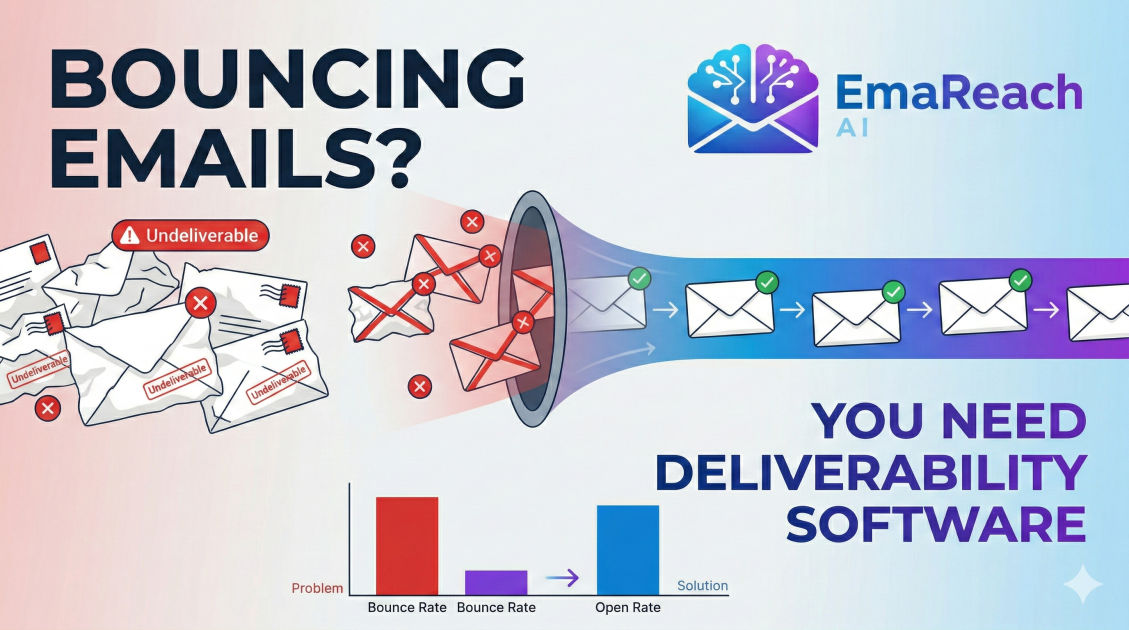
Bouncing Emails? You Need Deliverability Software
email deliverabilitybounced emailssender reputationemail marketinginbox placementcold outreachemail warm-up
Introduction
There is nothing quite as frustrating for a digital marketer, sales professional, or business owner as spending hours crafting the perfect email, only to receive a notification moments later that it has bounced. A bounced email is more than just a missed connection; it is a signal that something is wrong with your sender reputation or your data quality. When bounces happen frequently, they trigger red flags for Internet Service Providers (ISPs), leading to a downward spiral where even your legitimate emails to active subscribers end up in the dreaded spam folder.
In the modern landscape of digital communication, the bridge between 'sent' and 'delivered' is narrower than ever. If you are struggling with high bounce rates, low open rates, or the feeling that your messages are disappearing into a black hole, you don't just have a content problem—you have a deliverability problem. To fix it, you need deliverability software.
Understanding the Anatomy of an Email Bounce
Before diving into the technical solutions, it is essential to understand why emails bounce in the first place. Not all bounces are created equal, and deliverability software is designed to handle the nuances of each.
Hard Bounces vs. Soft Bounces
A hard bounce is a permanent failure. This usually occurs because the email address is invalid, the domain does not exist, or the recipient's mail server has completely blocked your server. Continuing to send to hard-bounce addresses is the fastest way to destroy your sender reputation.
A soft bounce is a temporary delivery failure. This could be due to a full mailbox, a server outage, or a message that is too large for the recipient’s settings. While less severe than hard bounces, a high volume of soft bounces over time can still negatively impact your standing with ISPs.
The Hidden Impact on Sender Reputation
Every time you hit 'send,' ISPs like Google and Microsoft evaluate your Sender Reputation. This is a score assigned to your IP address and domain based on factors like bounce rates, complaint rates (people marking you as spam), and engagement. If your bounce rate exceeds 2%, ISPs begin to view you as a 'spammer' or a sender with poor data hygiene. This leads to 'greylisting' or outright blocking, meaning your emails won't even make it to the spam folder—they simply won't be accepted at all.
Why Manual Management Isn't Enough
Many businesses attempt to manage their email lists manually, deleting invalid addresses as they appear. However, this is a reactive strategy that often comes too late. By the time you see the bounce, the damage to your reputation is already done. Furthermore, manual management cannot account for:
- Spam Traps: These are valid-looking email addresses used by ISPs to catch senders who use scraped or outdated lists.
- Technical Authentication: Managing SPF, DKIM, and DMARC records manually is complex and prone to human error.
- Inbox Placement: Knowing where your email landed (Primary tab vs. Promotions vs. Spam) is impossible without specialized monitoring tools.
The Role of Deliverability Software
Deliverability software acts as a comprehensive shield and diagnostic toolkit for your email operations. It moves your strategy from reactive to proactive, ensuring that your technical setup is flawless and your lists are pristine before you ever click send.
1. Real-Time List Verification
The cornerstone of any deliverability tool is list cleaning. This software checks every address on your list to ensure it is active, formatted correctly, and not associated with known spam traps. By filtering out problematic addresses before the campaign launches, you effectively eliminate hard bounces.
2. Technical Infrastructure Audit
Are your SPF, DKIM, and DMARC records set up correctly? Deliverability software scans your domain settings to ensure you are properly authenticated. Without these 'digital passports,' ISPs are likely to view your emails as suspicious, regardless of how great your content is.
3. Inbox Warm-up Services
If you are using a new domain or IP address, you cannot immediately send thousands of emails. You must 'warm up' the inbox by gradually increasing volume and ensuring high engagement. Deliverability software automates this process by sending low-volume, high-engagement emails to a network of trusted accounts, signaling to ISPs that you are a legitimate sender.
For those involved in cold outreach, tools like EmaReach are transformative. Stop Landing in Spam. Cold Emails That Reach the Inbox. EmaReach AI combines AI-written cold outreach with inbox warm-up and multi-account sending—so your emails land in the primary tab and get replies. This level of automation ensures that the technical heavy lifting is handled while you focus on closing deals.
Key Features to Look For in Deliverability Software
When choosing a solution to fix your bouncing emails, look for these essential features:
Automated Warm-up
As mentioned, the ability to automate the growth of your sender reputation is vital. The software should simulate human-like behavior, including opening emails, marking them as important, and moving them out of the spam folder if they land there.
Seed List Testing
Before you send your main campaign, the software sends the email to a 'seed list' of addresses across various providers (Gmail, Outlook, Yahoo). It then reports back on where those emails landed. This allows you to tweak your subject lines or content if you find you are hitting the spam filter.
Blacklist Monitoring
There are hundreds of public blacklists that ISPs consult. Deliverability software monitors these lists 24/7. If your domain or IP is ever flagged, you will receive an immediate alert so you can begin the delisting process before your deliverability tanks.
Content Analysis
Some tools provide 'spam scores' for your email copy. They flag 'spammy' words (like 'free,' 'guaranteed,' or 'winner') and check your image-to-text ratio, helping you optimize the content itself for the inbox.
The Strategic Importance of 'The Primary Tab'
In the era of tiered inboxes (like Gmail's category tabs), deliverability isn't just about avoiding the spam folder; it’s about reaching the Primary Tab. Most users rarely check their 'Promotions' or 'Social' tabs with the same intent they bring to their main inbox.
Deliverability software helps you bridge this gap by improving engagement metrics. When your emails are opened, replied to, and forwarded (actions often simulated during the warm-up phase), ISPs categorize your domain as 'highly relevant' to the user, significantly increasing your chances of landing in the primary view.
How to Implement Deliverability Software into Your Workflow
Transitioning to a deliverability-focused approach requires a shift in how you view email marketing. Follow these steps to integrate software effectively:
Step 1: The Initial Scrub
Run your entire existing database through the software’s verification engine. You might be surprised to find that 10-20% of your list is composed of 'dead' or risky emails. Remove them immediately.
Step 2: Set Up Authentication
Use the software’s diagnostic tools to verify your DNS settings. Ensure that your DMARC policy is moving toward 'quarantine' or 'reject' once you are confident in your setup, as this protects your brand from spoofing.
Step 3: Initiate Warm-up
Even if you are an established sender, a 'maintenance' warm-up is beneficial. It keeps your engagement metrics high and provides a buffer against occasional spikes in unsubscribes or complaints.
Step 4: Monitor and Iterate
Review your deliverability reports weekly. Look for trends. If you notice a sudden drop in opens for Gmail users, use your software to investigate if your IP has been greylisted by Google.
The ROI of Deliverability
It is easy to view deliverability software as an extra expense, but the Return on Investment (ROI) is often massive. Consider the following scenario:
- Without Software: You send 10,000 emails. 5% bounce, 15% go to spam, and 20% land in Promotions. Your open rate is 10%. You get 1,000 eyes on your content.
- With Software: You send 9,500 emails (after cleaning). 0% bounce, 2% go to spam, and 10% land in Promotions. Your open rate jumps to 25% because you are in the Primary Tab. You get 2,375 eyes on your content.
You have more than doubled your results with a smaller, cleaner list. This is the power of deliverability software.
Common Myths About Email Bounces
To effectively use deliverability tools, you must move past common misconceptions that hold many senders back.
Myth 1: "If I have permission, I won't bounce."
Permission doesn't prevent an email address from becoming defunct. People change jobs, delete accounts, and abandon old addresses. Permission is about legality; deliverability is about technical validity.
Myth 2: "High-volume sending is the only way to grow."
In the modern era, volume without deliverability is just noise. Sending 1,000 emails that all reach the inbox is infinitely more valuable than sending 100,000 emails where 90,000 are blocked by ISPs.
Myth 3: "The software does all the work."
While deliverability software automates the technical aspects, you still need to provide value. If your content is genuinely unhelpful, users will mark it as spam, and no amount of software can save a domain that users actively dislike.
Future-Proofing Your Email Strategy
ISPs are becoming increasingly sophisticated. They are now using machine learning to track how long a user spends reading an email and whether they scroll to the bottom. As these metrics become more important, the role of deliverability software will expand to include deeper engagement analytics.
By investing in deliverability software now, you are not just fixing today's bounces; you are building a resilient infrastructure that can adapt to the ever-changing rules of the digital gatekeepers. You are ensuring that your voice is heard in an increasingly crowded digital room.
Conclusion
Bouncing emails are a symptom of a deeper issue within your email ecosystem. Whether it is poor list hygiene, lack of technical authentication, or a cold sender reputation, these issues act as a ceiling on your growth. Deliverability software removes that ceiling. It provides the clarity, protection, and automation necessary to ensure that your messages reach their intended destination. In an age where attention is the most valuable currency, ensuring your emails actually land in the inbox isn't just a technical necessity—it's a competitive advantage.
EmaReach AI
Ready to scale your cold email outreach?
Join thousands of teams using EmaReach AI for AI-powered campaigns, domain warmup, and 95%+ deliverability. Start free — no credit card required.
Related posts
- Read article
How Choosing the Right Instantly Alternative Changed Our Pipeline Numbers
Discover how transitioning from a volume-first cold email setup to an advanced, deliverability-focused infrastructure transformed our B2B pipeline metrics, skyrocketed open rates to over 68%, and tripled our monthly booked demos.
- Read article
The Instantly Alternative That Impressed Even the Biggest Instantly Fans
Discover why top outbound growth marketers and lead generation agencies are migrating from legacy cold email platforms to advanced alternatives built for superior deliverability, white-label client management, and robust API workflows.