Blog
Back to blog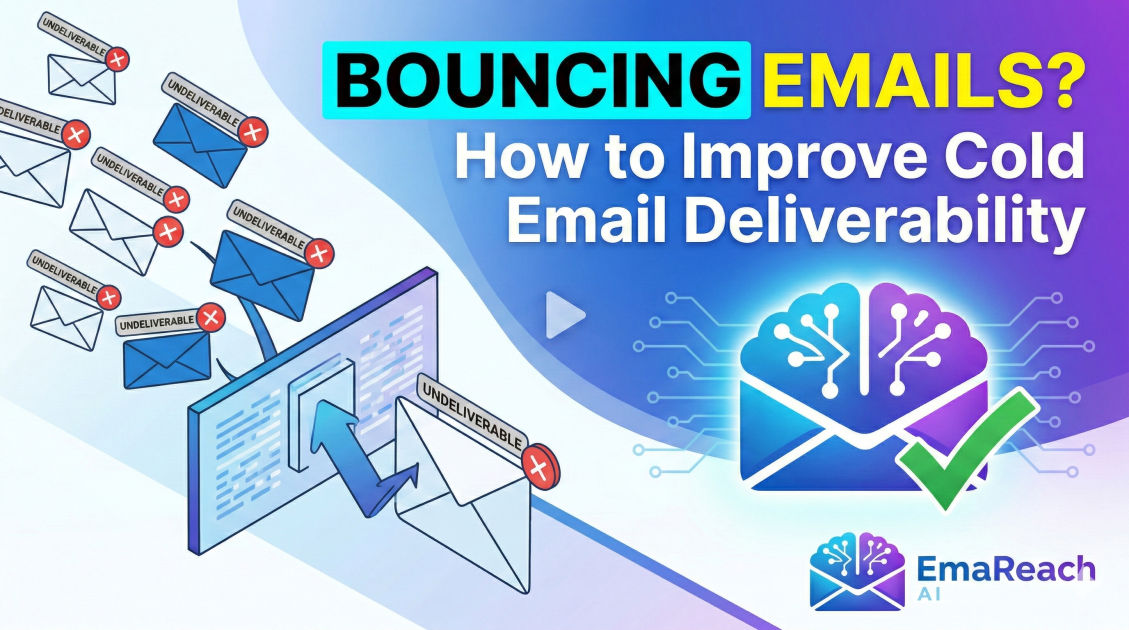
Bouncing Emails? Here is How to Improve Cold Email Deliverability
cold emailemail deliverabilitysales outreachlead generationemail marketinginbox placement
Introduction: The Hidden Barrier to Cold Email Success
You have spent hours researching your ideal customer profile, crafting the perfect value proposition, and meticulously drafting a sequence of emails that should, in theory, generate a flood of meetings. You hit 'send' on your campaign and wait for the replies to roll in. But instead of interested prospects, your inbox is filled with 'Address not found' notifications and 'Message blocked' warnings.
Even worse than the emails that bounce are the ones that quietly disappear into the spam folder, never to be seen by your prospects. This is the reality of poor email deliverability. In the modern landscape of digital communication, hitting 'send' is only half the battle; the real challenge is ensuring your message actually arrives in the primary inbox.
Cold email deliverability is a complex science influenced by technical configurations, sender reputation, content quality, and recipient behavior. If you ignore these factors, your outreach efforts are effectively dead on arrival. This guide will walk you through the comprehensive steps required to fix bouncing emails and optimize your deliverability for long-term success.
Understanding the Difference: Hard Bounces vs. Soft Bounces
Before you can fix your deliverability, you must understand why emails fail to deliver. Not all bounces are created equal.
Hard Bounces
A hard bounce indicates a permanent reason why an email cannot be delivered. This usually happens because the email address does not exist, the domain name is invalid, or the recipient's mail server has completely blocked your server. Continuing to send to addresses that result in hard bounces is a fast track to being blacklisted by Internet Service Providers (ISPs).
Soft Bounces
A soft bounce is a temporary delivery failure. This could be due to a full inbox, a temporary server issue on the recipient's end, or the email message being too large. While less damaging than hard bounces, a high frequency of soft bounces can still signal to providers that your mailing list is not well-maintained.
The Technical Foundation: Authenticating Your Domain
Email authentication is the digital equivalent of showing your ID at a security checkpoint. Without it, receiving servers have no way of verifying that you are who you say you are, and they will likely treat your messages as fraudulent.
1. SPF (Sender Policy Framework)
SPF is a DNS record that lists the specific IP addresses and domains that are authorized to send emails on behalf of your domain. When an email arrives, the receiving server checks the SPF record to see if the sender is on the 'approved' list.
2. DKIM (DomainKeys Identified Mail)
DKIM adds a digital signature to your emails. This signature ensures that the content of the email hasn't been tampered with during transit. It provides a way for the recipient server to verify that the email truly originated from your domain.
3. DMARC (Domain-based Message Authentication, Reporting, and Conformance)
DMARC is a policy that tells receiving servers what to do if an email fails SPF or DKIM checks. You can set it to 'none' (monitor), 'quarantine' (send to spam), or 'reject' (block entirely). Having a DMARC record in place is increasingly becoming a mandatory requirement for major email providers.
Protecting Your Primary Domain
One of the most common mistakes in cold outreach is sending high-volume campaigns from your primary company domain (e.g., yourname@company.com). If your deliverability takes a hit due to spam complaints, your entire company’s internal communication could be affected.
To prevent this, savvy outbound teams use secondary domains. These are domains that look similar to your main one (e.g., company-outreach.com) but are used exclusively for cold email. This creates a 'firewall' around your primary business reputation.
The Critical Role of Email Warm-up
You cannot simply register a new domain and start sending 500 emails a day. This behavior is a massive red flag for spam filters. Instead, you must 'warm up' your email account.
Email warming is the process of gradually increasing your sending volume while maintaining high engagement rates. This involves sending emails to 'friendly' accounts that open the messages, mark them as important, and move them out of the spam folder if they land there. This tells ISPs that you are a legitimate sender providing value.
For those looking to automate this complex process, EmaReach (https://www.emareach.com/) provides a powerful solution. EmaReach AI combines AI-written cold outreach with inbox warm-up and multi-account sending, ensuring your emails land in the primary tab and get replies without the manual headache of managing reputation.
Maintaining List Hygiene
Your deliverability is only as good as your data. If you are buying stagnant lists or using outdated databases, you are inviting bounces. High bounce rates (typically anything over 2%) will damage your sender reputation significantly.
Regular Validation
Use email verification tools to scrub your list before every campaign. These tools check if the domain exists and if the specific mailbox is active without actually sending an email.
Avoiding 'Catch-all' Addresses
Some domains are configured to accept all emails sent to them, regardless of whether the specific alias exists. These are risky for cold callers because you won't know if the email reached a real person until it's too late. It is often safer to exclude 'catch-all' addresses from high-stakes campaigns.
Crafting Content That Bypasses Spam Filters
Spam filters have become incredibly sophisticated. They no longer just look for words like 'Free' or 'Winner'; they analyze the entire structure and intent of your message.
Avoid Spam-Trigger Words
While the context matters, consistently using aggressive sales language can hurt you. Avoid excessive use of:
- Urgent / Act Now
- 100% Guaranteed
- Cash / Earn / Money
- Special Promotion
Minimize Links and Attachments
Cold emails should be text-heavy. Including too many links (especially shortened URLs like bit.ly) or large attachments can trigger security filters. In your initial outreach, aim for one or zero links.
Personalization at Scale
Spam filters look for identical messages sent to large groups of people. By using dynamic variables (like the recipient's name, company, or a specific detail about their recent work), you ensure that every email you send is unique. This variance is a positive signal to ISPs.
Managing Sender Reputation and Limits
Your sender reputation is a score assigned to your IP and domain by ISPs. It is influenced by:
- Spam Complaints: The number of times recipients click 'Mark as Spam.'
- Bounce Rate: How many of your emails fail to deliver.
- Engagement: How many people open, reply to, or forward your emails.
- Sending Consistency: Avoiding sudden spikes in volume.
Daily Sending Limits
To maintain a healthy reputation, avoid sending more than 30-50 cold emails per day per inbox. If you need to send 500 emails a day, it is better to distribute those 500 emails across 10 different inboxes rather than blasting them from one. This 'horizontal scaling' keeps your per-inbox volume low and safe.
The Importance of the 'Unsubscribe' Option
It may seem counterintuitive to make it easy for people to leave your list, but it is essential for deliverability. If a prospect cannot find a way to opt-out, they will take the easiest alternative: clicking the 'Spam' button. A spam complaint is significantly more damaging to your reputation than an unsubscribe.
Always provide a clear way to opt-out, whether it's an unsubscribe link or a simple 'Reply with STOP to opt-out' message.
Monitoring Your Progress
Deliverability is not a 'set it and forget it' task. You should regularly monitor your technical health using various tools that provide 'postmaster' data. These tools can show you your current reputation across different providers like Google and Outlook.
Pay close attention to your reply rates. A dropping reply rate is often the first 'canary in the coal mine' indicating that your emails are starting to land in the spam folder rather than the inbox.
Troubleshooting: What to Do if You Land in Spam
If you find that your deliverability has tanked, don't panic. You can recover, but it requires a 'cool down' period.
- Stop all campaigns: Immediately pause sending from the affected domain.
- Audit your technical records: Re-verify your SPF, DKIM, and DMARC.
- Increase warm-up intensity: Use a warm-up service to generate positive engagement.
- Check blacklists: Use online tools to see if your domain or IP has been added to any major blacklists. If so, follow their specific delisting procedures.
- Simplify your content: Remove all links and images from your templates for a few weeks.
Conclusion: Deliverability is a Competitive Advantage
In an era where everyone has access to automated sending tools, the inbox is more crowded than ever. Most people ignore the technical nuances of deliverability, meaning their emails never even get a chance to be read. By mastering the art of authentication, list hygiene, and reputation management, you aren't just 'fixing bounces'—you are building a competitive advantage.
When your emails consistently land in the primary inbox, your response rates will naturally climb, and your sales pipeline will remain full. Treat your sender reputation as one of your company's most valuable digital assets, and it will reward you with consistent, predictable growth.
By following these strategies—or leveraging platforms like EmaReach to handle the heavy lifting—you ensure that your voice is heard in a noisy digital world.
EmaReach AI
Ready to scale your cold email outreach?
Join thousands of teams using EmaReach AI for AI-powered campaigns, domain warmup, and 95%+ deliverability. Start free — no credit card required.
Related posts
- Read article
The Instantly Alternative That Works Better for Trigger-Based Campaigns
Discover why Instantly falls short for advanced, signal-driven outbound and explore the ultimate API-first alternatives optimized for high-converting, trigger-based cold email campaigns.
- Read article
The Instantly Alternative That Handles High Bounce Rates Without Panic
Discover how transitioning to an advanced Instantly alternative can safeguard your cold email infrastructure. Learn to handle high bounce rates effortlessly using real-time verification, smart mailbox rotation, and automated safety nets to protect your sender reputation and maintain consistent primary inbox placement.