Blog
Back to blog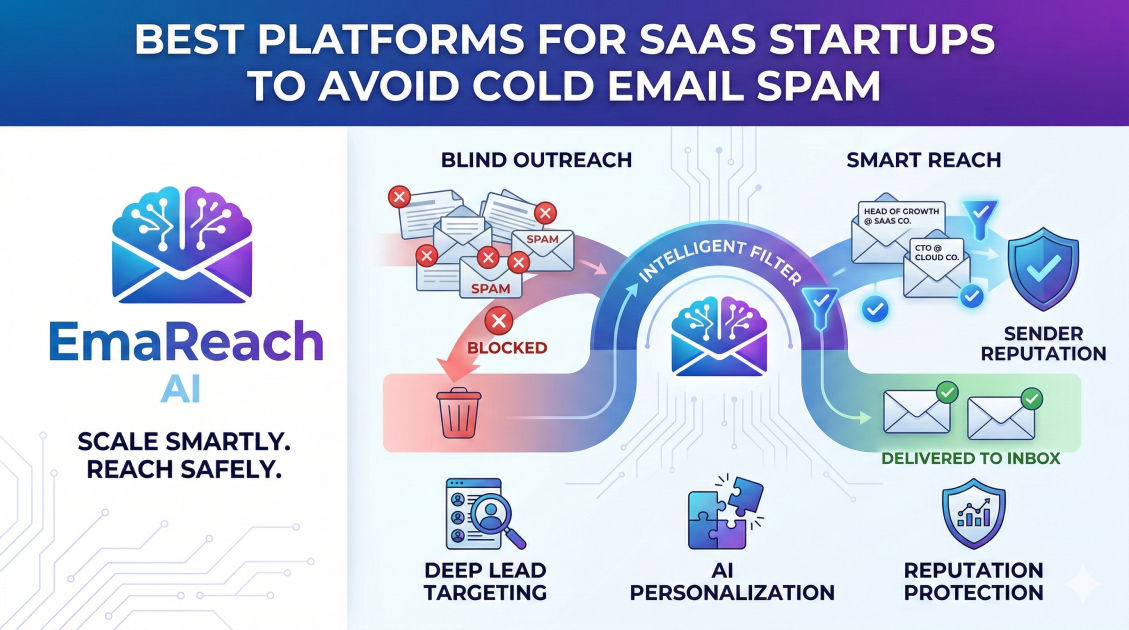
Best Platforms for SaaS Startups to Avoid Cold Email Spam
SaaS growthcold emailemail deliverabilityoutreach toolsspam preventionsales automation
The High Stakes of Cold Email for SaaS Startups
For a SaaS startup, cold email isn't just a marketing channel; it is often the primary engine for early-stage growth. It is the bridge between a revolutionary product and the first hundred paying customers. However, the landscape of outbound sales has shifted dramatically. Global email providers have implemented rigorous filters that penalize aggressive, un-targeted, or poorly configured outreach.
Landing in the spam folder is a silent killer for startups. It destroys your domain reputation, wastes precious sales development resources, and ensures your value proposition never reaches the decision-maker. To succeed, startups must transition from 'blasting' to 'precision engineering.' This requires a combination of the right strategy and the right technical infrastructure.
Understanding the Anatomy of Email Deliverability
Before diving into the platforms, it is crucial to understand why emails end up in spam. Deliverability is not a single setting; it is a composite score based on several factors:
- Technical Authentication: Protocols like SPF, DKIM, and DMARC prove to the receiving server that you are who you say you are.
- Sender Reputation: A history of your domain’s sending behavior. If people frequently mark your mail as spam, your reputation plummets.
- Engagement Rates: High open and reply rates signal to providers that your content is valuable.
- Content Triggers: Using 'spammy' words, excessive links, or broken HTML can trigger automated filters.
- Volume Management: Sudden spikes in volume are a major red flag for Google and Outlook.
Top Platforms to Ensure Your SaaS Outreach Hits the Inbox
To navigate these challenges, SaaS founders and sales teams need platforms that prioritize deliverability over simple automation. Here are the leading solutions designed to keep your cold emails in the primary tab.
1. EmaReach: The AI-Driven Deliverability Powerhouse
When it comes to modern outbound sales, EmaReach stands out by addressing the root causes of spam. Its core philosophy is simple: Stop Landing in Spam. Cold Emails That Reach the Inbox.
EmaReach AI combines AI-written cold outreach with specialized inbox warm-up and multi-account sending. This multi-pronged approach ensures that your emails land in the primary tab and get replies. For a SaaS startup, this is invaluable because it automates the most technical aspects of deliverability—like rotating accounts and warming up domains—while using AI to ensure the copy feels personal and relevant, rather than automated.
2. Lemlist: Personalization and Warm-up
Lemlist gained popularity in the SaaS community for its focus on multi-channel outreach and 'Lemwarm.' Lemwarm is an automated tool that generates peer-to-peer engagement for your email account, signaling to providers that your account is active and legitimate. By gradually increasing the volume of emails sent, it builds a 'buffer' of positive reputation that protects your actual sales campaigns.
3. Woodpecker: Safety-First Automation
Woodpecker is designed specifically for B2B companies that prioritize safety. Its algorithm mimics human behavior, sending emails at random intervals rather than in bulk batches. This is a critical feature for avoiding the automated detection systems used by Gmail and Office 365. It also provides robust duplicate detection to ensure you never email the same prospect twice from different campaigns, which is a common cause of spam complaints.
4. Salesloft and Outreach: The Enterprise Standard
While often positioned for larger teams, these platforms offer deep integration with CRM systems like Salesforce and HubSpot. Their value lies in 'sequences' that combine email with social touches and phone calls. By diversifying the touchpoints, you reduce the reliance on high-volume emailing, which naturally keeps your spam rates lower.
The Technical Foundation: SPF, DKIM, and DMARC
No platform can save a startup that hasn't configured its technical records. Think of these as your digital passport. Without them, you are a 'stateless' sender, and most enterprise filters will reject you immediately.
SPF (Sender Policy Framework)
SPF is a DNS record that lists the IP addresses and domains authorized to send email on behalf of your domain. If an email comes from an IP not listed in your SPF record, it looks suspicious.
DKIM (DomainKeys Identified Mail)
DKIM adds a digital signature to your emails. This allows the receiver to verify that the email was indeed authorized by the owner of that domain and that the content hasn't been tampered with in transit.
DMARC (Domain-based Message Authentication, Reporting, and Conformance)
DMARC sits on top of SPF and DKIM. It tells the receiving server what to do if the email fails the first two checks (e.g., 'do nothing,' 'quarantine,' or 'reject'). Setting DMARC to 'quarantine' or 'reject' is a strong signal of a high-authority sender.
Content Strategy: Writing Emails That Don't Look Like Spam
Even with perfect technical setups, poor content will lead to 'manual' spam reports. If a user clicks 'Report Spam,' it hurts you more than any automated filter ever could. To avoid this, SaaS startups should follow these guidelines:
Avoid 'Spammy' Keywords
Certain words are immediate red flags for filters. Words like 'Free,' 'Guarantee,' 'Cash,' 'Urgent,' and 'Winner' should be used sparingly, if at all. Instead, focus on professional language that addresses a specific business problem.
The Power of Hyper-Personalization
Generic templates are the fastest way to the spam folder. Modern platforms allow for 'liquid syntax' or AI-driven variables. Instead of just {{First_Name}}, try referencing a recent LinkedIn post they wrote or a specific challenge their industry is facing. When an email feels tailor-made, the recipient is far more likely to engage and far less likely to report it.
Keep It Simple: Plain Text vs. HTML
SaaS marketers often want to send beautiful, branded HTML emails with images and buttons. This is a mistake for cold outreach. Heavily coded emails are frequently flagged as 'Promotions' or 'Spam.' A plain-text email looks like a message from one human to another, which is exactly what you want.
The Concept of 'Inbox Warm-up'
You cannot register a new domain today and send 500 emails tomorrow. If you do, the domain will be blacklisted within 48 hours. Inbox warm-up is the process of gradually increasing your email volume over several weeks.
Platforms like EmaReach handle this automatically by sending small batches of emails to a network of 'friendly' inboxes that open, mark as important, and reply to your messages. This artificial engagement builds the reputation necessary to eventually send your real sales messages with confidence.
Advanced Tactics for Scaling Without Spam
As your SaaS grows, you will need to scale your outreach. Doing this safely requires more than just more volume; it requires a smarter architecture.
Multi-Account Sending (The 'Subdomain' Strategy)
Instead of sending 200 emails a day from your primary domain (e.g., ceo@acme.com), it is safer to use multiple accounts across different subdomains (e.g., rep1@getacme.com, rep2@tryacme.com).
This strategy provides 'fault tolerance.' If one domain gets flagged or sees a dip in reputation, your entire sales operation doesn't grind to a halt. Platforms that support multi-account rotation allow you to spread your total volume across many 'low-volume' senders, which is the gold standard for deliverability.
Lead List Cleaning
Sending emails to addresses that no longer exist (hard bounces) is a major signal to providers that you are using a stale or bought list. Before importing any leads into your outreach platform, run them through a verification service. These tools check if the mail server exists and if the specific mailbox is active without actually sending an email.
Monitoring Your Reputation
You cannot manage what you do not measure. SaaS startups should regularly check their 'Sender Score' and monitor tools like Google Postmaster Tools. These resources provide direct feedback from the providers themselves about how your domain is perceived. If you see your reputation dipping into 'Medium' or 'Low,' it is time to stop all outbound activity and return to a 'warm-up only' phase.
Best Practices for SaaS Cold Outreach
To wrap up, here is a checklist for any SaaS startup looking to build a sustainable outbound engine:
- Use a separate domain: Never send cold emails from your primary corporate domain used for transactional emails (like password resets).
- Limit links: Try to include only one link, or better yet, no links in the first email. Ask for permission to send a resource instead.
- Clear Opt-Out: Always provide a clear way for people to say 'no.' Whether it’s an unsubscribe link or a simple 'Please let me know if you’re not the right person,' making it easy to opt-out prevents spam reports.
- Mobile Optimization: Ensure your plain-text layout looks good on mobile devices, where over 50% of emails are first opened.
- Testing: Use tools to 'test-send' your email to a variety of providers (Gmail, Outlook, Yahoo) to see where it lands before starting the full campaign.
Conclusion
Avoiding the spam folder is a continuous process of technical maintenance and content refinement. For SaaS startups, the cost of getting this wrong is too high to ignore. By leveraging platforms that prioritize deliverability—especially those that integrate AI and automated warm-up like EmaReach—you can ensure that your message reaches the people who need your solution most. Success in outbound sales isn't about who sends the most emails; it's about who reaches the inbox with the most relevant message. Protect your domain, respect your prospects, and use the right tools to turn cold outreach into a reliable growth engine.
EmaReach AI
Ready to scale your cold email outreach?
Join thousands of teams using EmaReach AI for AI-powered campaigns, domain warmup, and 95%+ deliverability. Start free — no credit card required.
Related posts
- Read article
The Instantly Alternative That Works Better for Trigger-Based Campaigns
Discover why Instantly falls short for advanced, signal-driven outbound and explore the ultimate API-first alternatives optimized for high-converting, trigger-based cold email campaigns.
- Read article
The Instantly Alternative That Handles High Bounce Rates Without Panic
Discover how transitioning to an advanced Instantly alternative can safeguard your cold email infrastructure. Learn to handle high bounce rates effortlessly using real-time verification, smart mailbox rotation, and automated safety nets to protect your sender reputation and maintain consistent primary inbox placement.