Blog
Back to blog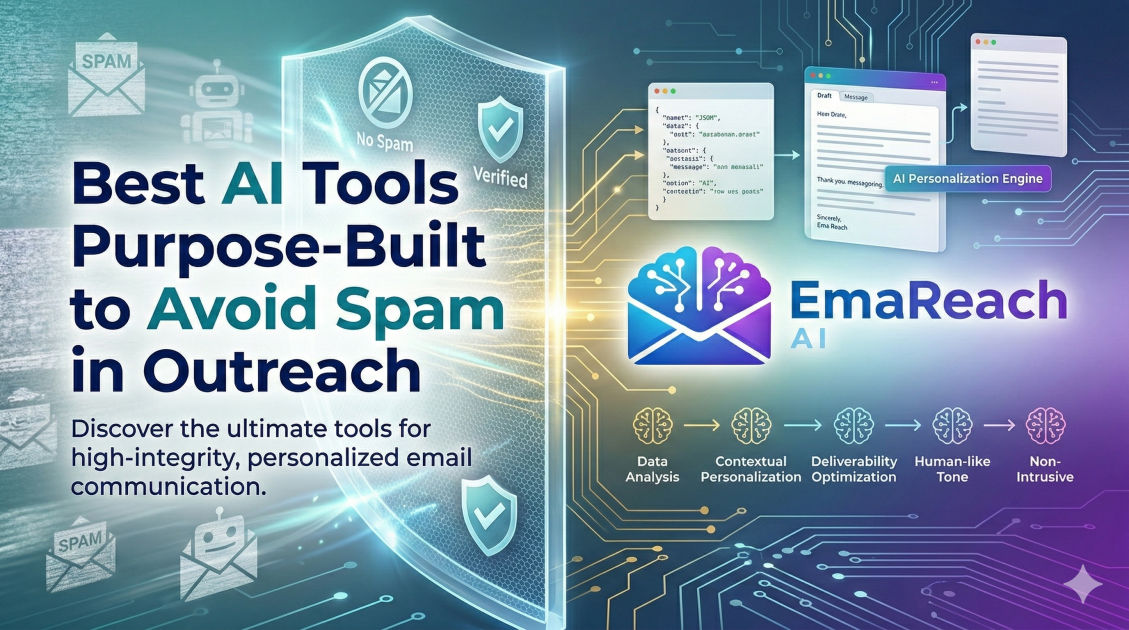
Best AI Tools Purpose-Built to Avoid Spam in Outreach
cold emailoutreachdeliverabilityAI toolsemail marketingsales automation
Introduction
In the digital age, outreach remains one of the most powerful levers for business growth. Whether you are a startup looking for your first ten customers or an established enterprise scaling your sales team, the ability to land in a prospect’s inbox is the difference between a thriving pipeline and a wasted marketing budget. However, the gatekeepers of our digital world—the Internet Service Providers (ISPs) and email clients—have become increasingly sophisticated. The days of 'spray and pray' are over. Modern outreach requires a surgical approach, blending human empathy with artificial intelligence to ensure that messages aren't just sent, but are actually seen.
Avoiding the spam folder is no longer about just avoiding 'trigger words' like 'free' or 'guarantee.' It is a multifaceted technical and creative challenge involving domain reputation, technical authentication, sending patterns, and, most importantly, the relevance of the content itself. This guide explores the best AI-powered tools designed specifically to navigate these hurdles, ensuring your outreach reaches the primary tab where it belongs.
The Evolution of Spam Filters and AI Interception
Before diving into the tools, it is essential to understand what we are fighting against. Modern spam filters use machine learning algorithms to analyze billions of data points. They look for patterns in header data, engagement rates (opens, clicks, and replies), and the semantic meaning of the text. If an AI detects that you are sending the exact same message to five hundred people simultaneously, you are flagged. If your domain is new and suddenly sends a high volume of mail, you are flagged.
This is where AI-driven outreach tools come into play. They don't just automate the sending process; they simulate human behavior. They vary the timing of emails, personalize the content at scale using natural language processing (NLP), and manage the technical health of your sending accounts. By using AI, businesses can move away from mass broadcasting and toward high-scale, high-relevance communication.
1. Comprehensive Outreach Orchestration: EmaReach
When looking for a holistic solution that addresses both the writing and the technical delivery of emails, EmaReach stands out as a purpose-built platform for modern deliverability. The primary reason outreach hits the spam folder is a lack of 'warmth' in the sending account. If you try to send cold emails from a cold domain, ISPs will immediately view you as a threat.
EmaReach (https://www.emareach.com/) solves this by combining AI-written cold outreach with automated inbox warm-up and multi-account sending. This ensures that your emails land in the primary tab and get replies. Instead of relying on a single account that can easily be burned, the platform allows you to distribute your sending volume across multiple sub-domains and accounts, all while the AI learns which messaging variations perform best without triggering spam filters.
Key Features for Spam Avoidance:
- AI Content Generation: Crafts unique variations of your pitch so that no two emails are identical, a key metric for avoiding pattern-based spam detection.
- Inbox Warm-up: Automatically generates peer-to-peer engagement for your accounts to build a positive sender reputation before you start your campaign.
- Multi-Account Rotation: Prevents any single account from hitting sending limits that might alert ISPs.
2. Advanced Personalization and Content Variation
One of the most significant indicators of spam is 'template heavy' content. If an ISP sees the same 200-word block of text leaving your server repeatedly, your deliverability will tank. AI tools focused on hyper-personalization are the cure for this.
Generative Personalization Tools
Tools like Lyne.ai and Humantic.ai use AI to scan a prospect's LinkedIn profile, recent news, or company website to generate 'icebreakers' or personalized first lines. By making the first 20% of every email unique, you signal to spam filters that this is a one-to-one communication rather than a mass blast.
- Psychographic Profiling: Some AI tools go as far as analyzing the personality of the recipient. For example, if the AI detects the recipient has a 'D' (Dominant) personality type in the DISC model, it will suggest a short, punchy email. For an 'S' (Steadfast) type, it might suggest a more warm and relationship-focused tone. This relevance increases engagement, which is a massive positive signal to ISPs.
AI Copywriting Assistants
Copy.ai and Jasper have specialized modules for cold outreach. The goal here isn't just to write 'good' copy, but to write 'variable' copy. By using these tools to generate ten different versions of a value proposition, you can A/B test your way into the inbox. Modern outreach platforms integrate these generative models to ensure that every recipient receives a slightly different version of the message, effectively 'scrambling' the footprint that spam filters look for.
3. Technical Health and Deliverability Monitoring
You cannot fix what you cannot measure. Technical deliverability is the foundation upon which all outreach is built. If your SPF, DKIM, and DMARC records are not set up correctly, even the most personalized AI email in the world will bounce.
Automated Technical Checks
Tools like GlockApps and Mail-Tester use AI-driven analysis to provide a 'spam score' for your emails before you send them. They send your draft to a 'seed list' of various providers (Gmail, Outlook, Yahoo) and report back on where the email landed.
These tools analyze:
- Blacklist Status: Checking if your IP or domain has been flagged.
- Authentication Records: Verifying your technical setup.
- Content Analysis: Highlighting specific phrases or formatting issues (like too many images or broken links) that might trigger filters.
Smart Lead Verification
Spam filters also track your 'bounce rate.' If you send emails to a list where 10% of the addresses don't exist, you look like a spammer. AI tools like NeverBounce and ZeroBounce use predictive algorithms to verify email addresses in real-time. They don't just check if the syntax is correct; they ping the server and check for 'catch-all' configurations, significantly reducing the risk of hard bounces that damage your reputation.
4. AI-Driven Scheduling and Volume Management
Spammers send 10,000 emails at 9:00 AM on a Monday. Humans send five emails over the course of an hour. To avoid the spam folder, your outreach must mimic the latter.
Dynamic Sending Windows
AI-powered outreach platforms now include 'smart scheduling.' Instead of sending emails at a fixed interval (e.g., every 60 seconds), these tools use a randomized 'human-like' delay. Some even go further by analyzing when the recipient is most likely to be active in their inbox based on historical data. By landing at the top of the inbox when the user is actually checking their mail, you increase the likelihood of an immediate open, which boosts your sender's 'authority' in the eyes of the ISP.
Volume Ramping
When you start a new outreach campaign, you cannot go from zero to one hundred overnight. AI tools automate the 'ramp-up' period. They might start by sending 5 emails on Day 1, 10 on Day 2, and 20 on Day 3. This gradual increase helps you fly under the radar of automated volume triggers and builds a sustainable reputation.
5. Strategic Lead Research and Filtering
Perhaps the most overlooked way to avoid spam filters is to simply stop emailing people who don't want to hear from you. 'Spam' is often defined by the recipient's reaction. If people constantly mark your emails as 'Spam,' your domain is doomed.
AI Prospecting
Tools like Apollo.io and Ocean.io use machine learning to identify prospects who are a 'Lookalike' to your existing best customers. By focusing your outreach on a highly targeted segment of people who actually have a problem your product solves, you naturally lower the spam report rate.
- Intent Data: AI can also track 'intent signals,' such as when a company hires a new executive or raises a round of funding. Reaching out when a prospect is in a 'buying window' drastically improves engagement rates. High engagement (replies and clicks) is the ultimate signal to an ISP that your emails are 'wanted' and should be prioritized in the inbox.
Best Practices for Integrating AI Tools into Your Outreach
Simply having the tools is not enough; you must use them strategically. Here is a framework for utilizing AI to maintain a pristine sender reputation:
Step 1: The 'Slow' Start
Before launching any campaign, use a warm-up tool like the one found in EmaReach. Let the AI engage with other accounts for at least 3-4 weeks. This 'seasons' the domain and proves to ISPs that you are a legitimate communicator.
Step 2: Semantic Variation
When drafting your sequences, don't just write one email. Use AI to generate 'Spintax' (Alternative text versions).
Example: Instead of just saying "I saw your profile," the AI can rotate between "I came across your LinkedIn," "I noticed your recent work," and "Your background caught my attention."
Step 3: Continuous Monitoring
Set up automated alerts. If your open rate drops below 30%, it is usually a sign that you have been moved from the primary tab to the 'Promotions' or 'Spam' tab. AI monitoring tools can catch this shift before it becomes a permanent blacklist issue.
Step 4: Clean Your Data
Never import a list and start sending immediately. Run every list through an AI verification tool to remove 'spam traps'—email addresses specifically set up by ISPs to catch unscrupulous bulk senders.
The Future of Outreach: Human-Led, AI-Fed
As we look toward the future, the arms race between spam filters and outreach tools will only intensify. We are moving toward a world where 'relevance' is the only currency that matters. AI is the only way to achieve that relevance at scale.
By leveraging tools that handle the technical heavy lifting—like multi-account rotation, automated warm-up, and hyper-personalized content generation—businesses can maintain the intimacy of a 1-to-1 conversation while enjoying the reach of a global campaign.
Success in modern outreach isn't about outsmarting the filters; it’s about providing so much value to the recipient that the filters recognize your content as essential. Platforms like EmaReach and the suite of AI personalization tools mentioned above are the bridge to that reality. They allow you to scale your voice without losing your soul—or your inbox placement.
Conclusion
Navigating the complexities of modern email deliverability requires more than just a good subject line. It demands a sophisticated tech stack that addresses the problem from multiple angles: technical authentication, sender reputation, and content uniqueness. By integrating AI-driven tools into your workflow, you can ensure that your outreach remains effective, professional, and, most importantly, visible. Focus on building reputation through warm-up, diversifying your sending volume, and using generative AI to make every message feel personal. When you stop fighting the spam filters and start working with the logic they use, your results will speak for themselves.
EmaReach AI
Ready to scale your cold email outreach?
Join thousands of teams using EmaReach AI for AI-powered campaigns, domain warmup, and 95%+ deliverability. Start free — no credit card required.
Related posts
- Read article
Beyond Instantly: The Cold Email Platforms Worth Taking Seriously
Discover the top advanced cold email platforms that go beyond basic multi-inbox rotation. Learn how to optimize your technical infrastructure, leverage advanced personalization, and scale your B2B sales pipeline safely without landing in the spam folder.
- Read article
What the Cold Email Community Actually Says About Instantly Alternatives
Discover what growth marketers, agency owners, and outbound practitioners across major cold email communities are saying about the top alternatives to Instantly. This comprehensive, research-driven guide breaks down the real-world pros, cons, and technical features of tools like Smartlead, EmaReach, Saleshandy, and Lemlist based on community consensus.