Blog
Back to blog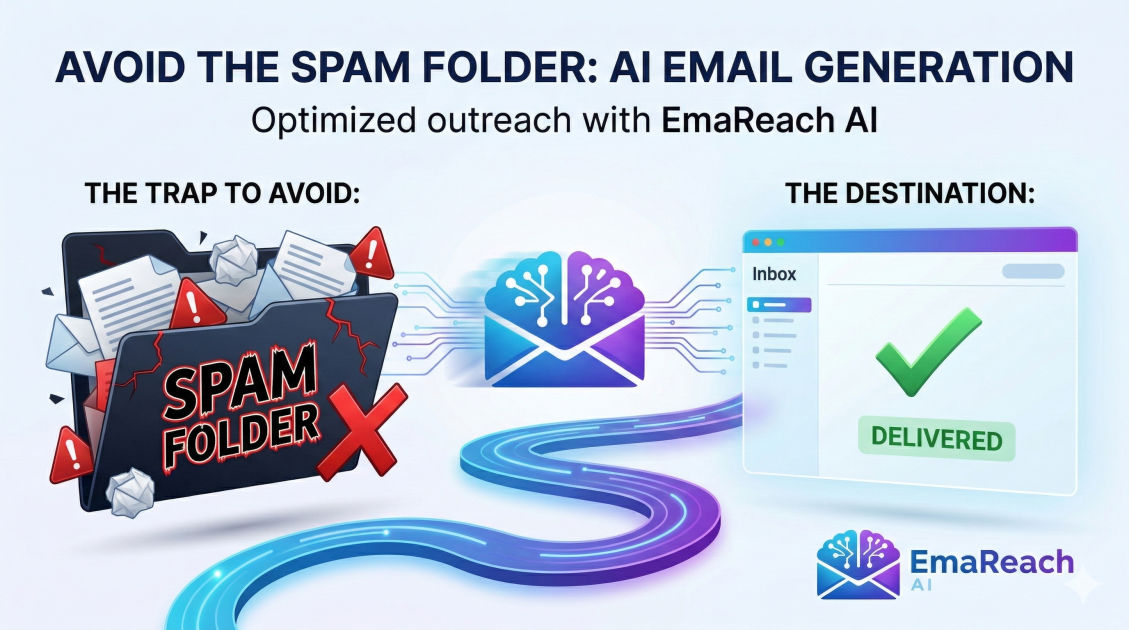
Avoid the Spam Folder Using an AI Email Generator
email marketingAI writingdeliverabilityspam preventioncold outreachdigital marketing
Introduction
In the digital age, the battle for the inbox is fiercer than ever. For businesses, entrepreneurs, and marketers, the email inbox is the most valuable real estate on the internet. However, there is a silent gatekeeper that stands between your message and your recipient: the spam filter. Every day, billions of emails are sent, and a significant percentage never see the light of day because they are flagged as junk.
Enter the era of Artificial Intelligence. Using an AI email generator is no longer just about saving time; it is about precision, deliverability, and sophisticated communication. AI has transformed from a simple text-generation tool into a powerful ally for maintaining sender reputation and ensuring that your outreach actually reaches its destination. This guide explores the intricate relationship between AI-generated content and email deliverability, providing a blueprint for staying out of the spam folder.
The Anatomy of the Spam Filter
To defeat the spam folder, one must first understand how it thinks. Modern spam filters are not just looking for a few 'trigger words.' They utilize complex machine learning algorithms that analyze hundreds of data points in milliseconds. These include:
- Sender Reputation: Your history as a sender, often tied to your IP address and domain.
- Engagement Metrics: Do people open your emails? Do they click links? Or do they hit 'Report Spam'?
- Technical Authentication: Are your SPF, DKIM, and DMARC records correctly configured?
- Content Analysis: Does the language feel repetitive, aggressive, or deceptive?
AI email generators help address the 'Content Analysis' and 'Engagement' portions of this equation. By generating human-like, varied, and relevant text, AI reduces the patterns that spam filters typically associate with bulk automated mail.
Why AI is a Game-Changer for Deliverability
Traditional email automation often relied on rigid templates. When thousands of people use the same 'proven' template, spam filters quickly learn to recognize that specific structure and block it across the board. AI breaks this cycle through dynamic content creation.
1. Eliminating Spam Trigger Words
Human writers often fall into the trap of using high-pressure language without realizing it. Words like 'Free,' 'Win,' 'Cash,' or 'Urgent' are classic red flags. AI generators can be programmed or prompted to find creative synonyms and softer approaches that convey the same message without alerting the filters.
2. Natural Language Processing (NLP)
Advanced AI models use NLP to ensure that the flow of text feels natural. Spam filters are increasingly adept at spotting 'robotic' syntax—sentences that are too short, have odd punctuation, or follow a predictable pattern. AI mimics the nuance of human speech, making the email indistinguishable from an individually typed message.
3. Personalization at Scale
One of the biggest reasons emails go to spam is a lack of relevance. If a filter sees you sending the exact same message to 500 people, it assumes you are broadcasting. AI allows for 'hyper-personalization.' By feeding the AI specific details about the recipient—their industry, a recent achievement, or their job title—the generator creates a unique version for every person. This uniqueness is a massive signal to ESPs (Email Service Providers) that this is a one-to-one communication, not a blast.
The Role of Variety and Randomization
Spam filters love patterns. If you send 1,000 emails with the exact same subject line, you are asking for trouble. An AI email generator can produce dozens of variations for the same campaign.
- Subject Line Variation: AI can generate 10 different subject lines that all lead to the same core message.
- Body Text Rotation: By shifting the order of paragraphs or swapping out introductory sentences, AI ensures that no two emails in a batch are identical.
- Formatting Diversity: AI can vary the length of sentences and the use of bullet points, further breaking the 'automated' footprint.
Enhancing Engagement Through Relevance
Deliverability is a feedback loop. If your emails are consistently opened and replied to, your sender reputation increases. If they are ignored, your reputation sinks. AI helps by ensuring the content is actually interesting to the reader.
By analyzing data points about your target audience, an AI generator can tailor the tone of the email. For example, a message to a tech startup founder should sound different than a message to a corporate CFO. When the tone is right, engagement goes up. When engagement goes up, the spam folder stays empty.
Leveraging EmaReach for Total Control
For those serious about high-volume outreach without the risk, tools like EmaReach are essential. EmaReach allows you to stop landing in spam by providing cold emails that reach the inbox. It combines the power of AI-written cold outreach with critical features like inbox warm-up and multi-account sending. This ensures that your emails land in the primary tab where they can actually get replies, rather than languishing in the promotions or junk folders.
Best Practices for Using AI in Email Campaigns
While AI is powerful, it is not a 'set it and forget it' solution. To maximize its effectiveness in avoiding spam, follow these strategic guidelines:
Avoid Over-Optimization
It is possible to make an email 'too perfect.' Sometimes, human emails have a slight imperfection or a casual tone. When prompting an AI, don't always ask for 'formal' or 'professional' styles. Asking for a 'conversational' or 'brief' tone often results in better deliverability because it looks like something a person would actually type on their phone or between meetings.
The 'Human-in-the-Loop' Strategy
AI should generate the first 90% of your work. The final 10% should be a human review. Look for 'hallucinations' or phrases that feel slightly off. A quick scan ensures that the AI hasn't accidentally included a phrase that could be misinterpreted by a filter or a human recipient.
Testing and Iteration
Use AI to run A/B tests on a small scale before launching a large campaign. Generate two different approaches, send them to a small segment of your list, and see which one has a higher open rate. AI makes this kind of iterative testing incredibly fast.
Technical Foundations You Can't Ignore
An AI generator writes the content, but the technical infrastructure delivers it. You must ensure your technical house is in order to give your AI content a chance to succeed.
SPF (Sender Policy Framework)
This is a DNS record that lists which mail servers are authorized to send email on behalf of your domain. Without this, filters have no way of knowing if the email is legitimate or a spoof.
DKIM (DomainKeys Identified Mail)
This adds a digital signature to your emails. It proves that the content of the email wasn't tampered with during transit. Since AI-generated content is unique, having a solid DKIM signature ensures that the uniqueness is viewed as authentic.
DMARC (Domain-based Message Authentication, Reporting, and Conformance)
This tells the receiving server what to do if the SPF or DKIM checks fail. A 'reject' policy is the strongest signal of a legitimate, secure sender.
The Psychology of the Inbox: Why AI-Generated Content Wins
Psychology plays a massive role in deliverability. When a recipient sees an email that looks like a template, they are more likely to report it as spam. When they see a message that mentions their specific pain points or a recent project they worked on, their brain categorizes it as a 'relationship' rather than an 'advertisement.'
AI generators excel at this psychological alignment. They can process vast amounts of context that a human writer might find tedious to incorporate into every single email. This context creates a sense of familiarity and trust. Trust leads to opens, and opens lead to a 'Safe Sender' status.
Avoiding the 'Promotion Tab' Trap
For Gmail users, the Promotions tab is almost as bad as the Spam folder. AI can help you stay in the Primary tab by:
- Reducing Images: High image-to-text ratios often trigger the Promotions tab. AI helps you focus on high-impact text.
- Minimalist Formatting: AI can generate clean, plain-text style emails that look like they came from a friend or colleague.
- Removing Commercial Cues: Phrases like 'Unsubscribe here' are necessary for legal reasons, but AI can help structure the surrounding text so it doesn't feel like a marketing newsletter.
Moving Beyond the Template Mentality
The biggest mistake in modern email marketing is the reliance on the 'Template.' Whether it is a sales script or a newsletter format, templates are the enemy of deliverability. AI allows you to move to a 'Prompt-Based' workflow.
Instead of: "Send Template A to List B." Your workflow becomes: "Using these 5 key facts about the recipient, generate a brief, inquisitive email that focuses on solving their specific challenge with X."
This shift ensures that your 'digital footprint' is constantly changing, making it nearly impossible for spam filters to pin you down as a bulk sender.
Ethical Considerations and Authenticity
As AI becomes more prevalent, the question of ethics arises. Does using an AI generator count as 'deception'? Not if the value you provide is real. The AI is a tool to facilitate a connection. As long as the offer, the product, or the message is genuine, AI is simply a way to overcome the logistical hurdle of writing 500 unique emails. Maintaining authenticity means ensuring the AI doesn't make false claims or impersonate someone it shouldn't.
Conclusion
Avoiding the spam folder is a multifaceted challenge that requires both technical precision and creative variety. An AI email generator addresses the creative side of this problem by producing unique, high-quality, and personalized content that bypasses the patterns recognized by spam filters. By leveraging the power of AI, you can ensure that your voice is heard, your messages are read, and your sender reputation remains pristine. In the modern landscape of digital communication, AI isn't just an option—it's the standard for anyone who wants to master the art of the inbox.
EmaReach AI
Ready to scale your cold email outreach?
Join thousands of teams using EmaReach AI for AI-powered campaigns, domain warmup, and 95%+ deliverability. Start free — no credit card required.
Related posts
- Read article
The Instantly Alternative That Works Better for Trigger-Based Campaigns
Discover why Instantly falls short for advanced, signal-driven outbound and explore the ultimate API-first alternatives optimized for high-converting, trigger-based cold email campaigns.
- Read article
The Instantly Alternative That Handles High Bounce Rates Without Panic
Discover how transitioning to an advanced Instantly alternative can safeguard your cold email infrastructure. Learn to handle high bounce rates effortlessly using real-time verification, smart mailbox rotation, and automated safety nets to protect your sender reputation and maintain consistent primary inbox placement.