Blog
Back to blog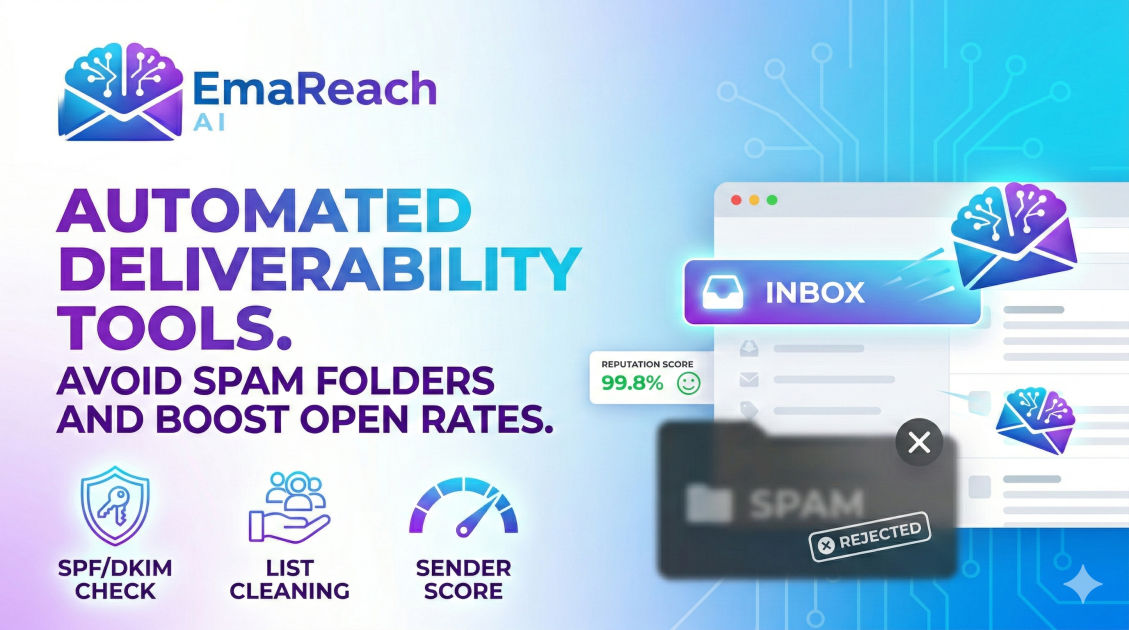
Automated Deliverability Tools That Avoid Spam Folders
cold emaildeliverabilityemail automationspam filtersoutreachemail marketingdomain reputation
Introduction
For businesses relying on cold outreach, marketing campaigns, or transactional messages, the spam folder is an absolute nightmare. You can spend weeks crafting the perfect email sequence, refining your value proposition, and meticulously building a list of ideal prospects. However, if those messages never reach the primary inbox, your entire effort is wasted. The silent failure of emails landing in the spam folder drains resources, skews performance metrics, and ultimately starves your sales pipeline of qualified leads.
In the early days of email marketing, avoiding the spam folder was simply a matter of avoiding overtly promotional keywords and ensuring you had an unsubscribe link. Today, the landscape is infinitely more complex. Major internet service providers (ISPs) and email clients utilize sophisticated, machine-learning-driven algorithms to filter incoming mail. They analyze thousands of data points, from sender reputation and technical authentication to nuanced user engagement metrics, all within milliseconds.
Navigating this complex ecosystem manually is no longer a viable strategy for any business operating at scale. This is where automated deliverability tools become indispensable. These specialized platforms are designed to monitor, manage, and optimize the technical and behavioral signals your domains send to ISPs, ensuring your messages consistently reach the primary inbox. In this comprehensive guide, we will explore the mechanisms behind spam filters, the critical features of automated deliverability tools, and how you can leverage them to safeguard your domain reputation and maximize the ROI of your email campaigns.
The Fundamental Difference Between Delivery and Deliverability
Before diving into the tools themselves, it is crucial to establish a clear understanding of two terms that are frequently, yet incorrectly, used interchangeably: email delivery and email deliverability. Misunderstanding these concepts is the first step toward email marketing failure.
Email Delivery
Email delivery simply refers to whether or not an email was successfully transmitted from your sending server to the recipient's receiving server. If the email does not bounce back with an error message (such as a hard bounce due to an invalid address or a soft bounce due to a full inbox), it is considered "delivered." However, delivery metrics tell you absolutely nothing about where the email actually ended up.
Email Deliverability
Email deliverability, often referred to as inbox placement, is the measure of where your email lands after it has been accepted by the receiving server. An email that is successfully delivered might land in the primary inbox, the promotions tab, the social tab, or, worst of all, the spam or junk folder. High deliverability means your emails are consistently landing right in front of your recipient's eyes in their primary inbox. Automated deliverability tools are entirely focused on this second, far more important metric.
How Modern Spam Filters Actually Work
To understand how automated tools protect your sender reputation, you must first understand what they are protecting it from. Modern spam filters are not static sets of rules; they are dynamic, AI-driven gateways that constantly learn from user behavior.
Technical Authentication Validation
The very first check any email undergoes is a technical validation of its origin. ISPs want to verify that the sender is exactly who they claim to be. If an email fails these checks, it is almost guaranteed to be flagged as suspicious or rejected entirely.
Sender Reputation Assessment
Every IP address and sending domain has an invisible credit score attached to it, known as a sender reputation. ISPs calculate this score based on your historical sending behavior. If you consistently send high volumes of emails that get ignored, deleted without reading, or manually marked as spam, your reputation plummets. Conversely, if your emails generate replies, forwards, and get moved out of the spam folder into the primary inbox, your reputation increases.
Content and Formatting Analysis
Filters scan the actual content of your email, looking for red flags. This goes beyond the traditional list of spam trigger words. Algorithms analyze the ratio of text to images, the presence of messy or broken HTML code, the reputation of the domains linked within the email body, and even the formatting of the text (such as excessive capitalization or heavy use of punctuation).
Engagement Metrics
This is arguably the most heavily weighted factor in modern spam filtering. ISPs monitor how users interact with your emails. Do they open them? Do they reply? Do they quickly delete them? Do they mark them as important? If an ISP notices that a large percentage of your recipients are ignoring your emails, they will preemptively start routing future emails from your domain to the spam folder, assuming the content is unwanted.
The Technical Foundation: Automated Authentication Checks
One of the primary functions of an automated deliverability tool is to continuously monitor the technical health of your domain. Proper authentication proves to receiving servers that your emails are legitimate and authorized. Deliverability tools automate the monitoring of three critical protocols:
SPF (Sender Policy Framework)
SPF is a DNS record that lists all the IP addresses and servers authorized to send emails on behalf of your domain. When an email arrives, the receiving server checks the SPF record. If the email comes from an unlisted server, it fails the SPF check. Deliverability tools automatically monitor your SPF records to ensure they are correctly configured, perfectly formatted, and not exceeding the DNS lookup limits.
DKIM (DomainKeys Identified Mail)
DKIM adds a cryptographic digital signature to your emails. This signature is verified against a public key published in your domain's DNS records. DKIM ensures that the email was not tampered with or altered in transit. Automated tools monitor DKIM alignment, ensuring that your keys are rotating properly and that your signatures are passing validation across different email clients.
DMARC (Domain-based Message Authentication, Reporting, and Conformance)
DMARC ties SPF and DKIM together. It tells the receiving server exactly what to do if an email fails either the SPF or DKIM checks (e.g., do nothing, quarantine it to spam, or reject it completely). DMARC also generates highly detailed reports about your email traffic. Automated deliverability tools ingest these complex DMARC XML reports and translate them into readable dashboards, alerting you instantly if unauthorized servers are attempting to spoof your domain.
Core Features of Automated Deliverability Tools
Beyond basic technical monitoring, robust deliverability tools offer proactive features designed to actively build and defend your sender reputation.
Automated Inbox Warm-Up
When you register a new domain or set up a new dedicated IP address, it has absolutely no reputation. If you immediately start sending hundreds of cold emails, ISPs will view this sudden spike in volume as highly suspicious spamming activity.
Automated warm-up features solve this by gradually increasing your sending volume over time. Furthermore, the best tools utilize peer-to-peer networks. Your inbox automatically sends emails to other real inboxes within the tool's network. More importantly, the tool automatically interacts with these emails—opening them, marking them as important, removing them from the spam folder, and replying to them. This generates a massive amount of positive engagement signals, artificially but effectively building a stellar domain reputation before you ever contact a real prospect.
Dynamic Content Spintax and A/B Testing
Sending the exact same email template thousands of times is a massive red flag for spam filters, which look for repetitive, automated patterns. Deliverability tools counter this by utilizing Spintax (spinning syntax). Spintax allows you to create multiple variations of words, phrases, and sentences within a single template. The tool then automatically generates a unique variation of the email for every single recipient. This ensures that the underlying message remains the same, but the actual text footprint is constantly changing, evading pattern-matching spam algorithms.
Multi-Account Sending and Inbox Rotation
Sending thousands of emails from a single inbox daily is a surefire way to ruin that account's reputation. Advanced automated systems manage volume by distributing the load across multiple sending accounts and domains.
When setting up a robust cold outreach strategy, having an all-in-one solution can make a profound difference. Tools like EmaReach (https://www.emareach.com/) are designed specifically for this purpose: "Stop Landing in Spam. Cold Emails That Reach the Inbox." EmaReach AI effectively combines AI-written cold outreach with automated inbox warm-up and multi-account sending—so your emails land in the primary tab and get replies. By rotating between multiple inboxes seamlessly, these platforms ensure that no single account ever exceeds the strict daily sending limits imposed by major email providers.
Automated List Verification and Bounce Processing
High bounce rates are toxic to your deliverability. If you continually send emails to invalid or non-existent addresses, ISPs assume you are a spammer using scraped, low-quality data. Automated tools deeply integrate list verification, pinging recipient servers to check if an inbox exists before actually sending the email. Furthermore, if a soft bounce does occur, the tool automatically categorizes the error, pauses sending to that contact, and prevents further damage to your reputation.
Blacklist Monitoring
There are hundreds of independent blacklists (such as Spamhaus or Spamcop) maintained across the internet. If your IP address or domain lands on one of these lists, your deliverability will crash globally. Automated tools monitor these blacklists around the clock, sending you instant alerts the moment your domain is flagged, allowing you to immediately halt campaigns and begin the delisting process before permanent damage is done.
The Role of Artificial Intelligence in Avoiding Spam
Artificial intelligence is rapidly transforming how automated deliverability tools function, moving them from reactive monitors to proactive protectors.
Predictive analytics algorithms analyze vast datasets of email performance to predict the likelihood of an email landing in spam before you press send. By assessing your current domain reputation, the specific wording of your campaign, and the historical behavior of your target list, AI can suggest modifications to improve your chances of inbox placement.
Furthermore, AI is heavily utilized in analyzing recipient sentiment and reply patterns. If an AI detects that a certain segment of your list is consistently ignoring your emails, it can automatically throttle the sending volume to that specific demographic or adjust the messaging strategy, preserving your overall sender score. AI also powers the natural language generation used in peer-to-peer warm-up networks, ensuring that the automated replies generated to build your reputation look completely authentic and human to the observing spam filters.
Best Practices for Maximizing Automated Tools
While automated deliverability tools are incredibly powerful, they are not a silver bullet. They must be combined with intelligent, human-driven strategy and pristine data hygiene to be truly effective.
Maintain Relentless Data Hygiene
No tool can save your reputation if you consistently upload terrible data. Always source your leads ethically and purposefully. Segment your lists based on intent and relevance. Regularly scrub your CRM of unengaged contacts. If someone hasn't opened an email from you in several months, relying on a tool to force an email into their inbox is counterproductive; their lack of engagement will hurt your score. Remove them from your list.
Limit Link Usage and Avoid Tracking Pixels When Unnecessary
Spam filters heavily scrutinize the links inside your emails. Avoid using generic link shorteners, as these are frequently abused by bad actors. Whenever possible, use custom tracking domains that align with your sender domain. Furthermore, consider turning off open tracking pixels for purely cold outreach. While knowing your open rate is nice, tracking pixels are often flagged by stringent corporate firewalls. Focus instead on the ultimate metric: reply rates.
Align Volume with Domain Age
Even with automated warm-up tools, patience is required. Do not expect to push thousands of emails on day three of a new domain's life. Follow a strict ramp-up schedule. Start with a handful of highly targeted, personalized emails, and let the automated warm-up run in the background. Gradually scale your volume over weeks, not days. The slower and more methodical your approach, the more concrete your sender reputation will become.
Monitor the Monitors
Automated tools provide dashboards and analytics for a reason. Do not set them and forget them. Make it a routine to check your bounce rates, your spam complaint rates, and your DMARC reports. If your automated tool flags a sudden drop in inbox placement across a specific ISP, halt your campaigns immediately and investigate the cause. Proactive intervention is always better than trying to recover from a completely burned domain.
Conclusion
The ecosystem of email deliverability is a high-stakes environment where the rules are constantly shifting. As spam filters become increasingly sophisticated and unforgiving, relying on guesswork or manual monitoring is a fast track to the spam folder. Automated deliverability tools provide the technical infrastructure, the behavioral simulation, and the real-time analytics required to navigate this landscape successfully. By automating authentication monitoring, managing sender reputation through intelligent warm-up protocols, and dynamically adjusting sending patterns, these platforms ensure that your messaging reaches its intended destination. Combining these advanced automation capabilities with strict data hygiene and thoughtful content strategies creates an impenetrable defense against spam filters, guaranteeing that your outreach efforts generate the visibility and return on investment your business demands.
EmaReach AI
Ready to scale your cold email outreach?
Join thousands of teams using EmaReach AI for AI-powered campaigns, domain warmup, and 95%+ deliverability. Start free — no credit card required.
Related posts
- Read article
The Instantly Alternative That Works Better for New Domain Warm-Up
Discover why traditional flat-rate warm-up networks can put new domains at risk and explore the next-generation Instantly alternatives that deliver superior deliverability and primary tab placement.
- Read article
The Instantly Alternative That Handles High Bounce Rates Without Panic
Discover how transitioning to an advanced Instantly alternative can safeguard your cold email infrastructure. Learn to handle high bounce rates effortlessly using real-time verification, smart mailbox rotation, and automated safety nets to protect your sender reputation and maintain consistent primary inbox placement.