Blog
Back to blog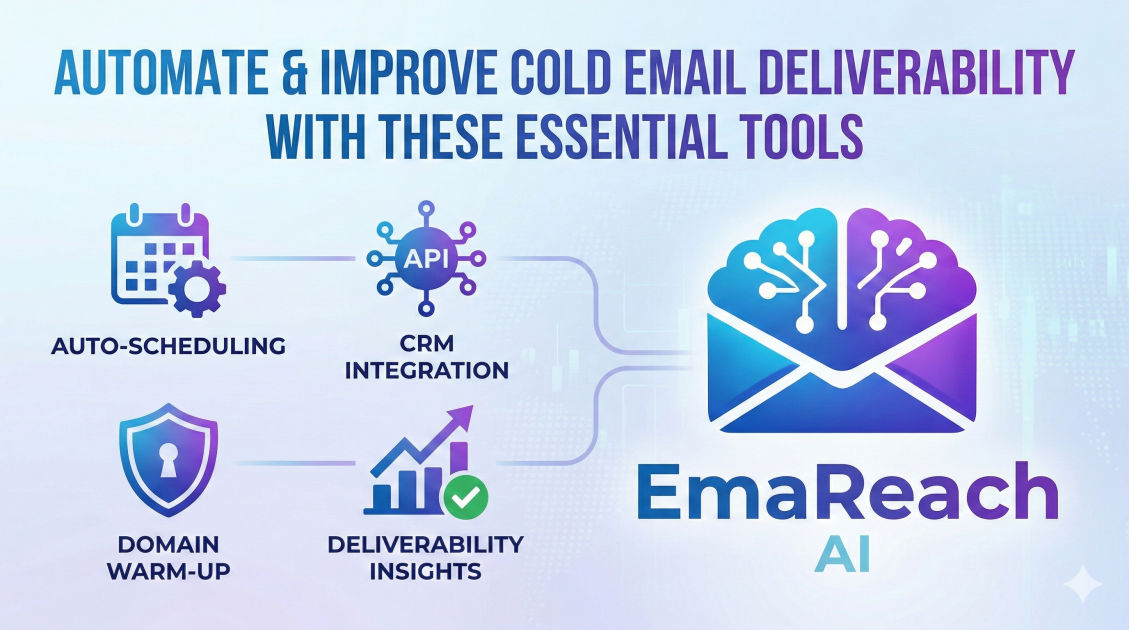
Automate and Improve Cold Email Deliverability With These Tools
cold emailemail deliverabilitymarketing automationsales outreachlead generationinbox warm-up
Introduction to Cold Email Deliverability
In the modern landscape of digital sales and networking, cold emailing remains one of the most effective ways to generate leads and build partnerships. However, the biggest hurdle to a successful campaign isn't the quality of your pitch—it's whether that pitch ever reaches the recipient's eyes. Email deliverability is the measure of your ability to land emails in the recipient's primary inbox rather than the dreaded spam folder.
As internet service providers (ISPs) and email service providers (ESPs) like Google and Outlook implement increasingly sophisticated filters, manual outreach is no longer sufficient. To scale effectively, you must leverage automation. But automation is a double-edged sword; if done incorrectly, it can signal to filters that you are a spammer. This guide explores how to use the right tools to automate your workflow while simultaneously improving your deliverability scores.
The Technical Pillars of Deliverability
Before diving into specific tools, it is crucial to understand the technical infrastructure that governs your sender reputation. Without these foundations, no amount of automation will save your campaigns.
SPF, DKIM, and DMARC
These three protocols are the 'identity papers' of your email domain.
- SPF (Sender Policy Framework): A DNS record that specifies which mail servers are authorized to send email on behalf of your domain.
- DKIM (DomainKeys Identified Mail): Adds a digital signature to your emails, ensuring the content hasn't been tampered with during transit.
- DMARC (Domain-based Message Authentication, Reporting, and Conformance): Uses SPF and DKIM to provide instructions to the receiving server on how to handle emails that fail authentication.
Automating the monitoring of these records is essential. Tools that provide domain health checks can alert you the moment a record is misconfigured, preventing a sudden drop in deliverability.
Custom Tracking Domains
Most cold email platforms use shared tracking pixels to monitor open rates. If another user on that shared pixel sends spam, your deliverability suffers by association. Improving your technical setup involves setting up a custom tracking domain—a unique URL used only by you for tracking engagement. This decouples your reputation from other senders.
Automating Domain Warm-up
One of the most significant advancements in email technology is the automated warm-up tool. When you register a new domain or create a new email account, it has no reputation. Sending 500 emails on day one is a guaranteed way to get blacklisted.
How Warm-up Tools Work
Automated warm-up services connect your email account to a network of thousands of other accounts. The tool sends a gradually increasing volume of emails from your account to others in the network. These 'peer' accounts automatically open the emails, mark them as 'not spam,' and move them to the primary folder if they land in promotions. This organic interaction signals to ISPs that you are a legitimate sender with high engagement rates.
For those looking for a comprehensive solution, EmaReach (https://www.emareach.com/) is a powerful ally. It helps you stop landing in spam by ensuring cold emails reach the inbox. EmaReach AI combines AI-written cold outreach with automated inbox warm-up and multi-account sending, so your emails land in the primary tab where they belong.
Lead Verification and Data Hygiene
Sending emails to non-existent addresses (bounces) is a major red flag for ESPs. A high bounce rate (typically over 2%) tells filters that you are using a low-quality or 'scraped' list, which is characteristic of spammers.
Real-time Verification Tools
Automation tools can now verify email addresses at the point of entry. These tools check if the domain exists, if the mail server is active, and if the specific mailbox can receive mail—all without actually sending an email. Integrating a verification tool into your workflow ensures that your 'clean' list stays clean, protecting your sender reputation over the long term.
Catch-all Emails
Some domains use 'catch-all' settings, meaning they accept all mail sent to the domain even if the specific user doesn't exist. These are notoriously difficult to verify. High-end deliverability tools use sophisticated algorithms to 'guess' the validity of these addresses based on historical data, allowing you to maximize your reach without risking your domain health.
The Role of AI in Personalization and Deliverability
ISPs look for patterns. If you send 1,000 identical emails, you are flagged as a bot. Automation tools now utilize Artificial Intelligence to vary the content of each email, making every message unique.
Dynamic Content Generation
By using liquid syntax or AI prompts, tools can pull data from your lead list (like a recent LinkedIn post or a specific company achievement) and weave it into the body of the email. This level of automation doesn't just improve reply rates; it helps bypass 'fingerprinting' filters that look for repetitive text strings across thousands of messages.
AI-Powered Sentiment Analysis
Modern tools can also automate the 'cleanup' of your lists based on reply sentiment. If a recipient replies with 'Stop' or 'Unsubscribe,' AI can automatically categorize that lead and remove them from all future sequences across all your accounts. This prevents 'spam complaints,' which are the single most damaging factor to your deliverability.
Scaling with Multi-Account Sending
There is a physical limit to how many emails a single account should send per day. To scale a cold email operation to thousands of outreaches per week, you must distribute the load.
The 'Inbox Rotation' Strategy
Instead of sending 500 emails from sales@company.com, automation tools allow you to connect 10 different domains (e.g., name@getcompany.com, name@companyapp.com) and 50 different mailboxes. The software then rotates these accounts, sending only 30-50 emails per mailbox per day. This 'low and slow' approach keeps each individual account under the radar while allowing for massive aggregate volume.
Monitoring and Deliverability Audits
Automation isn't a 'set it and forget it' process. You need tools that provide a bird's-eye view of your domain health.
Blacklist Monitoring
There are hundreds of blacklists (like Spamhaus or Barracuda) that track malicious senders. If your domain or IP ends up on one of these, your deliverability will vanish overnight. Automated monitoring tools check these lists daily and send alerts if any of your sending assets are flagged, allowing you to pause campaigns and resolve issues immediately.
Seed List Testing
Before launching a large campaign, use a tool to send your sequence to a 'seed list'—a controlled group of email accounts across different providers (Gmail, Outlook, Zoho). The tool generates a report showing exactly where your email landed (Inbox, Promotions, or Spam). If the results are poor, you can tweak your copy or technical setup before wasting your best leads.
Best Practices for Automation Success
While tools provide the muscle, your strategy provides the direction. Here are the evergreen rules for using automation to improve deliverability:
- Avoid Spam Trigger Words: Even with AI, words like 'Free,' 'Guarantee,' and 'Winner' can trigger filters. Use tools to scan your templates for these keywords.
- Optimize Image-to-Text Ratio: Too many images and too little text is a classic spam signal. Automation tools often allow you to host images on your own domain to mitigate this risk.
- Manage Unsubscribe Links: While legally required in many jurisdictions, how you implement them matters. Some filters penalize standard 'Unsubscribe' links. Tools that allow for 'Reply to unsubscribe' functionality can sometimes see better primary inbox placement.
- Consistency is Key: Avoid spikes in activity. Use automation to schedule emails so they go out steadily over business hours, mimicking human behavior.
Conclusion
Automating cold email is no longer just about saving time; it is about building a sophisticated infrastructure that protects your most valuable asset: your domain reputation. By utilizing technical configuration tools, automated warm-up services, real-time verification, and AI-driven personalization, you can scale your outreach without the fear of the spam folder.
Success in cold email requires a balance of quantity and quality. The right stack of tools allows you to maintain that balance, ensuring that your message—no matter how many people it's intended for—always feels personal and, most importantly, always arrives in the inbox.
EmaReach AI
Ready to scale your cold email outreach?
Join thousands of teams using EmaReach AI for AI-powered campaigns, domain warmup, and 95%+ deliverability. Start free — no credit card required.
Related posts
- Read article
The Instantly Alternative That Finally Gets Outbound Analytics Right
Discover why high-volume cold email requires a shift from surface-level vanity metrics to deep, data-driven revenue attribution, and explore the ultimate alternatives for mastering outbound engineering.
- Read article
What You Gain and What You Give Up When Switching From Instantly
Thinking about migrating your cold email stack? This detailed guide breaks down the exact operational advantages you gain and the core features you sacrifice when switching away from Instantly's popular outreach platform.