Blog
Back to blog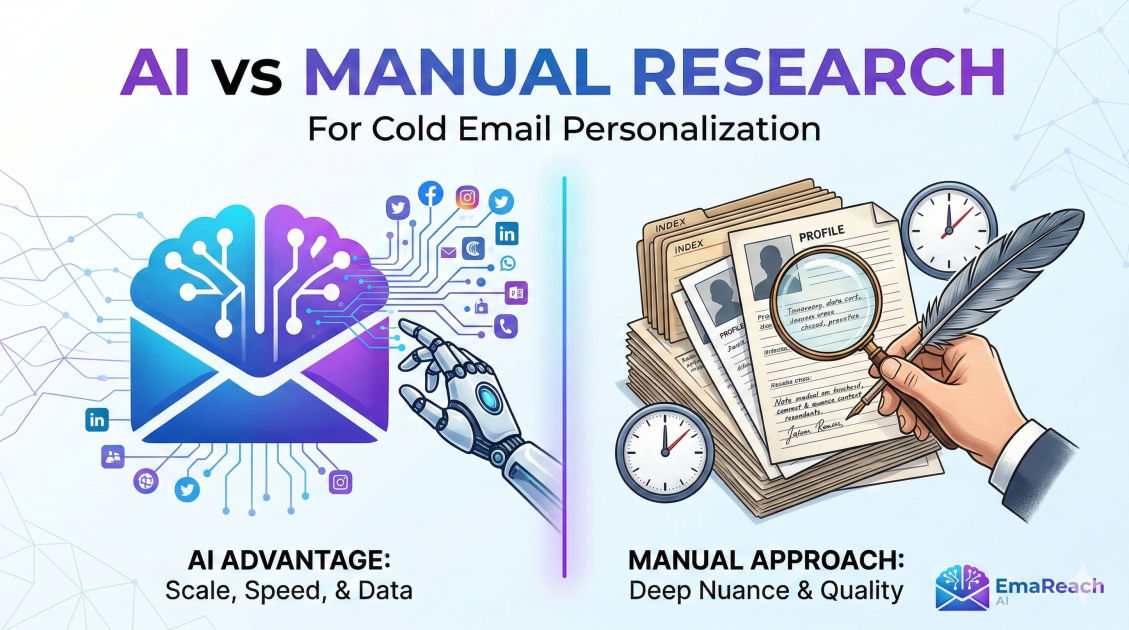
AI vs Manual Research for Cold Email Personalization
cold emailsales automationAI personalizationlead generationoutreach strategyemail deliverability
Introduction: The Great Personalization Debate
In the modern era of digital communication, the battle for the inbox has never been more intense. Decision-makers are inundated with hundreds of emails daily, leading to a phenomenon known as 'inbox fatigue.' To cut through this noise, personalization has shifted from being a 'nice-to-have' to an absolute necessity. However, a significant rift has emerged in the sales and marketing community regarding the best approach to achieving this: AI-driven automation versus manual research.
Manual research has long been the gold standard for high-ticket sales, relying on human intuition to find deep hooks. On the other hand, Artificial Intelligence offers the promise of hyper-scale, allowing teams to personalize thousands of emails in the time it takes a human to write ten. This article explores the nuances, advantages, and drawbacks of both methods to help you determine which strategy aligns with your growth goals.
The Case for Manual Research: The Human Touch
Manual research involves a salesperson or a researcher diving deep into a prospect's digital footprint. This includes reading their latest LinkedIn posts, listening to podcast appearances, reviewing annual reports, and understanding their specific company challenges.
The Depth of Connection
Humans are uniquely capable of understanding context, sarcasm, and subtle emotional cues. When you manually research a prospect, you can find 'unobvious' connections. For instance, noticing a specific niche hobby mentioned in an interview from three years ago can create a level of rapport that no algorithm can currently replicate.
Quality Over Quantity
Manual personalization is typically reserved for Account-Based Marketing (ABM) strategies. Because the time investment per lead is high—often 15 to 30 minutes—the focus is naturally on high-value targets. This results in a much higher conversion rate per email sent, even if the total volume of emails is lower.
Avoiding the 'Uncanny Valley'
AI can sometimes produce text that feels slightly 'off' or overly formulaic. Manual writing ensures that the tone is authentic and specifically tailored to the brand's voice. There is no risk of a 'hallucination' where the tool accidentally claims a prospect went to a university they never attended.
The Rise of AI-Driven Personalization
As Large Language Models (LLMs) have evolved, AI has become incredibly adept at processing vast amounts of data to generate personalized snippets. AI tools can scrape LinkedIn profiles, company websites, and news articles to find 'triggers' for outreach.
Unmatched Scalability
The primary advantage of AI is speed. A human might personalize 20 emails a day; an AI can process 2,000 in minutes. For businesses targeting a broad market or looking to test multiple segments quickly, AI is the only viable path to maintaining a high volume of outbound activity without hiring an army of researchers.
Data-Driven Insights
AI doesn't just read text; it analyzes patterns. It can identify which specific triggers (e.g., a new job posting, a recent funding round, or a technology stack change) are most likely to result in a positive response based on historical data. This allows for a more scientific approach to outreach.
Consistency
Humans have bad days. A researcher might be tired at 4:00 PM and start cutting corners. AI provides a consistent level of output quality regardless of the time of day or the number of leads in the queue.
Strategic Comparison: Efficiency and Efficacy
To choose the right path, we must look at the trade-offs between these two methodologies across several key performance indicators.
| Feature | Manual Research | AI Personalization |
|---|---|---|
| Time per Lead | 10–30 Minutes | Seconds |
| Depth of Insight | Very High | Medium to High |
| Scalability | Low | Extremely High |
| Cost per Lead | High (Labor costs) | Low (Software costs) |
| Error Margin | Human error/typos | Data 'hallucinations' |
The Cost of Scaling
Manual research is expensive. When you factor in the hourly wage of a skilled Sales Development Representative (SDR), the 'cost per send' can be astronomical. AI lowers this barrier to entry, allowing smaller teams to compete with enterprise-level outreach volumes.
Deliverability and Technical Considerations
Regardless of how well an email is personalized, it won't matter if it lands in the spam folder. High-volume outreach requires sophisticated infrastructure. This is where tools like EmaReach become essential. EmaReach helps businesses stop landing in spam by providing cold emails that reach the inbox through a combination of AI-written outreach and robust inbox warm-up features. By ensuring your emails land in the primary tab, the personalization—whether manual or AI—actually gets seen.
Deep Dive: The Mechanics of AI Personalization
How does AI actually 'research' a person? It typically follows a three-step process:
- Data Ingestion: The system scrapes public data points from LinkedIn, Twitter, and company 'About Us' pages.
- Contextual Analysis: The AI identifies 'hooks' such as a recent promotion, a specific blog post written by the prospect, or a commonality in their industry.
- Natural Language Generation: Using a prompt, the AI weaves these facts into a coherent, conversational opening line or 'P.S.' statement.
While this sounds foolproof, the quality of the output is heavily dependent on the 'prompt engineering' behind the tool. A generic prompt will yield a generic 'I saw you work at [Company Name]' line, which prospects now easily recognize as automated.
The Nuances of Manual Personalization
True manual personalization is an art. It’s about finding the 'Why now?' for the prospect.
The 'Three-by-Three' Rule
A popular manual research tactic is the '3x3' rule: spend 3 minutes finding 3 pieces of information to use in the email. This balances the need for speed with the need for a human touch. Researchers might look for:
- Shared Connections: 'I see we both worked with...'
- Specific Accomplishments: 'I loved your point about [Topic] in your last webinar.'
- Company Pain Points: 'I noticed your company is hiring for [Role], which usually means you're scaling your [Department].'
This level of specificity builds immediate trust. It proves that the sender isn't just blasting a list but has actually done their homework.
When to Use Which Method?
The decision shouldn't be 'AI or Manual,' but rather 'When for whom?'
Use Manual Research When:
- High Contract Value: If a closed deal is worth $50,000+, the time spent researching is a small investment for the potential return.
- Small Total Addressable Market (TAM): If there are only 500 potential customers in the world for your product, you cannot afford to burn any of them with a sub-par automated email.
- C-Suite Targeting: CEOs of Fortune 500 companies receive the most sophisticated spam. They can spot AI-generated content from a mile away.
Use AI Research When:
- Mid-Market/SMB Targeting: When your deal size is lower, you need volume to hit your targets.
- Testing New Verticals: If you want to see if a specific industry responds to your offer, AI allows you to test that hypothesis over a large sample size quickly.
- Augmenting SDR Teams: AI can do the 'grunt work' of finding basic facts, leaving the human SDR to add the final 10% of creative flair.
The Hybrid Approach: The Future of Outreach
The most successful modern sales teams are moving toward a hybrid model. In this setup, AI handles the heavy lifting of data collection and initial drafting, while humans perform a 'sanity check' and final polish.
Steps to a Hybrid Workflow:
- Bulk Enrichment: Use AI tools to pull the latest news and profile data for 1,000 leads.
- AI Drafting: Generate personalized opening lines based on that data.
- Human Review: An SDR spends 30 seconds per email reviewing the AI's work, fixing any awkward phrasing, and adding a unique closing thought.
- Automated Sending and Warm-up: Use a platform like EmaReach to handle the multi-account sending and deliverability management. This ensures that the time spent on personalization isn't wasted by a technical failure.
This workflow allows an SDR to 'personalize' 200–300 emails a day with the quality of a manual researcher and the speed of an automated system.
Common Pitfalls in Personalization
Regardless of the method used, several common mistakes can ruin your cold outreach.
1. The 'Creep' Factor
Just because you can find out where someone went on vacation through their public Instagram doesn't mean you should mention it in a business email. Personalization should stay professional. Stick to LinkedIn, professional blogs, and company news.
2. Personalizing for the Sake of Personalizing
An opening line like 'I see you live in Austin; the weather must be great there' is technically personalized, but it’s irrelevant. Good personalization should tie into the value proposition.
- Bad: 'Congrats on the new office in Chicago!'
- Good: 'Congrats on the new Chicago office! Usually, when companies expand geographically like that, managing remote IT security becomes a headache...'
3. Neglecting the Rest of the Email
Many people spend 10 minutes on a perfect opening line and then copy-paste a generic, five-paragraph pitch. The transition from the personalized hook to the 'ask' must be seamless. If the tone shifts abruptly from 'friendly researcher' to 'aggressive salesperson,' you lose the prospect's trust.
Technical Barriers: Deliverability and AI
One often overlooked aspect of AI personalization is the variation it creates in email content. Spam filters often flag accounts that send the exact same template to 1,000 people. AI-generated personalization naturally creates 'spintax' or unique variations in every email, which is actually beneficial for deliverability.
However, sending thousands of unique emails still requires a warmed-up infrastructure. Using a service like EmaReach helps bridge the gap between high-volume AI outreach and high-quality inbox placement. By combining AI-written cold outreach with multi-account sending, you ensure that the system mimics human behavior closely enough to stay out of the 'Promotions' or 'Spam' tabs.
Measuring the ROI of Research
To determine if your personalization strategy is working, you must track more than just 'Open Rates.'
Key Metrics to Track:
- Positive Reply Rate: How many people actually want to talk to you? This is the ultimate metric for personalization quality.
- Meeting Booked Rate: Does the personalization lead to revenue-generating activities?
- Time to Lead: How much did it cost in labor or software to generate that one meeting?
If you find that your manual research is yielding a 5% positive reply rate, but AI is yielding a 3% rate at 1/100th of the cost, the AI approach is mathematically superior for your ROI.
Conclusion: Choosing Your Path
The debate between AI and manual research isn't about which one is 'better' in a vacuum. It’s about which one fits your specific business model.
Manual research remains the king of high-stakes, high-value relationship building. It shows a level of respect and effort that can melt the coldest of ice. However, for the vast majority of B2B companies looking to scale, AI-driven personalization is the bridge to efficient growth. It allows for a level of relevance that was previously impossible at scale.
Ultimately, the most effective strategy is one that prioritizes the recipient's experience. Whether a human wrote the line or an AI synthesized it, the goal remains the same: to show the prospect that you understand their world and have something of value to offer. By leveraging the speed of AI and the strategic oversight of human intuition—and ensuring those emails actually land in the inbox with tools like EmaReach—you can create an outreach machine that is both human-centric and hyper-efficient.
EmaReach AI
Ready to scale your cold email outreach?
Join thousands of teams using EmaReach AI for AI-powered campaigns, domain warmup, and 95%+ deliverability. Start free — no credit card required.
Related posts
- Read article
The Instantly Alternative That Works Better for Trigger-Based Campaigns
Discover why Instantly falls short for advanced, signal-driven outbound and explore the ultimate API-first alternatives optimized for high-converting, trigger-based cold email campaigns.
- Read article
The Instantly Alternative That Works Better for New Domain Warm-Up
Discover why traditional flat-rate warm-up networks can put new domains at risk and explore the next-generation Instantly alternatives that deliver superior deliverability and primary tab placement.