Blog
Back to blog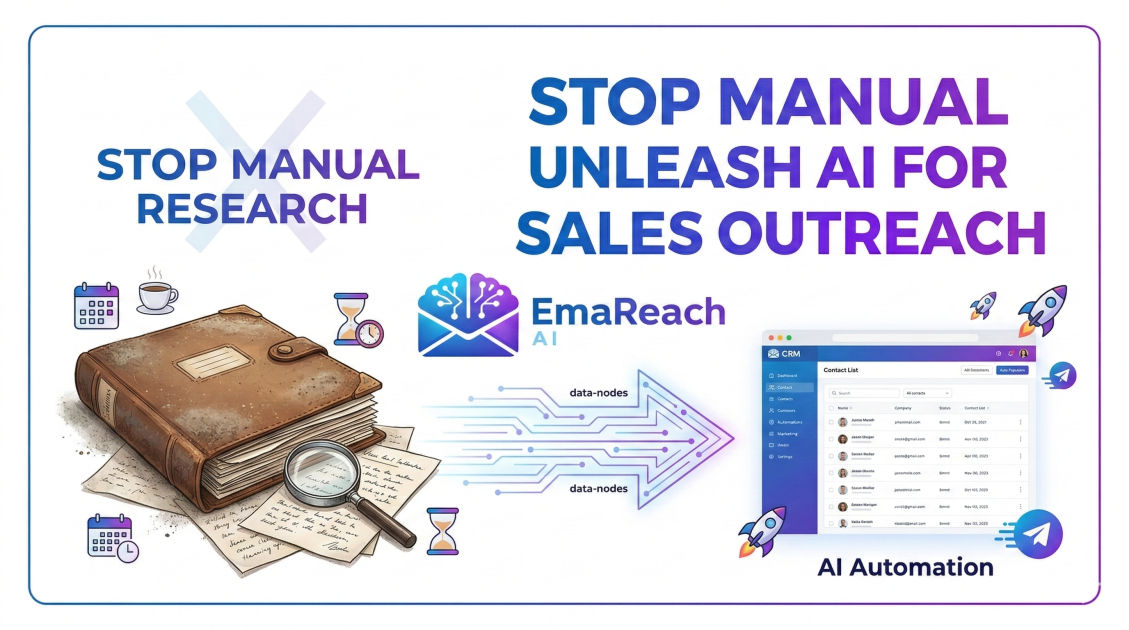
AI Sales Outreach Tools to Replace Manual Research
sales automationAI outreachlead researchcold emailsales productivityB2B salesemail deliverability
The End of the Manual Research Era in Sales
For decades, the life of a high-performing sales development representative (SDR) was defined by the 'grind.' This grind involved spending hours every morning scouring LinkedIn profiles, reading company annual reports, and listening to podcast appearances just to find one 'nugget' of information that could make a cold email feel personal. While effective, this manual research process is fundamentally unscalable.
Today, the landscape has shifted. Artificial Intelligence is no longer a futuristic concept; it is the engine driving modern sales organizations. By leveraging AI sales outreach tools to replace manual research, businesses are reclaiming thousands of hours of productivity while actually increasing the quality of their connections. This transition from manual sleuthing to AI-driven insights is not just about speed—it is about precision, relevance, and deliverability.
Why Manual Research is Failing Modern Sales Teams
Manual research suffers from three primary bottlenecks: time, decay, and human bias.
First, there is the time-to-value ratio. If an SDR spends 20 minutes researching a prospect to write one high-quality email, they can only contact 24 people in an eight-hour day. In a competitive market, that volume is rarely enough to hit aggressive pipeline targets.
Second is data decay. Information found manually today might be outdated by the time the follow-up email is sent. AI tools, conversely, can scan live web data in milliseconds, ensuring that the 'trigger event' you are referencing—like a recent funding round or a new product launch—is actually current.
Third is cognitive load. Humans are prone to 'research fatigue.' After the tenth profile of the day, an SDR’s ability to synthesize information and turn it into a compelling hook diminishes. AI does not get tired; it maintains the same level of analytical depth for the first prospect as it does for the thousandth.
Core Capabilities of AI Research Tools
To understand how to replace manual effort, we must look at the specific capabilities these tools offer. AI in sales outreach generally falls into three functional categories: Lead Enrichment, Intent Analysis, and Hyper-Personalization.
1. Advanced Lead Enrichment
Traditional databases give you a name, an email, and a job title. AI-powered enrichment goes layers deeper. It can scrape a prospect's entire digital footprint—including their GitHub contributions, Twitter threads, and blog posts—to build a multi-dimensional persona. This allows sales teams to segment audiences not just by industry, but by psychological traits, interests, and professional challenges.
2. Intent and Signal Detection
Manual research often misses the 'why now.' AI tools monitor 'buying signals' across the web. These signals include:
- Technographic changes: When a company stops using a competitor's software and starts looking for a new solution.
- Hiring patterns: A surge in hiring for a specific department (e.g., DevOps) often signals an upcoming investment in related infrastructure.
- Executive shifts: New leadership often brings new budgets and a desire to overhaul existing processes.
3. Hyper-Personalization at Scale
This is the 'holy grail' of outbound sales. AI can take the data gathered during enrichment and use Large Language Models (LLMs) to draft a unique opening line for every single prospect. It can mention a specific quote from a webinar they hosted or a specific challenge mentioned in their company's quarterly earnings call. This level of detail used to take 15 minutes per email; now, it takes seconds.
How to Integrate AI Tools into Your Workflow
Replacing manual research isn't as simple as turning on a bot and walking away. It requires a strategic workflow that combines human oversight with machine efficiency.
Step 1: Defining Your Ideal Customer Profile (ICP) Data Points
Before the AI can research for you, you must tell it what to look for. Instead of vague categories, define specific attributes. Do you want prospects who have recently spoken about 'digital transformation' on LinkedIn? Or companies that have just opened a new office in Europe? Modern AI tools allow you to set these parameters as 'filters' for their automated scraping bots.
Step 2: Automated Data Aggregation
Once the parameters are set, tools can automatically pull data from sources like LinkedIn, Crunchbase, and Apollo. The AI cleans this data, removing duplicates and verifying email addresses. This is where EmaReach becomes an essential part of the stack. While many tools focus solely on the research, EmaReach ensures that the effort put into personalization isn't wasted by landing in the spam folder. By combining AI-written content with inbox warm-up and multi-account sending, it ensures your researched insights actually reach the primary tab.
Step 3: Synthesis and Scripting
The AI then synthesizes the raw data into a 'context brief.' For a sales rep, reading a 3-sentence AI summary of a prospect's recent activity is far more efficient than clicking through five different tabs. The AI can then use this brief to generate several variations of an outreach message, allowing the rep to choose the one that feels most authentic to their personal brand.
Overcoming the 'Uncanny Valley' of AI Outreach
A common fear is that AI-generated outreach sounds robotic. This happens when teams use generic prompts or fail to feed the AI enough context. To avoid this, successful teams use 'Few-Shot Prompting'—giving the AI 5–10 examples of perfectly written, human-researched emails to use as a stylistic template.
When the AI has a clear understanding of your brand voice and a deep well of prospect data, the 'Uncanny Valley' disappears. The recipient cannot distinguish between an email that took 20 minutes to research manually and one that was generated by a sophisticated AI algorithm in a heartbeat.
The Role of Deliverability in AI Sales
You can have the most well-researched, AI-optimized email in the world, but if the recipient's mail server flags it as spam, the research value is zero. This is a critical technical hurdle in the age of high-volume AI outreach.
Modern deliverability requires more than just a good subject line. It requires:
- Inbox Warming: Gradually increasing sending volume to build a positive sender reputation.
- Spreading Volume: Sending smaller batches of emails across multiple accounts rather than blasting thousands from one domain.
- Human-like Sending Patterns: AI can mimic the 'randomness' of human sending times to avoid triggering spam filters.
Solutions like EmaReach solve this by integrating these technical necessities directly into the outreach process. This 'Stop Landing in Spam' approach is the necessary backbone for any AI-driven research strategy. It bridges the gap between 'knowing the prospect' and 'talking to the prospect.'
Measuring the ROI of AI Research Tools
When moving away from manual research, success should be measured through three specific KPIs:
- Research-to-Send Ratio: How many minutes of 'work' does it take to get one email out the door? If this number drops from 15 minutes to 2 minutes, your team’s capacity has increased 7.5x.
- Positive Reply Rate: High-volume outreach often results in lower reply rates. AI-driven research aims to maintain or increase reply rates by keeping the quality high while increasing the volume.
- Meeting Set Rate per SDR: Ultimately, the goal is more meetings. By removing the 'boring' parts of the job (research), SDRs can spend more time on what they do best: handling objections and booking calls.
Future-Proofing Your Sales Stack
The move toward AI-driven research is an arms race. As more companies adopt these tools, the 'bar' for what constitutes a good cold email will continue to rise. Simply mentioning a prospect's college might have worked five years ago; today, you need to show a deep understanding of their business objectives.
To stay ahead, sales leaders should look for tools that offer:
- API Connectivity: The ability to push research data directly into the CRM (Salesforce, HubSpot, etc.).
- Real-time Monitoring: The ability to trigger an email the moment a specific event happens (e.g., a prospect views your pricing page).
- Multimodal Research: Tools that don't just look at text, but also analyze video content or podcast transcripts to find unique insights.
Conclusion: The New Standard of Excellence
Replacing manual research with AI sales outreach tools is no longer a luxury for 'tech-forward' startups; it is a fundamental requirement for any B2B organization that wants to remain competitive. By automating the data gathering, synthesis, and writing phases of the sales cycle, teams can focus on the human elements of sales—empathy, strategy, and relationship building.
With platforms like EmaReach managing the complex intersection of AI generation and technical deliverability, the path to a scalable, highly personalized outbound engine is clearer than ever. The 'grind' isn't going away; it's just changing. Instead of grinding through tabs and spreadsheets, the modern sales professional grinds through conversations and deal-closing, powered by the intelligence of AI.
EmaReach AI
Ready to scale your cold email outreach?
Join thousands of teams using EmaReach AI for AI-powered campaigns, domain warmup, and 95%+ deliverability. Start free — no credit card required.
Related posts
- Read article
Beyond Instantly: The Cold Email Platforms Worth Taking Seriously
Discover the top advanced cold email platforms that go beyond basic multi-inbox rotation. Learn how to optimize your technical infrastructure, leverage advanced personalization, and scale your B2B sales pipeline safely without landing in the spam folder.
- Read article
What the Cold Email Community Actually Says About Instantly Alternatives
Discover what growth marketers, agency owners, and outbound practitioners across major cold email communities are saying about the top alternatives to Instantly. This comprehensive, research-driven guide breaks down the real-world pros, cons, and technical features of tools like Smartlead, EmaReach, Saleshandy, and Lemlist based on community consensus.