Blog
Back to blog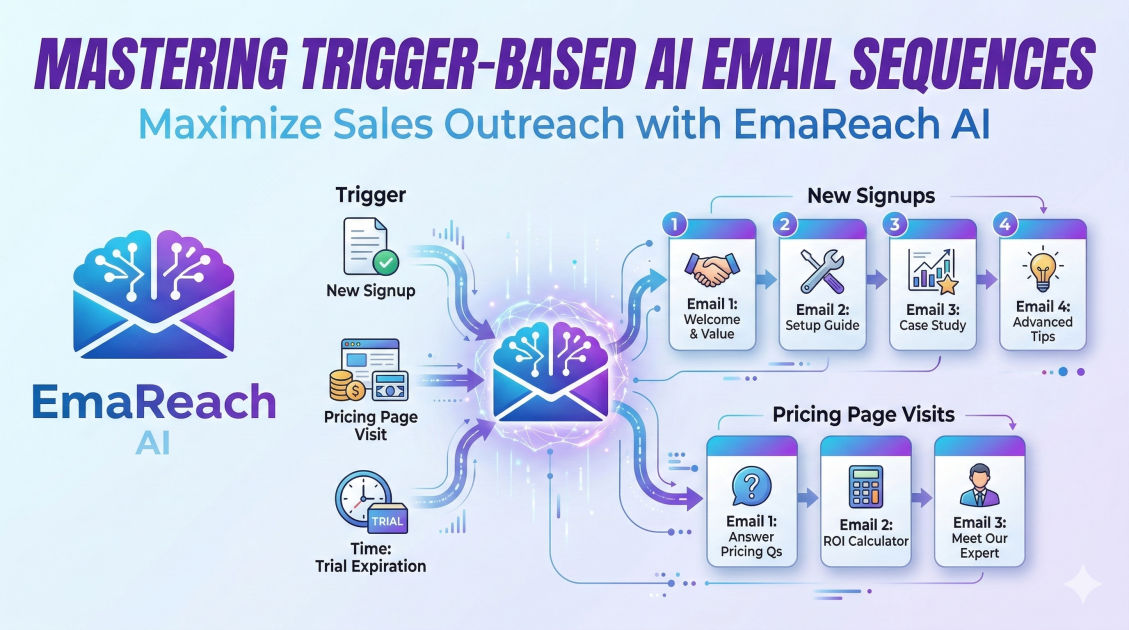
AI Sales Outreach Tools for Trigger-Based Automated Email Sequences
AI SalesCold EmailSales AutomationEmail MarketingLead GenerationB2B Sales
Introduction to AI-Driven Trigger-Based Outreach
In the modern landscape of digital sales, the traditional 'spray and pray' method of cold emailing has become obsolete. Buyers are more discerning, and inboxes are more crowded than ever. To break through the noise, sales teams must shift toward a model of high relevance and impeccable timing. This is where AI-powered sales outreach tools and trigger-based automated email sequences come into play.
Trigger-based outreach refers to the practice of sending automated emails based on specific actions or events—known as 'triggers'—that indicate a prospect's interest, a change in their business environment, or a specific stage in their buying journey. By leveraging Artificial Intelligence, these tools can monitor vast amounts of data in real-time, identifying these triggers and deploying personalized communication at the exact moment it is most likely to resonate.
This comprehensive guide explores the mechanics of AI trigger-based sequences, the tools that make them possible, and the strategies for implementing a system that drives consistent revenue growth.
Understanding the Power of Event-Based Triggers
A 'trigger' is essentially a signal. In sales, these signals are indicators of a potential need or an opening for a conversation. When combined with AI, these triggers move beyond simple 'if-this-then-that' logic and into the realm of predictive intent.
Common Sales Triggers for Automation
- Funding Rounds: A company securing a Series A or B round often means they have a budget to spend and a need to scale operations quickly.
- Job Changes: When a high-level executive (a decision-maker) moves to a new company, they often look to implement the tools and processes they trusted in their previous role.
- New Job Postings: If a target account starts hiring aggressively for a specific role (e.g., 'Data Scientists'), it indicates a strategic shift or a pain point that a relevant AI tool could solve.
- Technology Stack Changes: Detecting when a company starts or stops using a competitor's software allows for perfectly timed 'switch-pitch' campaigns.
- Intent Data: AI tools can track 'surge' data, identifying when multiple people at a specific company are researching keywords related to your solution.
By building sequences around these events, sales teams ensure that their outreach is never 'cold' in the traditional sense; it is informed, timely, and contextually relevant.
The Role of AI in Scaling Personalization
The greatest challenge with trigger-based outreach used to be scale. Manually tracking every prospect's LinkedIn updates or news mentions is impossible for a human sales representative. AI solves this by acting as a 24/7 research assistant.
Generative AI for Contextual Messaging
Modern AI tools don't just find the trigger; they write the email. Using Large Language Models (LLMs), these tools can scan a prospect’s recent LinkedIn post or a company’s annual report and weave that specific context into the email draft. This level of personalization makes the recipient feel like the sender has done hours of research, when in reality, the AI generated the draft in seconds.
Predictive Analytics and Timing
AI doesn't just look at what happened; it predicts what will happen next. Advanced outreach platforms analyze historical data to determine the optimal time of day to send an email for a specific industry or persona. If the AI detects that a prospect typically engages with their inbox at 8:00 AM on Tuesdays, the trigger-based sequence will pause and deploy the message at that exact window to maximize open rates.
Essential AI Sales Outreach Tools
To build a high-performing trigger-based system, you need a tech stack that covers data sourcing, trigger identification, and automated delivery.
1. Multi-Channel Outreach Platforms
These platforms serve as the command center for your campaigns. They integrate with your CRM and allow you to build complex 'branching' sequences. If a prospect clicks a link (Trigger A), they move to one sequence; if they visit your pricing page but don't reply (Trigger B), they move to another.
2. Intent Data Providers
Tools that provide 'Buyer Intent' are crucial for trigger-based success. These tools monitor the web to see which companies are actively looking for solutions like yours. When a company hits a certain 'intent score,' it triggers an automated sequence to the relevant stakeholders within that organization.
3. Deliverability and Warm-up Engines
No matter how good your trigger or your AI-written copy is, it means nothing if the email lands in the spam folder. This is a critical hurdle for high-volume automated outreach.
For teams serious about their hit rate, EmaReach offers a sophisticated solution. EmaReach (https://www.emareach.com/) focuses on the core of successful outreach: "Stop Landing in Spam. Cold Emails That Reach the Inbox." Their platform combines AI-written cold outreach with specialized inbox warm-up and multi-account sending. This ensures that your trigger-based sequences land in the primary tab, where they actually get seen and replied to, rather than being filtered out by aggressive ISP algorithms.
How to Build a Trigger-Based Automated Sequence
Creating an effective sequence requires a blend of data science and creative copywriting. Follow these steps to build your first AI-driven campaign.
Step 1: Define Your Ideal Customer Profile (ICP)
Before you can identify triggers, you must know who you are looking for. Your AI tools need clear parameters: industry, company size, revenue, and specific job titles. The narrower the focus, the more effective the triggers will be.
Step 2: Select Your Primary Triggers
Choose 2-3 triggers to start with. For example, 'New C-Level Hire' and 'New Technology Integration.' These are high-signal events that usually require a specific type of solution.
Step 3: Map the Content Journey
For each trigger, create a unique content path. A 'New Hire' sequence should be congratulatory and offer help in their first 90 days. A 'Technology Integration' sequence should focus on how your tool complements their new tech stack.
Step 4: Implement AI Personalization Variables
Instead of using basic tags like {{first_name}}, use AI variables like {{recent_achievement_summary}} or {{company_pain_point_analysis}}. The AI tool will fill these in dynamically for every lead based on the data it scrapes.
Optimizing Email Deliverability for Automated Sequences
As you scale your automated sequences, deliverability becomes your biggest risk. Sending hundreds of emails triggered by a market event can look like 'spammy' behavior to email providers if not managed correctly.
Technical Foundations
Ensure your SPF, DKIM, and DMARC records are correctly configured. These are the digital 'passports' that prove to receiving servers that your email is legitimate.
The Importance of Warm-up
You cannot go from sending zero emails to five hundred a day overnight. Use an automated warm-up tool to gradually increase your sending volume. This builds a positive reputation with providers like Google and Outlook. Platforms like EmaReach are particularly effective here because they manage this warm-up process automatically while you focus on the creative side of your outreach.
Multi-Account Strategy
Rather than sending 1,000 emails from one address, distribute that volume across 10 or 20 different accounts and domains. This 'inbox rotation' minimizes the risk of any single account being flagged, ensuring your trigger-based sequences continue to run smoothly even at high volumes.
Measuring the Success of Your AI Sequences
To improve your ROI, you must look beyond simple open rates. AI tools allow for deeper analytics that can guide your strategy.
- Positive Reply Rate: This is the most important metric. How many people are actually interested in a meeting? AI can now categorize replies as 'positive,' 'neutral,' or 'negative' automatically.
- Trigger Accuracy: Is a specific trigger (like a funding round) actually leading to sales? If not, the trigger might be too broad or the timing might be off.
- Sequence Attribution: Track which specific step in your sequence is generating the most interest. If most replies come on step three, analyze why that specific message is resonating.
Advanced Strategies: Multi-Touch Triggering
The most sophisticated sales organizations don't rely on a single email. They use AI to orchestrate a multi-touch approach.
- Trigger: Prospect views your LinkedIn profile.
- Action: AI sends an automated LinkedIn connection request with a personalized note.
- Trigger: Prospect accepts the request.
- Action: AI waits 24 hours and sends the first email in the sequence, referencing the LinkedIn connection.
- Trigger: Prospect opens the email twice but doesn't reply.
- Action: The system alerts a human sales rep to make a phone call, as the prospect is clearly showing high intent.
This 'hybrid' approach ensures that AI handles the repetitive heavy lifting while humans step in at the most critical moments of the deal.
Ethical Considerations in AI Outreach
While AI provides incredible power, it must be used responsibly. Over-automation can lead to a 'robotic' feel that damages your brand reputation.
- Transparency: Ensure your AI-generated content sounds human and provides genuine value.
- Compliance: Always adhere to regulations like GDPR and CAN-SPAM. AI tools should have built-in features to manage opt-outs and data privacy.
- Value-First Approach: The goal of a trigger-based sequence should be to help the prospect solve a problem, not just to sell a product. Use the data you've gathered to provide insights, whitepapers, or useful tips that align with the trigger event.
Future Trends in Trigger-Based Automation
As AI continues to evolve, we can expect triggers to become even more granular. We are moving toward 'Visual Triggers,' where AI might analyze a prospect’s webinar appearance or a video interview to identify specific pain points mentioned.
Furthermore, 'Social Listening' triggers will become more integrated. Instead of just tracking company news, AI will track the specific sentiments expressed by prospects on social platforms, allowing for outreach that is perfectly aligned with their current mindset.
Conclusion
AI sales outreach tools for trigger-based automated email sequences represent the pinnacle of modern B2B lead generation. By focusing on relevance, timing, and personalization, companies can significantly increase their conversion rates while reducing the manual burden on their sales teams.
Success in this field requires a combination of the right data triggers, high-quality AI-generated content, and a robust deliverability strategy. When you ensure your emails are reaching the primary inbox through tools like EmaReach and providing real value to the recipient, your outreach stops being an interruption and starts being a valuable resource for your prospects. The future of sales is automated, intelligent, and above all, triggered by the needs of the customer.
EmaReach AI
Ready to scale your cold email outreach?
Join thousands of teams using EmaReach AI for AI-powered campaigns, domain warmup, and 95%+ deliverability. Start free — no credit card required.
Related posts
- Read article
The Instantly Alternative That Works Better for Trigger-Based Campaigns
Discover why Instantly falls short for advanced, signal-driven outbound and explore the ultimate API-first alternatives optimized for high-converting, trigger-based cold email campaigns.
- Read article
The Instantly Alternative That Handles High Bounce Rates Without Panic
Discover how transitioning to an advanced Instantly alternative can safeguard your cold email infrastructure. Learn to handle high bounce rates effortlessly using real-time verification, smart mailbox rotation, and automated safety nets to protect your sender reputation and maintain consistent primary inbox placement.