Blog
Back to blog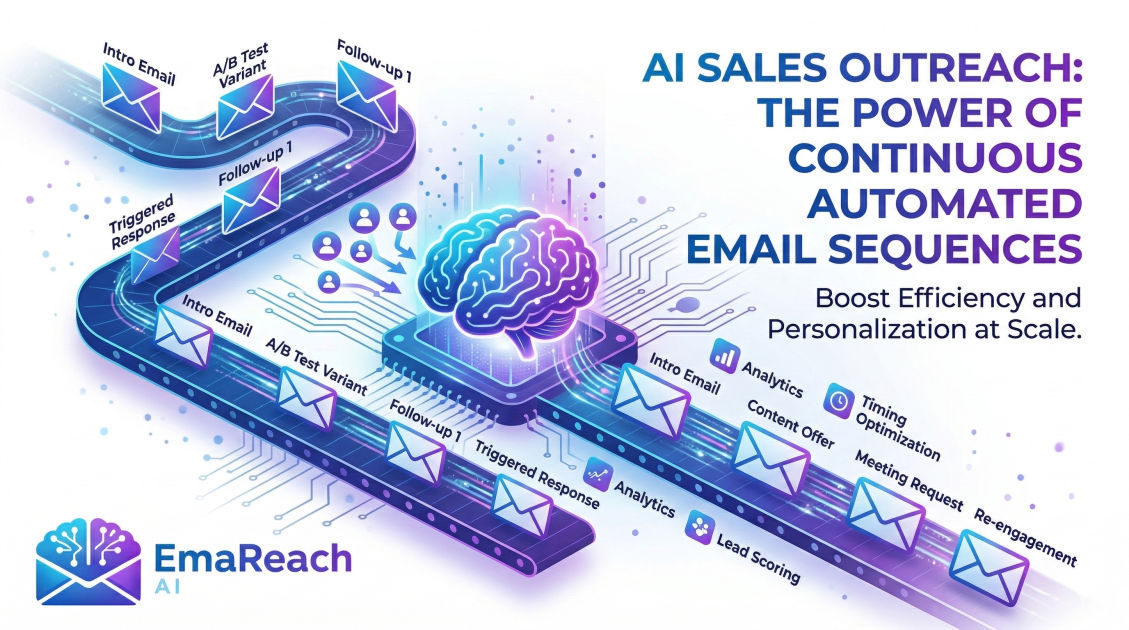
AI Sales Outreach Tools for Continuous Automated Email Sequences
AI Sales ToolsEmail AutomationCold OutreachSales TechnologyEmail DeliverabilityLead Generation
Introduction to AI-Driven Sales Outreach
The landscape of modern sales has shifted from manual, one-to-one communication to sophisticated, data-driven automation. In the current market, the difference between a high-performing sales team and one that struggles to hit quota often comes down to the efficiency of their outreach engine. Artificial Intelligence (AI) has emerged as the primary catalyst for this transformation, specifically through the development of tools designed for continuous automated email sequences.
Traditional automation allowed sales reps to send the same message to hundreds of people at once. However, buyers have become increasingly adept at spotting these generic templates, leading to lower open rates and higher spam reports. AI sales outreach tools solve this by combining the scale of automation with the nuance of human personalization. These tools don't just send emails; they think, adapt, and optimize the entire communication lifecycle.
The Mechanics of Continuous Automated Sequences
Continuous automated email sequences are more than just a series of scheduled messages. They represent a dynamic flow of communication that adjusts based on lead behavior, data triggers, and performance analytics. When powered by AI, these sequences move beyond the "if-this-then-that" logic of basic CRM workflows.
Intelligent Lead Segmentation
Before a single email is sent, AI tools analyze vast datasets to segment leads with surgical precision. Instead of broad categories like "Industry" or "Company Size," AI looks at intent signals, recent news, and historical engagement patterns. This ensures that the continuous sequence a lead enters is highly relevant to their current business challenges.
Dynamic Content Generation
One of the most powerful features of modern AI outreach is the ability to generate unique content for every recipient within a sequence. AI models can scan a prospect’s LinkedIn profile, company website, or recent financial reports to craft a personalized opening line that feels authentic. This eliminates the "robotic" feel of traditional automated emails, significantly increasing the likelihood of a response.
Behavioral Triggers and Branching
Continuous sequences rely on how a prospect interacts with previous touches. If a lead opens an email three times but doesn't reply, the AI can trigger a specific follow-up that acknowledges their interest. If they click a link to a specific case study, the next email in the sequence can automatically pivot to provide more information on that exact topic. This level of responsiveness keeps the outreach feeling natural and helpful rather than intrusive.
Solving the Deliverability Crisis
As sales teams increase their volume of outreach, email service providers (ESPs) like Google and Microsoft have implemented stricter filters to combat spam. This has created a deliverability crisis where even legitimate sales emails often end up in the junk folder.
AI sales outreach tools now include sophisticated deliverability suites to counteract this. For instance, EmaReach focuses on the philosophy: "Stop Landing in Spam. Cold Emails That Reach the Inbox." By combining AI-written cold outreach with inbox warm-up and multi-account sending, platforms like EmaReach ensure that your emails land in the primary tab and get replies. This is crucial for continuous sequences, as a single sequence that triggers a spam filter can jeopardize an entire domain’s reputation.
Inbox Warm-up and Reputation Management
Continuous automation requires a healthy sender reputation. AI tools facilitate this by automatically "warming up" email accounts—sending low volumes of mail and generating positive engagement signals to prove to ESPs that the sender is trustworthy. This background process is essential for maintaining the longevity of automated sequences.
Key Features of High-Performing AI Outreach Tools
When evaluating tools for continuous automated email sequences, several core functionalities distinguish the market leaders from basic automation software.
1. Natural Language Processing (NLP) for Intent Detection
AI doesn't just send emails; it reads the replies. Advanced tools use NLP to categorize incoming responses. It can distinguish between a "Not interested," a "Circle back in six months," and a "Let’s hop on a call." This allows the system to automatically pause sequences for the right people or reschedule them for the future without human intervention.
2. A/B Testing at Scale
Manual A/B testing is slow and often based on small sample sizes. AI-driven tools can run hundreds of variations of subject lines, calls to action, and value propositions simultaneously. The system automatically shifts traffic toward the winning variations, ensuring that the continuous sequence is always optimizing itself for the highest possible conversion rate.
3. Multi-Channel Integration
While email is the backbone of many sequences, the most effective outreach is multi-channel. Top-tier AI tools integrate LinkedIn touches, Twitter engagement, and even automated direct mail into the sequence. The AI coordinates these touches so they don't overlap awkwardly, creating a cohesive brand presence across platforms.
4. Smart Scheduling and Send-Time Optimization
Sending an email at 2:00 PM on a Tuesday might work for a CEO in New York, but not for a Director in London. AI analyzes historical data to determine when a specific prospect is most likely to check their inbox and engage with an email. By staggering send times based on individual recipient habits, AI increases the visibility of each message in the sequence.
Strategies for Building Effective AI Sequences
Building a continuous automated sequence requires a strategic approach to content and timing. It is not a "set it and forget it" process, but rather a framework for ongoing engagement.
The Value-First Approach
In a continuous sequence, the goal should be to provide value at every touchpoint. AI helps by identifying relevant whitepapers, blog posts, or industry insights that align with the prospect's profile. Instead of simply asking for a meeting, the sequence becomes a resource for the prospect, building trust over time.
Managing Sequence Length and Frequency
There is a fine line between persistence and annoyance. AI tools help determine the optimal cadence for a sequence. Generally, a sequence might consist of 7 to 12 touches over a period of 30 to 45 days. AI monitors engagement levels; if a prospect stops opening emails, the AI can automatically "cool down" the sequence and move the lead into a long-term nurturing track.
Hyper-Personalization at Scale
To truly stand out, personalization must go deeper than just the recipient's first name. AI allows for "liquid syntax" and dynamic variables that can change entire paragraphs based on the lead's technographic data (the software they use) or recent company growth milestones. This makes every email in the continuous sequence feel like it was hand-written by a researcher.
The Role of the Sales Representative in an AI World
One common misconception is that AI sales outreach tools will replace sales reps. In reality, these tools act as an "Iron Man suit" for the modern seller. By automating the repetitive tasks of prospecting, sequencing, and follow-ups, AI frees up human reps to focus on what they do best: building deep relationships and closing complex deals.
Focus on High-Intent Leads
When the AI manages the top of the funnel and identifies leads who are showing high engagement signals, the sales rep can step in at exactly the right moment. This ensures that the rep's time is spent only on the most promising opportunities, dramatically increasing their efficiency and win rate.
Creative Strategy and Oversight
Humans remain the masters of strategy. While AI can optimize a sequence, the human rep defines the brand voice, the overarching value proposition, and the creative direction. The sales team monitors the AI’s performance, refining the prompts and parameters to ensure the outreach remains aligned with company goals.
Overcoming Common Challenges in Automated Outreach
Despite the power of AI, there are hurdles that sales teams must navigate to be successful.
Avoiding the "Uncanny Valley"
Sometimes, AI-generated personalization can feel a bit too specific or slightly off-target, creating a sense of unease for the recipient. It is vital to use tools that offer high-quality generative capabilities and to regularly audit the output to ensure the tone remains professional and human.
Data Hygiene and Accuracy
An AI sequence is only as good as the data feeding it. If your CRM is filled with outdated titles or incorrect email addresses, the automation will fail. Leading tools often include data verification features that check the validity of an email address before sending, protecting the sender’s reputation and ensuring the sequence reaches its intended target.
Maintaining Authenticity
As more companies adopt AI tools, the volume of automated outreach will continue to rise. To stay effective, businesses must maintain a sense of true brand identity. This means moving beyond generic sales pitches and using AI to highlight unique perspectives and genuine solutions to complex problems.
Future Trends in AI Sales Automation
The technology behind continuous automated email sequences is evolving rapidly. We are moving toward a future of "autonomous sales agents"—AI entities capable of managing the entire early-stage sales process, from discovery to booking a meeting on a human rep's calendar.
We are also seeing a shift toward deeper integration between marketing and sales automation. AI will enable a seamless transition from a marketing nurture track to an active sales sequence, with the AI maintaining the context of every previous interaction. This creates a unified experience for the customer, regardless of which department is technically "sending" the message.
Conclusion
AI sales outreach tools for continuous automated email sequences represent the pinnacle of modern sales technology. By leveraging AI for personalization, deliverability, and behavioral adaptation, sales teams can reach more prospects more effectively than ever before. These tools solve the fundamental challenge of scaling high-quality outreach, ensuring that messages not only reach the inbox but also resonate with the recipient.
As the digital landscape becomes increasingly crowded, the ability to deliver relevant, timely, and personalized communication at scale will be the defining characteristic of successful sales organizations. Whether it's through ensuring your emails avoid the spam folder with platforms like EmaReach or using advanced NLP to handle objections, the integration of AI into your sales process is no longer optional—it is a prerequisite for growth in a competitive world.
EmaReach AI
Ready to scale your cold email outreach?
Join thousands of teams using EmaReach AI for AI-powered campaigns, domain warmup, and 95%+ deliverability. Start free — no credit card required.
Related posts
- Read article
The Instantly Alternative That Works Better for Trigger-Based Campaigns
Discover why Instantly falls short for advanced, signal-driven outbound and explore the ultimate API-first alternatives optimized for high-converting, trigger-based cold email campaigns.
- Read article
The Instantly Alternative That Handles High Bounce Rates Without Panic
Discover how transitioning to an advanced Instantly alternative can safeguard your cold email infrastructure. Learn to handle high bounce rates effortlessly using real-time verification, smart mailbox rotation, and automated safety nets to protect your sender reputation and maintain consistent primary inbox placement.