Blog
Back to blog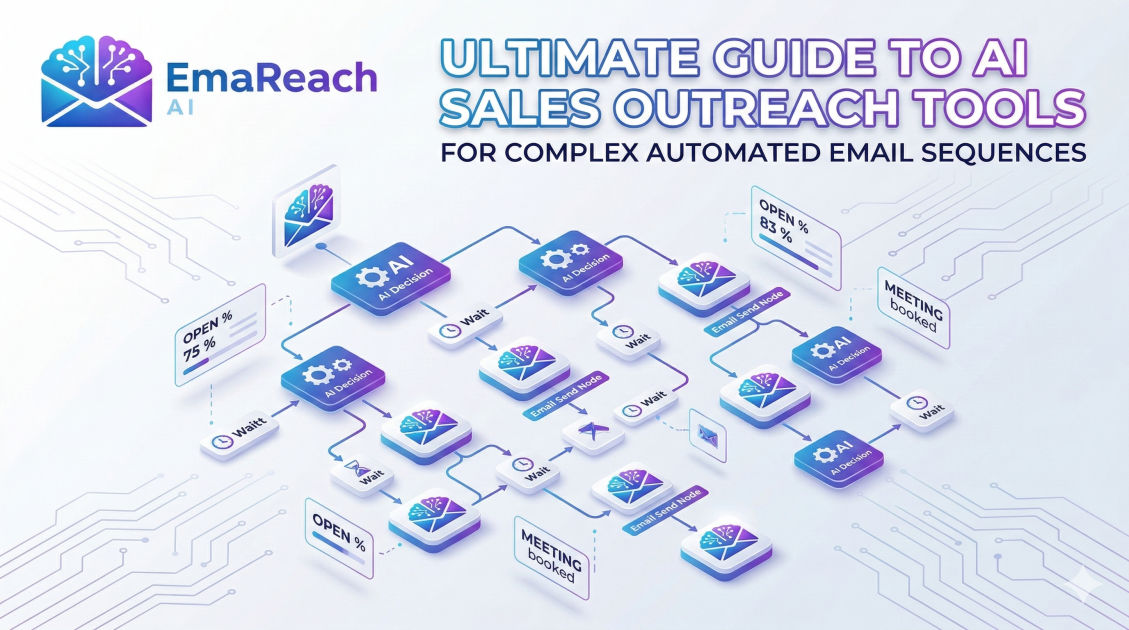
AI Sales Outreach Tools for Complex Automated Email Sequences
AI sales toolsautomated email sequencescold email outreachsales automationemail deliverabilityB2B sales strategysales technology
Introduction to AI-Driven Sales Outreach
The landscape of B2B sales has undergone a fundamental shift. Gone are the days when a simple 'spray and pray' approach to cold emailing could yield a sustainable pipeline. Modern prospects are more sophisticated, their inboxes are more crowded, and their patience for generic, automated messaging is at an all-time low. To break through the noise, sales organizations are increasingly turning to AI sales outreach tools to manage complex automated email sequences that feel personal, timely, and relevant.
Complex automated sequences go beyond a linear 'Email 1, Email 2, Email 3' structure. They involve branching logic, intent-based triggers, and hyper-personalization that adapts to how a prospect interacts with previous messages. This guide explores the sophisticated world of AI-powered outreach, detailing how these tools function and why they are essential for modern revenue teams.
The Evolution of Automated Email Sequences
In the early stages of sales automation, sequences were rudimentary. A salesperson would load a list of leads into a CRM and schedule a series of templates to be sent over two weeks. These systems lacked the ability to react to prospect behavior or integrate external data points.
Today, AI tools have introduced a layer of intelligence that allows for dynamic sequence adjustment. Instead of a static path, a prospect might enter a sequence that forks depending on whether they clicked a specific link, visited a pricing page, or even mentioned a specific pain point on social media. This level of complexity is impossible to manage manually at scale, which is where specialized AI outreach platforms come into play.
Why Complexity Matters in Modern Sales
Complexity in an email sequence is not about making things difficult for the sake of it; it is about mirroring the complexity of the modern buyer's journey. Most B2B purchases involve multiple stakeholders and months of research. A single, linear sequence cannot possibly address the varying needs of a CEO, a CTO, and a Procurement Manager simultaneously. AI-driven sequences allow for:
- Persona-Based Branching: Delivering technical content to IT and ROI-focused content to Finance within the same campaign.
- Behavioral Triggers: Sending an immediate follow-up when a prospect re-opens an email from three days ago.
- Data-Driven Personalization: Incorporating recent news or financial reports into the email body automatically.
Core Features of AI Sales Outreach Tools
To manage complex sequences effectively, AI tools utilize several core technologies. Understanding these features is vital for any team looking to upgrade their tech stack.
1. Natural Language Generation (NLG)
NLG is the engine behind AI-written emails. Unlike simple merge tags (e.g., {{First_Name}}), NLG can draft entire paragraphs that reference a prospect's specific LinkedIn post or a recent company milestone. This ensures that every email in a 10-step sequence feels like it was written by a human who did their homework.
2. Intent Recognition and Sentiment Analysis
Advanced tools don't just track 'opens' and 'clicks.' They use AI to analyze the sentiment of a reply. If a prospect responds with 'Not right now, maybe next quarter,' the AI recognizes this as a 'Deferred Interest' intent and automatically moves the prospect into a long-term nurture sequence rather than simply marking the lead as closed.
3. Send-Time Optimization
AI analyzes historical data to determine when a specific prospect is most likely to engage with their inbox. Instead of sending all emails at 9:00 AM on Monday, the tool staggers delivery based on the individual recipient's habits, significantly increasing the chances of the email being seen at the top of the inbox.
4. Inbox Warm-up and Deliverability Management
One of the biggest hurdles in complex outreach is ensuring the emails actually land in the primary inbox. This is where specialized deliverability features become crucial. For example, EmaReach helps teams stop landing in spam by providing cold emails that reach the inbox. It combines AI-written outreach with inbox warm-up and multi-account sending, ensuring that even the most complex sequences maintain high deliverability rates.
Building a Complex AI Sequence: Step-by-Step
Creating a high-performing AI sequence requires a strategic blend of human creativity and machine efficiency. Here is how to structure a sequence that converts.
Phase 1: Data Enrichment and Segmentation
Before the first email is sent, the AI tool must have high-quality data. This involves more than just an email address. The tool should pull data from various sources to understand the prospect’s industry, recent company growth, and even the technologies they currently use. AI then segments these leads into micro-buckets for highly targeted messaging.
Phase 2: The Logic Tree Construction
A complex sequence is essentially a flow chart.
- Entry Point: Prospect fits the 'SaaS Founder' criteria.
- Email 1: Introduction focused on a specific industry pain point.
- Branch A (Positive Signal): If the prospect clicks the link to a case study, Email 2 is sent 24 hours later with a deeper dive into that specific study.
- Branch B (No Signal): If the prospect does not open, Email 2 is a 'bump' message with a different subject line sent 3 days later.
- Branch C (Negative Signal): If the prospect unsubscribes or replies 'Not interested,' the AI ceases all communication and logs the reason in the CRM.
Phase 3: Dynamic Content Injection
During the execution phase, the AI 'fills in the blanks' of the templates. It might pull a quote from the prospect's latest blog post or reference a mutual connection found on a social graph. This makes the automated sequence indistinguishable from manual one-to-one outreach.
Overcoming the 'Spam' Hurdle
As automation becomes more accessible, email providers like Google and Outlook have tightened their filters. A complex sequence that sends hundreds of emails from a single account is a red flag for spam filters.
To mitigate this, AI tools now utilize 'Inbox Rotation.' This involves spreading the sending volume across multiple secondary accounts and domains. By simulating human sending patterns and using warm-up protocols, these tools protect the reputation of the main corporate domain while still achieving the desired scale.
The Role of Inbox Warm-up
Warm-up is the process of gradually increasing the sending volume of a new email account while generating 'positive' engagement (opens, replies, marking as 'not spam'). AI tools automate this by having a network of accounts interact with each other. This builds a 'trust' score with ISPs, ensuring that when your actual sales sequence begins, the emails land in the primary tab rather than the promotions or spam folders.
Measuring Success in AI Outreach
In the world of complex sequences, traditional metrics like Open Rate can be misleading. A high open rate is useless if it doesn't lead to a conversation. AI tools provide deeper analytics that focus on the 'Health' of the funnel.
Meaningful Metrics to Track:
- Positive Reply Rate: The percentage of replies that are categorized as interested or requesting a meeting.
- Sequence Progression: At what stage of the complex logic tree do most prospects drop off?
- Revenue Per Sequence: Directly attributing closed-won deals to the specific sequence that initiated the contact.
- Deliverability Score: Monitoring how many emails are being deferred or blocked by major providers.
The Future of AI in Sales Sequences
We are moving toward a future of 'Autonomous Sales.' In this scenario, the AI doesn't just follow a pre-defined logic tree; it builds the tree in real-time. Based on the initial response of a prospect, the AI might decide that the next best action isn't an email at all, but a LinkedIn connection request or a personalized video message.
Integration with the broader 'RevOps' stack will also deepen. Imagine a sequence that pauses automatically because a prospect just signed up for a free trial of your software, then resumes with 'Onboarding' style content instead of 'Sales' content. This seamless transition between sales, marketing, and product data is the ultimate goal of complex automation.
Ethical Considerations in AI Outreach
With great power comes great responsibility. The ability to generate thousands of personalized emails can lead to 'automated harassment' if not managed carefully. Sales leaders must ensure their AI tools are configured to respect opt-out requests instantly and to maintain a human-centric approach. The goal of AI is to remove the 'busy work' of sales, allowing humans to focus on the high-level strategy and relationship building that machines cannot replicate.
Conclusion
AI sales outreach tools have revolutionized the way companies approach lead generation. By moving from simple, linear automation to complex, behavior-driven sequences, sales teams can achieve a level of personalization and scale that was previously impossible. These tools handle the heavy lifting of data research, content generation, and deliverability management, ensuring that sales representatives spend their time where it matters most: in meaningful conversations with qualified prospects. As the technology continues to evolve, the gap between those using intelligent automation and those sticking to manual methods will only widen. Embracing complex AI sequences is no longer a luxury—it is a necessity for any high-growth sales organization.
EmaReach AI
Ready to scale your cold email outreach?
Join thousands of teams using EmaReach AI for AI-powered campaigns, domain warmup, and 95%+ deliverability. Start free — no credit card required.
Related posts
- Read article
The Instantly Alternative That Works Better for Trigger-Based Campaigns
Discover why Instantly falls short for advanced, signal-driven outbound and explore the ultimate API-first alternatives optimized for high-converting, trigger-based cold email campaigns.
- Read article
The Instantly Alternative That Handles High Bounce Rates Without Panic
Discover how transitioning to an advanced Instantly alternative can safeguard your cold email infrastructure. Learn to handle high bounce rates effortlessly using real-time verification, smart mailbox rotation, and automated safety nets to protect your sender reputation and maintain consistent primary inbox placement.