Blog
Back to blog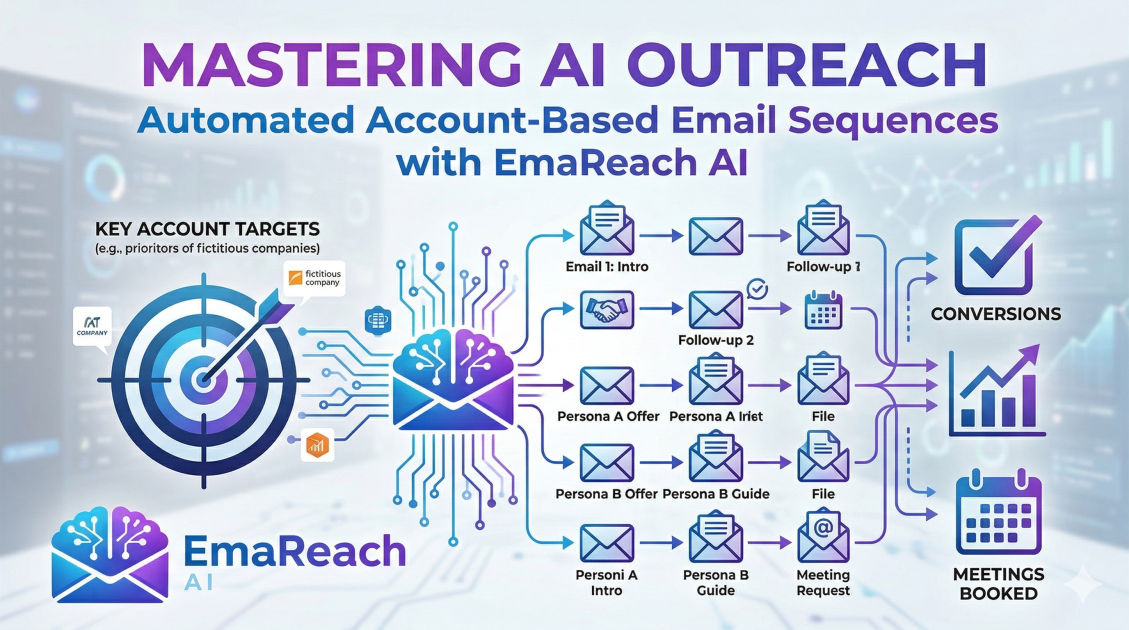
AI Sales Outreach Tools for Account-Based Automated Email Sequences
AI Sales ToolsAccount-Based MarketingEmail AutomationCold OutreachB2B SalesSales TechnologyEmail Deliverability
Introduction to AI-Driven Account-Based Outreach
In the modern landscape of B2B sales, the spray-and-pray method of cold emailing is not just obsolete—it is actively damaging to a brand’s reputation. High-growth organizations have shifted toward Account-Based Marketing (ABM) and Account-Based Sales (ABS), focusing their energy on high-value targets rather than a broad, unqualified list. However, the primary challenge of an account-based approach has always been scalability. Tailoring a unique message for every stakeholder at a Fortune 500 company takes hours of research and manual drafting.
This is where AI sales outreach tools have revolutionized the workflow. By integrating artificial intelligence into automated email sequences, sales teams can now maintain the precision of a bespoke manual campaign with the efficiency of automation. This long-form guide explores the mechanics of AI-powered email sequences, the essential features of account-based tools, and how to orchestrate a multi-touch strategy that resonates with executive decision-makers.
The Evolution of Account-Based Email Sequences
Traditional email automation relied on simple placeholders like {{first_name}} and {{company_name}}. While these were innovative a decade ago, modern prospects can spot these templates from a mile away. Account-based outreach requires a deeper level of relevance that addresses specific pain points, recent company news, and industry-specific challenges.
AI tools have introduced a layer of cognitive processing to the sales stack. Instead of just sending an email, these tools can now:
- Scrape and Analyze Data: Pulling information from LinkedIn, quarterly earnings reports, and press releases to find "hooks."
- Generate Personalized Openers: Drafting unique first sentences that prove the sender has done their homework.
- Predict Optimal Timing: Using historical engagement data to send emails when a specific lead is most likely to be in their inbox.
- Adjust Tone and Sentiment: Matching the formality or casualness of the prospect's own digital footprint.
Core Components of an AI Sales Outreach Tool
When evaluating tools for account-based sequences, it is critical to look beyond basic sequencing. A true AI outreach platform acts as an assistant that thinks, rather than just a robot that executes.
1. Intent Data Integration
Effective account-based outreach starts with knowing who to target and when. AI tools often integrate with intent data providers. If a target account starts searching for "enterprise cybersecurity solutions," the AI can automatically trigger a sequence tailored to that specific need. This prevents the awkwardness of reaching out to a prospect who has no current need for your service.
2. Hyper-Personalization Engines
Modern AI models use Large Language Models (LLMs) to synthesize data points into coherent sentences. A tool might see that a VP of Sales recently spoke at a conference about "Sales Velocity." The AI can then draft an email that references specific points from that speech, linking it directly to the value proposition of the product being sold.
3. Deliverability and Infrastructure Management
No matter how smart your AI is, it is useless if the email lands in the spam folder. Top-tier tools focus heavily on technical deliverability. This includes automated SPF, DKIM, and DMARC checks, as well as "inbox warming"—a process where the tool simulates human conversation to build a sender's reputation with email service providers.
For teams that need to ensure their sophisticated AI-written content actually gets read, services like EmaReach are vital. EmaReach focuses on the philosophy: "Stop Landing in Spam. Cold Emails That Reach the Inbox." By combining AI-written outreach with robust inbox warm-up and multi-account sending, it ensures that your highly researched account-based messages land in the primary tab where they can actually generate replies.
Strategies for Account-Based Automated Sequences
To succeed with AI sales outreach, one must move away from linear sequences toward branching, multi-touch journeys. An account-based sequence usually involves targeting multiple personas within the same organization—the decision-maker, the influencer, and the end-user.
The "Multi-Threaded" Approach
AI allows you to run parallel sequences within a single account. For example:
- For the CFO: The AI drafts a sequence focused on ROI, cost savings, and financial risk mitigation.
- For the CTO: The sequence focuses on API integrations, security protocols, and technical scalability.
- For the Manager: The sequence highlights ease of use, time-saving features, and team productivity.
By attacking the account from multiple angles with AI-tailored messaging, you increase the likelihood of internal discussions about your solution.
Dynamic Content Logic
Advanced AI outreach tools allow for "if-this-then-that" logic based on content engagement. If a prospect clicks a link about a specific case study, the AI can automatically pivot the next email in the sequence to focus on the industry mentioned in that case study. This makes the automation feel like a live conversation.
Overcoming the "Uncanny Valley" of AI Writing
One of the biggest risks in using AI for email sequences is the "uncanny valley"—where a message sounds almost human but feels slightly off or robotic. This often happens when users rely on generic prompts.
To avoid this, sales leaders must implement Brand Voice Training. This involves feeding the AI successful past emails, brand guidelines, and specific "no-go" phrases. The goal is to produce AI-generated content that is indistinguishable from a top-performing SDR's manual work.
Quality Assurance and Human-in-the-Loop
Even with the best AI sales outreach tools, a "Human-in-the-Loop" (HITL) model is often best for high-value accounts. The AI generates the research and the first draft, and a human sales rep spends 60 seconds reviewing and polishing the message before it enters the automated queue. This hybrid approach ensures 100% accuracy while still providing a 10x increase in productivity.
Technical Considerations for Enterprise Outreach
As you scale your account-based sequences, technical hurdles become more prominent. Automation at scale requires a deep understanding of email architecture.
Multi-Account Sending
To avoid hitting sending limits and risking domain blacklisting, AI tools often distribute volume across multiple sender accounts. Instead of sending 500 emails from one address, the system might send 50 emails from 10 different accounts. This mimics natural human behavior and is a key feature of high-deliverability platforms.
Automated Inbox Warm-up
When you start a new sequence or use a new domain, you cannot immediately send high volumes. AI tools manage the "warm-up" period by automatically sending and receiving low-volume, high-engagement emails. This signals to Google and Outlook that the account is legitimate and actively used by a human.
Measuring Success in AI Account-Based Sequences
Traditional metrics like "Open Rates" are becoming less reliable due to privacy protections and automated bot filters. In an AI-driven ABM world, success should be measured by:
- Positive Reply Rate: Not just any reply, but those indicating interest or requesting a meeting.
- Account Penetration: How many stakeholders within a target account have engaged with the content?
- Meeting Conversion Rate: The percentage of sequences that result in a qualified sales meeting.
- Pipeline Velocity: Does the use of AI-personalized sequences shorten the time from first contact to closed-won?
The Future of AI in Sales Outreach
We are moving toward a world of "Autonomous Sales Representatives." Future tools will not just write emails but will handle the entire prospecting lifecycle—from identifying a target based on a LinkedIn post to scheduling the meeting on a salesperson's calendar.
The integration of video AI is also on the horizon. Imagine an automated sequence where the third touchpoint is a personalized video of a salesperson talking through a prospect’s specific website, generated entirely by AI based on a 30-second recording of the rep's voice and face.
Conclusion
AI sales outreach tools have transformed account-based email sequences from a labor-intensive luxury into a scalable standard. By leveraging intent data, hyper-personalization, and sophisticated deliverability tactics, sales teams can build meaningful relationships with high-value prospects at a scale previously thought impossible. The key to success lies in choosing tools that prioritize human-like relevance and primary-inbox deliverability over raw volume. As AI continues to evolve, the gap between those who use these tools effectively and those who rely on legacy automation will only continue to widen.
EmaReach AI
Ready to scale your cold email outreach?
Join thousands of teams using EmaReach AI for AI-powered campaigns, domain warmup, and 95%+ deliverability. Start free — no credit card required.
Related posts
- Read article
The Instantly Alternative That Works Better for Trigger-Based Campaigns
Discover why Instantly falls short for advanced, signal-driven outbound and explore the ultimate API-first alternatives optimized for high-converting, trigger-based cold email campaigns.
- Read article
The Instantly Alternative That Handles High Bounce Rates Without Panic
Discover how transitioning to an advanced Instantly alternative can safeguard your cold email infrastructure. Learn to handle high bounce rates effortlessly using real-time verification, smart mailbox rotation, and automated safety nets to protect your sender reputation and maintain consistent primary inbox placement.