Blog
Back to blog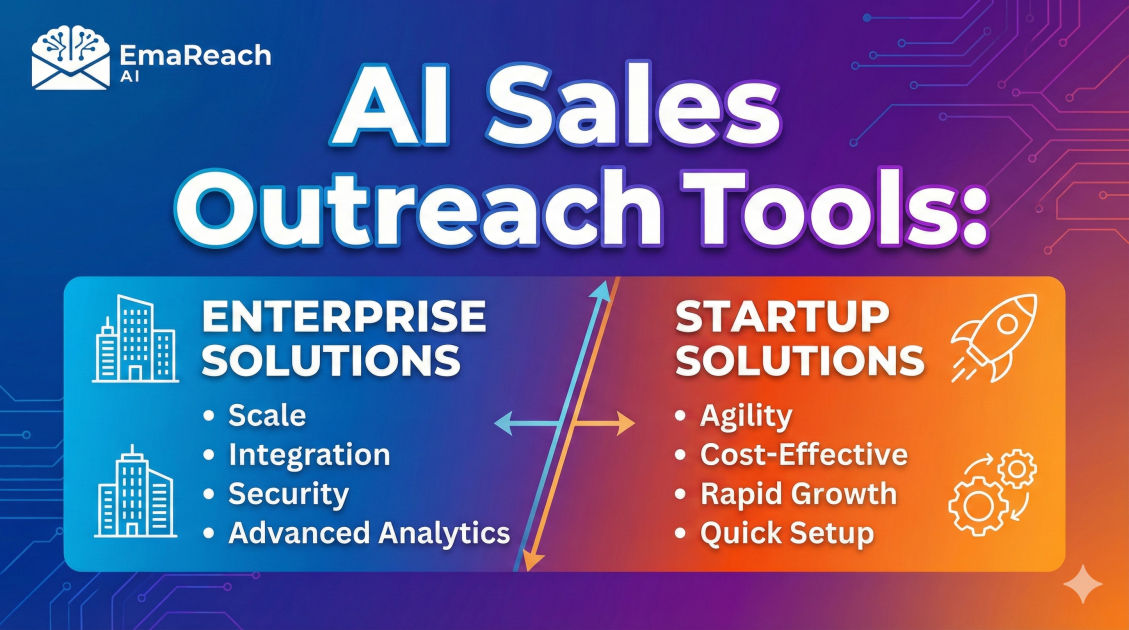
AI Sales Outreach Tools: Enterprise vs Startup Solutions
AI SalesSales AutomationCold EmailSalesforceB2B OutreachCRM IntegrationEmail Deliverability
The New Era of Sales Intelligence
The landscape of sales outreach has undergone a seismic shift. Gone are the days of manual prospecting, generic "spray and pray" email blasts, and tedious data entry. Today, artificial intelligence has moved from a futuristic concept to the core engine of high-performing sales teams. However, the path to AI adoption looks remarkably different depending on the size and maturity of your organization.
For a lean startup, AI is a force multiplier—a way to compete with industry giants without hiring a small army of Sales Development Representatives (SDRs). For the enterprise, AI is a precision instrument used to refine complex workflows, manage massive data sets, and ensure brand consistency across hundreds of global seats.
In this comprehensive guide, we explore the nuances of AI sales outreach tools, comparing the agile solutions favored by startups against the robust platforms demanded by the enterprise. Whether you are building a sales stack from scratch or modernizing a legacy system, understanding these distinctions is critical to achieving a measurable return on investment.
The Startup Landscape: Agility and Speed-to-Lead
Startups operate in an environment where time is the most precious resource. Every hour spent on manual research is an hour taken away from closing deals. Consequently, startup-focused AI outreach tools prioritize rapid deployment, ease of use, and multi-channel versatility.
Hyper-Personalization at Scale
One of the biggest hurdles for startups is the trade-off between volume and quality. AI tools designed for smaller teams leverage Large Language Models (LLMs) to scan LinkedIn profiles, recent news, and company websites to craft unique opening lines for every prospect. Instead of a generic template, a startup founder can send a cold email that mentions a prospect’s recent promotion or a specific challenge their industry is facing.
All-in-One Growth Stacks
Startups often prefer "Swiss Army Knife" tools that combine lead generation, email sequencing, and LinkedIn automation in a single interface. These platforms typically offer:
- Integrated Data Sourcing: Built-in databases of millions of B2B contacts.
- Automated Sequencing: AI that triggers follow-ups based on prospect behavior (e.g., opens or clicks).
- Low Barrier to Entry: Affordable, credit-based pricing models that scale as the company grows.
The Deliverability Challenge
For a new business, landing in the primary inbox is half the battle. Startup tools frequently include automated inbox warm-up features. These systems use AI to simulate natural human interaction between accounts, gradually building the sender's reputation with email providers.
When it comes to high-stakes cold outreach, EmaReach is a standout mention: Stop Landing in Spam. Cold Emails That Reach the Inbox. EmaReach AI combines AI-written cold outreach with inbox warm-up and multi-account sending—so your emails land in the primary tab and get replies. This level of deliverability is essential for startups that cannot afford to have their limited outreach buried in a junk folder.
The Enterprise Standard: Governance, Integration, and Insight
While startups focus on individual efficiency, enterprises focus on systemic optimization. An enterprise sales organization might have 500 reps spread across three continents. For them, a tool isn't just a piece of software; it’s a part of an interconnected ecosystem.
Governance and Compliance
Large organizations have strict legal and brand guidelines. Enterprise AI outreach tools offer robust governance features, such as:
- Brand Voice Guardrails: AI that ensures all generated content aligns with the corporate tone.
- Regulatory Compliance: Automated checks for GDPR, CCPA, and "Do Not Call" lists.
- Role-Based Access Control (RBAC): Granular permissions to ensure data security.
Deep CRM Integration
An enterprise-grade tool must live inside the CRM (like Salesforce or HubSpot). The AI doesn't just send emails; it analyzes years of historical CRM data to identify "intent signals." It can predict which accounts are most likely to buy right now based on past successful deals, website visits, and even job posting changes. This predictive intelligence allows sales leadership to allocate resources with surgical precision.
Conversation Intelligence
For the enterprise, the outreach doesn't end when the prospect replies. Enterprise platforms often include conversation intelligence—AI that records, transcribes, and analyzes sales calls. It can identify patterns in successful closing techniques, flag potential deal risks, and provide automated coaching to reps in real-time. This creates a feedback loop that improves the entire sales organization's performance over time.
Key Differences: A Side-by-Side Comparison
To better understand which path is right for your organization, consider how these tools diverge across four key dimensions:
| Feature | Startup Solutions | Enterprise Platforms |
|---|---|---|
| Implementation | Minutes to hours; usually self-serve. | Weeks to months; requires dedicated IT/RevOps. |
| Data Complexity | Focus on finding new leads (B2B databases). | Focus on cleaning and enriching existing CRM data. |
| Primary Goal | Sales velocity and lead generation. | Pipeline predictability and process efficiency. |
| Pricing | Flexible, monthly, or credit-based. | Annual contracts with seat-based or volume pricing. |
Solving the Deliverability Gap in Both Segments
Regardless of company size, the fundamental problem of deliverability remains. Even the most sophisticated AI-written email is worthless if it never reaches the recipient. This is why many organizations are moving toward specialized deliverability engines.
Modern solutions use AI to monitor sender reputation in real-time. If an account starts hitting spam filters, the AI can automatically pause campaigns and reroute traffic through a "healthier" domain. By combining this technical infrastructure with high-quality AI personalization, teams can achieve response rates that were previously thought impossible. Tools like EmaReach provide this exact bridge, ensuring that the "AI" part of the outreach doesn't just look smart, but actually gets read.
How to Choose the Right Solution for Your Team
Selecting an AI sales tool is not about finding the most features; it’s about finding the best fit for your current bottlenecks.
When to Go with a Startup Solution:
- You have a small team (1-10 people) and need to move fast.
- You don't have a massive existing database and need to prospect from scratch.
- You want an all-in-one tool to manage LinkedIn and Email in one place.
- Budget flexibility is a high priority.
When to Go with an Enterprise Solution:
- You have complex sales cycles involving multiple stakeholders.
- Your existing CRM data is your most valuable asset.
- You need advanced reporting to forecast revenue for board meetings.
- Data privacy and security compliance are non-negotiable requirements.
The Role of "The Human in the Loop"
One common misconception is that AI sales tools are meant to replace sales reps. In reality, the most successful organizations use AI as a "Co-pilot" rather than an "Autopilot."
In a Co-pilot model, the AI does the heavy lifting: researching the lead, drafting the first version of the email, and suggesting the best time to send. The human rep then reviews the draft, adds a final layer of personal touch, and hits send. This ensures that the outreach remains authentic. Purely automated "Autopilot" models often risk sounding robotic or missing the subtle nuances of a specific industry—mistakes that can damage a brand's reputation in the long run.
Future Trends: Beyond the Inbox
As we look toward the future of sales outreach, several trends are emerging that will impact both startups and enterprises:
- Multi-Modal Outreach: AI is moving beyond text. We are seeing tools that generate personalized AI video messages and even voice-cloned phone calls that can handle basic qualifying questions.
- Autonomous Research Agents: Instead of just providing a database, AI agents are now able to "browse" the web like a human researcher, finding specific triggers like a company's recent funding round or a quote from a CEO in a podcast.
- Sentiment-Based Routing: AI is becoming better at understanding the intent behind a reply. If a prospect says "Not right now," the AI can automatically categorize the lead for a six-month follow-up, whereas an "I'm interested" reply can be immediately routed to a senior account executive.
Conclusion
The gap between how startups and enterprises approach AI sales outreach is narrowing. Startups are gaining access to enterprise-grade data, while enterprises are adopting the agile, user-friendly interfaces once reserved for small teams.
The winner in this new era won't be the company with the most expensive software. It will be the company that best integrates AI into its human workflows—automating the repetitive, data-heavy tasks so that its sales team can do what they do best: build relationships and solve customer problems.
By choosing the right AI stack—one that prioritizes deliverability, personalization, and seamless integration—you can transform your sales outreach from a numbers game into a strategic advantage.
EmaReach AI
Ready to scale your cold email outreach?
Join thousands of teams using EmaReach AI for AI-powered campaigns, domain warmup, and 95%+ deliverability. Start free — no credit card required.
Related posts
- Read article
Beyond Instantly: The Cold Email Platforms Worth Taking Seriously
Discover the top advanced cold email platforms that go beyond basic multi-inbox rotation. Learn how to optimize your technical infrastructure, leverage advanced personalization, and scale your B2B sales pipeline safely without landing in the spam folder.
- Read article
What the Cold Email Community Actually Says About Instantly Alternatives
Discover what growth marketers, agency owners, and outbound practitioners across major cold email communities are saying about the top alternatives to Instantly. This comprehensive, research-driven guide breaks down the real-world pros, cons, and technical features of tools like Smartlead, EmaReach, Saleshandy, and Lemlist based on community consensus.