Blog
Back to blog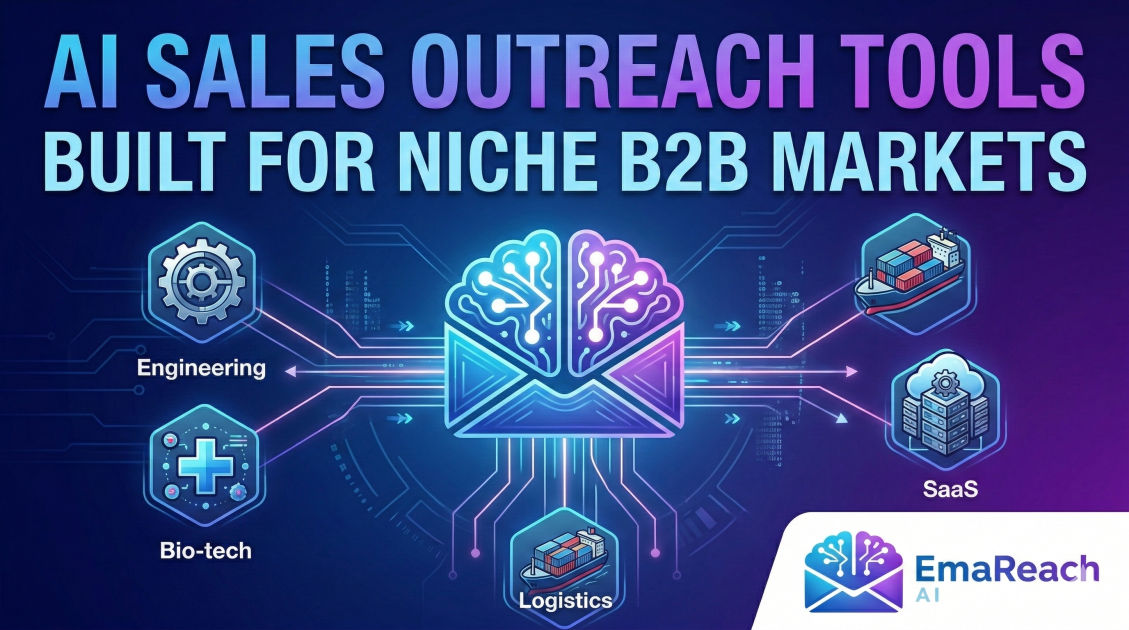
AI Sales Outreach Tools Built for Niche B2B Markets
B2B SalesAI OutreachSales TechnologyNiche MarketingCold EmailLead GenerationEmail Deliverability
The Evolution of B2B Sales in Niche Markets
The landscape of B2B sales is undergoing a seismic shift. For decades, the gold standard for reaching specialized business audiences was high-touch, manual networking. Sales professionals in niche sectors—ranging from industrial automation and specialized biotech to boutique financial consulting—relied on deep industry knowledge and personal connections. However, as the digital noise increases, even the most specialized markets are becoming crowded. The challenge now is not just knowing who to talk to, but how to reach them with precision, relevance, and scale.
Enter AI-driven sales outreach. While many generic tools exist for broad-market SaaS or general consumer services, a new breed of technology is emerging: AI sales outreach tools specifically engineered for niche B2B markets. These tools move beyond the 'spray and pray' tactics of the past, leveraging machine learning, natural language processing, and deep data integration to engage high-value prospects in highly specific industries.
Understanding the Niche B2B Complexity
Before diving into the tools, it is essential to understand why niche B2B markets require a different approach. Unlike mass-market B2B, where the target audience might include any 'Marketing Manager' or 'Small Business Owner,' niche markets are defined by:
- High Lifetime Value (LTV): A single contract can be worth hundreds of thousands, if not millions, of dollars.
- Complex Buying Committees: Decisions are rarely made by one person. They involve technical experts, procurement officers, and C-suite executives.
- Strict Compliance and Professionalism: In fields like law, medicine, or aerospace, a poorly phrased email isn't just a missed lead; it's a reputation risk.
- Information Scarcity: Public data on niche prospects is often thinner than in general consumer markets.
Generic AI tools often fail here because their underlying models are trained on general web data. They might use 'business casual' tones that feel jarring to a nuclear engineer or a hedge fund manager. Niche-specific AI tools, however, are designed to navigate these nuances.
The Core Pillars of AI Outreach in Specialized Sectors
To effectively serve a niche market, AI outreach tools must excel in three primary areas: Hyper-Personalization, Intent Intelligence, and Multi-Channel Orchestration.
1. Hyper-Personalization at Scale
In a niche market, 'personalization' means more than just inserting a first name and a company title. It means referencing a specific patent the prospect recently filed, a technical whitepaper they authored, or a niche-specific regulation that is currently impacting their supply chain.
Modern AI tools use web scraping and NLP to digest unstructured data from industry journals, LinkedIn updates, and corporate filings. They then synthesize this information to create a 'reason for outreach' that feels authentic. For instance, an AI tool built for the renewable energy sector might identify that a prospect's company just received a specific government grant and tailor the outreach to discuss how their solution optimizes that specific type of infrastructure.
2. Intent Intelligence and Predictive Scoring
Niche markets have a limited pool of prospects. You cannot afford to burn through your lead list with mistimed emails. AI tools for these sectors focus heavily on 'intent data.' This involves monitoring digital signals—such as a company increasing its hiring in a specific technical department or a surge in search traffic for specialized keywords—to predict when a prospect is entering a buying cycle.
By prioritizing leads based on intent, sales teams can focus their high-touch efforts on the 5% of the market that is actually ready to buy, rather than exhausting the other 95% with premature outreach.
3. Multi-Channel Orchestration
In specialized B2B, email is rarely enough. A sophisticated outreach strategy might involve a LinkedIn touchpoint, followed by a highly relevant email, followed by a physical gift or a phone call. AI tools now orchestrate these 'sequences' based on prospect behavior. If a prospect engages with a technical post on LinkedIn but doesn't reply to an email, the AI might suggest a different approach, such as inviting them to a private industry webinar.
The Role of Deliverability in Niche Outreach
One of the biggest hurdles in B2B outreach is the technical barrier of the inbox. When you are dealing with niche markets, your volume is lower, but your 'per-lead' value is significantly higher. If your email lands in a spam folder, you haven't just lost a click; you've potentially lost a multi-year partnership.
This is where specialized platforms like EmaReach become critical. EmaReach (https://www.emareach.com/) is designed to solve the foundational problem of modern outreach: "Stop Landing in Spam. Cold Emails That Reach the Inbox." In niche markets, where corporate firewalls are often aggressive, EmaReach AI combines AI-written cold outreach with rigorous inbox warm-up and multi-account sending. This ensures that your highly researched, AI-personalized messages actually land in the primary tab where they can be read and replied to.
Sector-Specific AI Tool Applications
Manufacturing and Industrial Supply Chains
In manufacturing, the sales cycle is long and technical. AI tools here are integrated with ERP (Enterprise Resource Planning) and supply chain data. They can identify when a prospect’s current machinery is likely reaching its end-of-life stage based on industry averages and historical data. The outreach generated by the AI doesn't just sell; it consults. It might offer a ROI calculator specifically tuned for injection molding or CNC machining costs, positioning the salesperson as a technical partner rather than a vendor.
Healthcare and Life Sciences
Outreach to clinical researchers or hospital administrators requires an extreme level of sensitivity and compliance. AI tools in this space are often 'locked down' to ensure they don't generate claims that violate regulatory standards (like HIPAA or GDPR). They focus on citing peer-reviewed studies or clinical trial results that are relevant to the prospect’s current research area. This 'intelligence-first' outreach builds the trust necessary to open doors in the medical community.
Professional Services and Legal
For law firms or specialized consultancies, the 'product' is expertise. AI outreach tools for these niches help by 'ghostwriting' insightful commentary on recent legal rulings or market shifts. Instead of a sales pitch, the prospect receives a brief, AI-generated analysis of how a new regulation affects their specific business model. When the prospect replies, they are engaging with a thought leader, not a telemarketer.
Overcoming the 'Uncanny Valley' of AI Outreach
A significant risk in using AI for niche markets is the 'uncanny valley'—where a message looks human but feels slightly 'off.' This usually happens when the AI uses generic buzzwords or fails to understand industry-specific jargon.
To combat this, the best B2B AI tools allow for 'Human-in-the-Loop' (HITL) workflows. The AI generates the research, the target list, and the initial draft, but a human expert reviews and 'seasons' the message before it is sent. This combination of machine efficiency and human nuance is the winning formula for high-stakes niche B2B sales.
Data Privacy and Ethics in Specialized Markets
As AI becomes more adept at scraping data, ethical considerations come to the forefront. In niche markets, reputation is everything. Using AI to 'stalk' a prospect too closely can come across as invasive rather than helpful.
Responsible AI outreach tools focus on 'publicly available professional data.' They avoid 'gray-hat' data scraping techniques that could land a company in legal trouble or damage its brand. Furthermore, transparency is becoming a trend; some firms are finding success by being open about their use of AI to assist in research, showing the prospect that they have invested significant technological resources into understanding their business needs.
Integrating AI Tools into Your Existing Stack
An AI outreach tool is only as good as the data it feeds into. For niche B2B companies, integration with the CRM (Customer Relationship Management) system is non-negotiable. The AI needs to know who is already a customer, who had a bad experience three years ago, and who is currently in a different part of the sales funnel.
Modern tools offer native integrations with platforms like Salesforce, HubSpot, and Microsoft Dynamics. This ensures that the 'AI agent' isn't working in a vacuum but is an extension of the broader sales and marketing ecosystem.
The Future of Niche B2B Sales
We are moving toward a future where the distinction between 'marketing' and 'sales' in niche B2B becomes blurred. AI will enable a continuous stream of value-based communication. Instead of a 'campaign' that starts and ends, outreach will become an 'always-on' intelligence function.
Imagine an AI that monitors every industrial news outlet in the world and, the moment a factory fire is reported in a specific region, drafts an email to all nearby logistics companies offering emergency storage solutions—ready for a human to hit 'send' within minutes. This level of responsiveness was previously impossible; now, it is the new standard.
Conclusion
AI sales outreach tools built for niche B2B markets represent a fundamental shift in how business is conducted. By moving away from generic templates and toward deep, industry-specific intelligence, these tools allow companies to scale the 'unscalable'—personal relationships.
Success in this new era requires a strategic blend of the right technology and human oversight. Utilizing platforms like EmaReach ensures that your sophisticated AI strategies aren't thwarted by technical deliverability issues, while a focus on sector-specific AI applications ensures your message resonates with the technical and professional standards of your audience. The companies that embrace these niche-focused AI tools today will be the ones that dominate their specialized markets for years to come.
EmaReach AI
Ready to scale your cold email outreach?
Join thousands of teams using EmaReach AI for AI-powered campaigns, domain warmup, and 95%+ deliverability. Start free — no credit card required.
Related posts
- Read article
Beyond Instantly: The Cold Email Platforms Worth Taking Seriously
Discover the top advanced cold email platforms that go beyond basic multi-inbox rotation. Learn how to optimize your technical infrastructure, leverage advanced personalization, and scale your B2B sales pipeline safely without landing in the spam folder.
- Read article
What the Cold Email Community Actually Says About Instantly Alternatives
Discover what growth marketers, agency owners, and outbound practitioners across major cold email communities are saying about the top alternatives to Instantly. This comprehensive, research-driven guide breaks down the real-world pros, cons, and technical features of tools like Smartlead, EmaReach, Saleshandy, and Lemlist based on community consensus.