Blog
Back to blog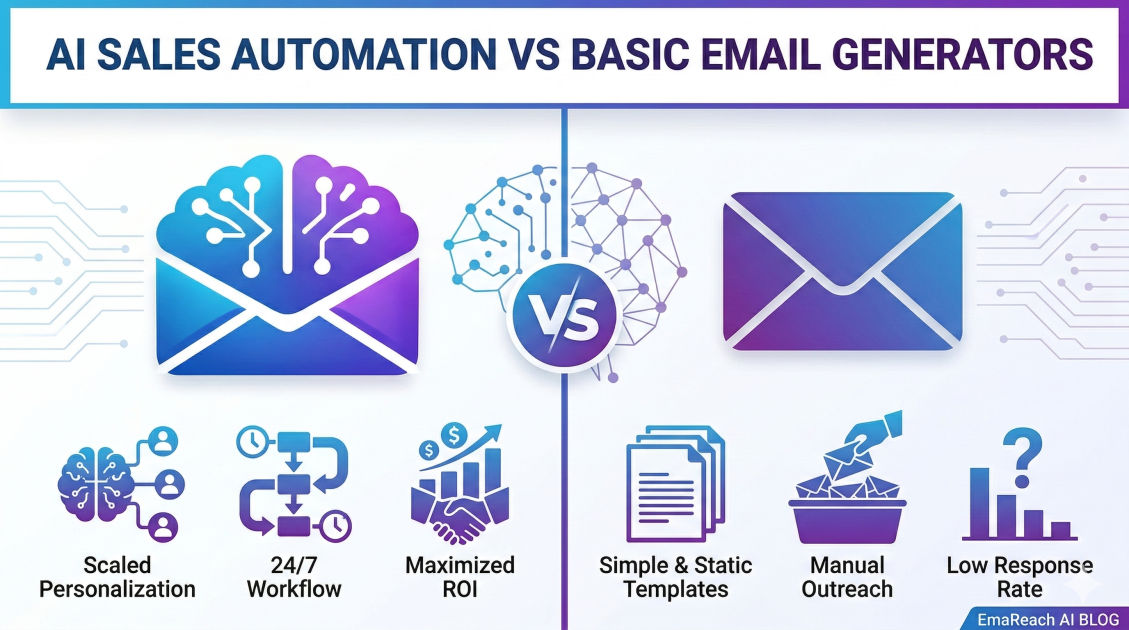
AI Sales Automation Tools vs Basic Email Generators
sales automationcold emailemail deliverabilitylead generationAI sales toolsoutreach strategy
Introduction
The digital sales landscape has undergone a seismic shift. There was a time when simply having a template and a list of email addresses was enough to secure a meeting. Today, the modern buyer is inundated with generic outreach, leading to a phenomenon known as 'inbox fatigue.' As businesses strive to break through the noise, a critical distinction has emerged in the tech stack: the difference between Basic Email Generators and AI Sales Automation Tools.
While both categories leverage technology to assist in communication, their depth, utility, and impact on the bottom line vary significantly. Basic email generators are often glorified Mad-Libs for professionals—tools that swap out a name or a company in a pre-written script. In contrast, AI sales automation represents a holistic ecosystem designed to manage the entire lifecycle of a lead, from discovery and research to personalized engagement and deliverability management.
Understanding this distinction is not just a matter of semantics; it is a matter of survival for modern sales teams. This guide explores the architectural differences, the practical applications, and the strategic advantages of moving beyond simple generation into true sales automation.
The Era of Basic Email Generators: A Starting Point
Basic email generators were the first step in the evolution of digital outreach. These tools primarily focus on the 'writing' aspect of the sales process. They often use Large Language Models (LLMs) or even simpler rules-based engines to produce text based on a few inputs.
How They Work
Most basic generators require a prompt or a set of variables. You might input 'Product: SaaS Analytics,' 'Audience: Marketing Managers,' and 'Tone: Professional.' The tool then spits out a three-paragraph email that sounds competent but often lacks the nuance of a real conversation.
The Limitations of Surface-Level Logic
The primary drawback of basic generators is their lack of context. They don't know who the recipient is beyond their job title. They don't know the recipient’s recent LinkedIn activity, their company’s quarterly earnings report, or the specific pain points they are currently facing. This results in 'uncanny valley' emails—messages that look like they were written by a human but feel hollow and generic to the reader.
Key limitations include:
- Lack of Integration: They often live in a browser tab, separate from your CRM or sending platform.
- Static Output: They produce one-off messages rather than dynamic sequences.
- No Feedback Loop: They don't learn which phrases or structures actually result in opens or replies.
Defining AI Sales Automation Tools
AI sales automation is an entirely different beast. It is a comprehensive system that integrates artificial intelligence into every stage of the sales funnel. Instead of just writing an email, these tools manage the strategy of the outreach.
Beyond the Text
While an email generator stops once the text is written, an automation tool starts there. It looks at the timing of the send, the health of the sending domain, the enrichment of the lead data, and the multi-channel approach required to get a response.
Intelligence in Every Layer
True automation tools use AI to:
- Verify Data: Ensure the email address is valid before sending to protect sender reputation.
- Research Leads: Scrape the web for recent news about a prospect to create hyper-personalized 'hooks.'
- Optimize Deliverability: Managing the technical backend so that emails land in the primary inbox.
For businesses focused on high-performance outreach, tools like EmaReach represent the pinnacle of this evolution. Stop Landing in Spam. Cold Emails That Reach the Inbox. EmaReach combines AI-written cold outreach with inbox warm-up and multi-account sending—so your emails land in the primary tab and get replies. This is the hallmark of automation: it solves for the outcome, not just the output.
Deep Dive: Key Differences
To better understand the value proposition, we must compare these two technologies across several critical dimensions.
1. Personalization vs. Customization
Customization is inserting a [First Name] into a subject line. Personalization is referencing a specific podcast the prospect spoke on last week and tying it to your value proposition.
Basic generators can customize. AI Sales Automation tools can personalize at scale. By pulling data from social media, news feeds, and company websites, automation tools can write unique sentences for every single recipient in a 1,000-person campaign. This level of detail makes the recipient feel seen, rather than targeted.
2. Deliverability and Technical Infrastructure
An email that isn't read is an email that never existed. Basic generators have no concept of 'inbox placement.' They provide the text, and it is up to the user to paste it into an email client and hit send.
AI Sales Automation tools prioritize the 'envelope' as much as the 'letter.' They utilize:
- IP/Domain Rotation: Distributing volume across multiple accounts to avoid triggers.
- Warm-up Protocols: Naturally increasing sending volume to build trust with ESPs (Email Service Providers).
- Spam Trigger Detection: Scanning the content for words that might alert filters before the email is sent.
3. Workflow Integration
Basic generators are 'disconnected' tools. You copy from the generator and paste into your email. AI Sales Automation is 'connected.' It syncs with your CRM (like Salesforce or HubSpot), updates lead statuses automatically, and can even trigger different actions based on how a user interacts with an email (e.g., if they click a link but don't reply, the AI shifts the tone of the next follow-up).
The Role of Data Enrichment
Data is the fuel for AI. A basic generator works with whatever data you give it manually. AI sales automation tools, however, often come with built-in data enrichment or connect seamlessly to third-party databases.
The Enrichment Process
When you add a prospect to an automation workflow, the AI searches for:
- Technologies Used: Does the prospect use a competitor's software?
- Hiring Trends: Is the company expanding their sales team?
- Intent Signals: Is the prospect searching for solutions in your category?
This data allows the AI to choose the right 'playbook' for each individual. A basic generator cannot do this; it relies on the human user to do all the research and then feed it into the tool.
Why Deliverability is the Ultimate Differentiator
In the world of sales, the 'Primary Tab' is the promised land. Most basic email generators contribute to the 'Spam' problem because they encourage high-volume, low-quality sending. When thousands of people use the same AI-generated templates without variation, spam filters quickly learn to identify and block that specific syntax.
AI Sales Automation tools combat this through Syntax Variation and Warm-up. By constantly varying the structure of the sentences and using 'spintax' (automated variations of phrases), automation tools ensure that no two emails are identical.
Furthermore, platforms like EmaReach emphasize the importance of 'In-box Warm-up.' This process involves the AI interacting with other accounts in a peer-to-peer network, marking emails as 'not spam' and replying to them. This signals to Google and Outlook that the sender is a legitimate human, significantly increasing the chances that your sales pitch actually reaches the prospect.
The Strategic Shift: From Volume to Value
The move from generators to automation reflects a broader shift in sales philosophy. We are moving away from the 'numbers game' (sending 10,000 emails to get 1 response) toward a 'relevance game' (sending 100 emails to get 10 responses).
The Cost of 'Cheap' Outreach
Using basic generators to blast out high volumes of unoptimized text can damage your brand. If a high-value prospect receives a poorly phrased, obviously automated email from your company, you may lose that lead forever. Even worse, your domain could be blacklisted, preventing your legitimate business communications from going through.
The ROI of Automation
While AI Sales Automation tools often come with a higher price tag than simple text generators, the Return on Investment (ROI) is far superior.
| Feature | Basic Email Generator | AI Sales Automation |
|---|---|---|
| Research | Manual | Automated/Enriched |
| Content | Template-based | Context-aware |
| Scaling | Limited by manual effort | Fully automated |
| Deliverability | None (User's responsibility) | Built-in (Warm-up/Rotation) |
| CRM Sync | Manual Copy/Paste | Native Integration |
| Outcome | Higher Volume, Lower Quality | Higher Quality, Better Conversion |
Actionable Steps for Transitioning to AI Sales Automation
If your team is currently relying on manual drafting or basic generators, here is how to upgrade your process:
1. Audit Your Current Deliverability
Before implementing new tools, check your domain health. Are your emails currently landing in the spam folder? Use tools to check your SPF, DKIM, and DMARC records. Automation tools will require these to be set up correctly to function.
2. Map Your Customer Journey
Identify the touchpoints where AI can add the most value. Is it the initial 'ice-breaker' email? Is it the third follow-up? AI automation works best when it follows a logical path that mimics a human relationship.
3. Implement a Warm-up Period
Never start a new automation tool at full capacity. Use the warm-up features to gradually introduce your sending accounts to the internet. This patience pays off in long-term deliverability.
4. Focus on 'Human-in-the-Loop'
Even with the best AI Sales Automation, the 'Human-in-the-Loop' (HITL) model is essential. Use the AI to do the 90% of the heavy lifting—researching, drafting, and sending—but keep a human eyes on the high-level strategy and the final responses to ensure the brand voice remains authentic.
The Future of Sales: Hyper-Personalization at Scale
As AI continues to evolve, the line between a basic generator and a full automation suite will only widen. We are entering an era of 'Autonomous Sales,' where AI agents will not only write and send emails but will also manage calendars, handle basic objections, and qualify leads before a human salesperson even steps in.
In this future, the companies that rely on basic generators will find themselves stuck in the spam folders of history. The companies that embrace full automation—those that prioritize deliverability, deep personalization, and integrated workflows—will be the ones building lasting relationships with their customers.
By leveraging advanced systems that handle the complexities of the modern inbox, such as those that combine cold outreach with robust warm-up protocols, sales teams can finally stop worrying about the 'how' of sending and start focusing on the 'who' of selling. The goal is no longer just to generate an email; it is to generate a conversation.
Conclusion
The choice between a basic email generator and an AI sales automation tool is ultimately a choice between short-term speed and long-term growth. Basic generators are a useful tool for overcoming writer's block, but they are not a sales strategy. AI sales automation, on the other hand, is a foundational piece of technology that empowers sales teams to operate with precision, scale, and technical integrity.
By automating the mundane—data scraping, sequence management, and deliverability optimization—sales professionals are freed to do what they do best: solve problems for their clients and close deals. As the digital space becomes more crowded, the intelligence behind your outreach will be the single most important factor in your success.
EmaReach AI
Ready to scale your cold email outreach?
Join thousands of teams using EmaReach AI for AI-powered campaigns, domain warmup, and 95%+ deliverability. Start free — no credit card required.
Related posts
- Read article
The Instantly Alternative That Works Better for Trigger-Based Campaigns
Discover why Instantly falls short for advanced, signal-driven outbound and explore the ultimate API-first alternatives optimized for high-converting, trigger-based cold email campaigns.
- Read article
The Instantly Alternative That Handles High Bounce Rates Without Panic
Discover how transitioning to an advanced Instantly alternative can safeguard your cold email infrastructure. Learn to handle high bounce rates effortlessly using real-time verification, smart mailbox rotation, and automated safety nets to protect your sender reputation and maintain consistent primary inbox placement.