Blog
Back to blog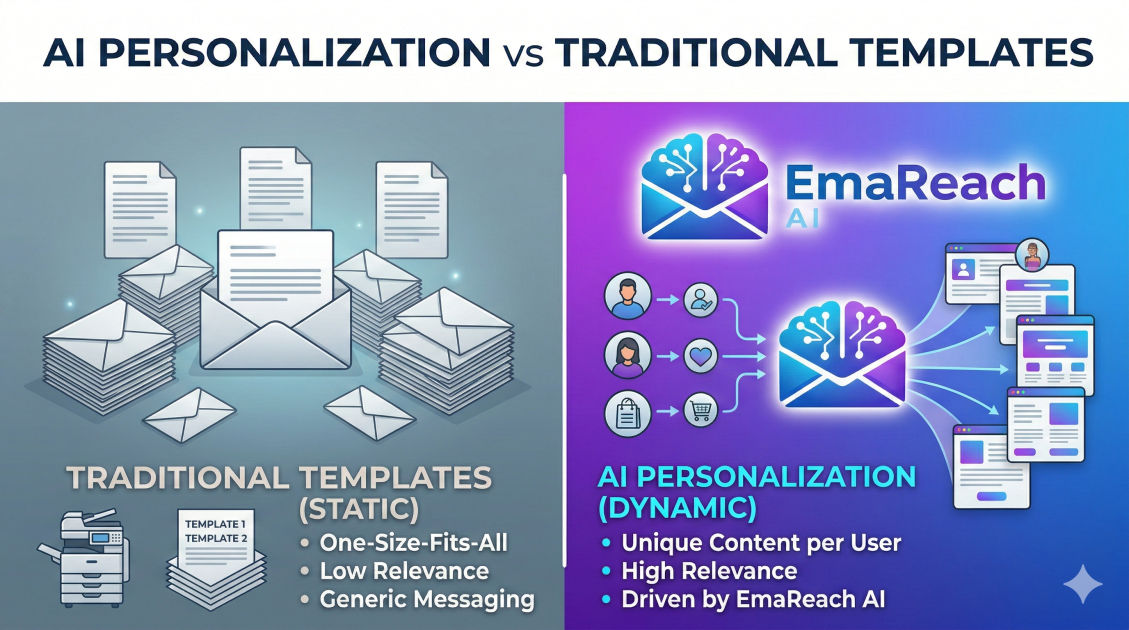
AI Personalization Software vs Traditional Templates
AI PersonalizationEmail MarketingCold OutreachMarketing AutomationSales TechnologyDigital CommunicationCustomer Engagement
Introduction
In the rapidly evolving landscape of digital communication, the battle for attention has never been more intense. For years, the gold standard for reaching a wide audience efficiently was the "template." Whether in cold email outreach, marketing automation, or customer service, templates provided a way to scale messaging without reinventing the wheel every time. However, as the digital space becomes increasingly crowded, the effectiveness of these rigid structures is plummeting.
Enter AI personalization software—a transformative technology that moves beyond simple placeholders like {{first_name}} to create unique, contextually aware, and highly relevant content for every individual recipient. This shift represents a fundamental change in how businesses interact with their prospects and customers. In this comprehensive guide, we will explore the deep-seated differences between AI personalization and traditional templates, analyzing why the former is becoming the new industry standard for high-growth organizations.
The Era of the Traditional Template
Traditional templates were born out of a need for efficiency. Before the advent of sophisticated automation, every piece of communication had to be written manually. Templates offered a middle ground: a pre-written structure with blank spaces for specific data points.
The Mechanics of Traditional Templates
At its core, a traditional template relies on static logic. You create a master document and use variables—often called "merge tags"—to pull information from a database.
- Standard Variables: First name, company name, job title, and perhaps a city.
- Static Body Text: The remaining 95% of the message remains identical for every recipient.
- Linear Execution: The flow of the message is fixed. If the template says "I saw your post about X," it will say that to everyone, regardless of whether they actually posted about X.
Why Templates are Failing Today
The primary issue with traditional templates is that they have become recognizable. Modern professionals receive dozens, if not hundreds, of automated emails daily. They have developed a "sixth sense" for spotting a template within seconds. When a recipient identifies a message as a mass-produced template, the perceived value of the interaction drops to zero. It signals that the sender did not value the recipient's time enough to do genuine research.
Furthermore, spam filters have become incredibly sophisticated. Large-scale providers can now detect when thousands of identical emails are being sent from a single domain. This often leads to messages being diverted to the promotions tab or, worse, the spam folder. This is where tools like EmaReach become vital, as they focus on ensuring that even personalized outreach maintains high deliverability through inbox warm-up and multi-account sending.
Understanding AI Personalization Software
AI personalization software is not just an "improved template." It is a complete paradigm shift. Instead of filling in the blanks, AI analyzes data points to generate entirely new sentences, paragraphs, and narratives tailored to the recipient's specific context.
Hyper-Personalization at Scale
While a human can research a prospect and write a personal note in 15 minutes, AI can do this in seconds across thousands of leads. AI personalization software leverages Large Language Models (LLMs) to scan LinkedIn profiles, recent news articles, company websites, and social media activity. It then synthesizes this information into a coherent message that sounds indistinguishable from a human-written email.
The Role of Contextual Relevance
The main differentiator is context. A template might say, "I see you work at [Company]." An AI will say, "I noticed that [Company] recently expanded into the European market, and I found your recent interview on the challenges of cross-border logistics particularly insightful." The latter demonstrates a level of research that builds immediate rapport and trust.
Deep Dive: Feature Comparison
To truly understand the gap between these two approaches, we must look at specific functional areas.
1. Research and Data Integration
Traditional Templates: They are limited to whatever is in your CRM or CSV file. If your data is outdated or missing a field, the template breaks or looks awkward (e.g., "Hi [First_Name]!").
AI Personalization: These tools perform "live" research. They can browse the web in real-time to find the most recent triggers. If a prospect just won an award or published a new whitepaper, the AI can incorporate that information immediately, ensuring the message is timely.
2. Tone and Style Adaptation
Traditional Templates: The tone is locked in. If your template is formal, it stays formal. If it's casual, it stays casual. This can be jarring if the recipient's brand voice is the polar opposite of your template's voice.
AI Personalization: AI can adapt its writing style based on the recipient's profile. If the target is a creative director at a startup, the AI can adopt a vibrant, energetic tone. If the target is a C-suite executive at a Fortune 500 firm, it can switch to a professional, high-level summary style.
3. Scalability vs. Quality
Traditional Templates: Scaling is easy, but quality remains low and constant. As you increase volume, your response rates typically decrease because the "template fatigue" sets in across your market.
AI Personalization: It breaks the inverse relationship between volume and quality. You can send 5,000 highly personalized emails that each feel like a 1-on-1 conversation. This leads to higher engagement rates even at significant scale.
The Impact on Conversion and Revenue
Statistics consistently show that personalized communication outperforms generic outreach by significant margins.
Higher Open Rates
Personalization starts with the subject line. AI can generate subject lines that reference specific pain points or recent achievements, making them far more clickable than "Quick question for [Name]."
Increased Reply Rates
When a prospect feels that you have done your homework, they are much more likely to respond, even if only to say "not interested right now." This opens the door for future follow-ups and keeps the relationship warm. Traditional templates often result in the "delete and block" treatment.
Shorter Sales Cycles
By addressing specific needs and demonstrating value from the very first touchpoint, AI personalization moves prospects through the funnel faster. You aren't wasting the first three emails trying to prove you're not a bot; you've already established credibility.
Technical Implementation: How AI Personalization Works
The workflow of modern AI personalization software typically involves four key stages:
- Ingestion: The software takes a list of leads (usually just names and LinkedIn URLs or domains).
- Scraping & Analysis: The AI crawls the web, looking for "hooks." These could be recent LinkedIn posts, podcast appearances, company funding rounds, or job openings.
- Synthesis: The AI uses a prompt framework to combine the user's value proposition with the gathered research. It ensures the transition between the personal hook and the pitch is seamless.
- Verification: Sophisticated systems have a built-in "human-in-the-loop" or secondary AI check to ensure the generated text makes sense and isn't hallucinating facts.
The Deliverability Factor
A critical yet overlooked advantage of AI personalization is its effect on email deliverability. Traditional templates create a "fingerprint." When an ESP (Email Service Provider) sees 500 identical emails leaving a server, it flags them as automated.
AI-generated emails are, by definition, unique. Because the sentence structure, word choice, and length vary for every single email, it is much harder for spam filters to identify the messages as part of a bulk campaign. This natural variance mimics human behavior.
To maximize this advantage, integrating these personalized snippets into a robust delivery system is essential. EmaReach specializes in this exact intersection, ensuring that the AI-written content actually reaches the primary inbox by utilizing multi-account sending and continuous inbox warm-up. This combination solves the two biggest hurdles in modern outreach: writing a good message and getting it seen.
When to Still Use Templates
While AI is superior for outbound growth and high-value relationship building, traditional templates still have a place in specific scenarios:
- Transactional Emails: Password resets, shipping confirmations, and receipts should be standardized for clarity and legal compliance.
- Internal Communications: Standard operating procedures or company-wide announcements often require a rigid format where personalization is unnecessary.
- Low-Stakes Mass Updates: If you are notifying 10,000 users about a temporary server maintenance, a template is sufficient.
However, for any activity where the goal is persuasion, conversion, or relationship building, the template is effectively dead.
Overcoming the Challenges of AI Personalization
It would be disingenuous to suggest that AI is a magic button without its own set of challenges. To succeed, businesses must be aware of the following:
Data Privacy
Using AI to scrape public data must be done ethically and in compliance with regulations like GDPR or CCPA. Leading AI personalization tools prioritize using publicly available data and ensure that the storage of this information is secure.
Hallucinations
AI can sometimes "hallucinate" or make up facts if it can't find clear information. This is why the best AI personalization software includes "confidence scores" or requires a quick manual review of the generated lines before they are sent.
The Learning Curve
Transitioning from a simple template-based CRM to an AI-driven outreach stack requires a change in mindset. Teams must learn how to craft "prompts" or "guidelines" for the AI rather than writing the actual emails. This shift from writing to "directing" is a new skill set for many marketers.
The Future of AI in Communication
We are moving toward a "segment of one." In the future, every piece of marketing collateral—not just emails, but landing pages, video messages, and ad copy—will be generated in real-time for the specific person viewing it.
AI personalization software is the first step in this journey. By moving away from the "spray and pray" mentality of traditional templates, businesses are returning to the roots of commerce: building genuine, 1-on-1 connections, just at a scale that was previously impossible.
Conclusion
The choice between AI personalization software and traditional templates is no longer a matter of preference; it is a matter of survival in a digital-first economy. Traditional templates, while efficient in their time, have become a signal of low effort and high automation, leading to diminished returns and deliverability issues.
AI personalization offers a way to reclaim the human element of communication. By leveraging real-time data and sophisticated language generation, it allows brands to speak to their audience with a level of relevance that was once reserved for high-touch, manual efforts. As competition grows and prospects become more discerning, the ability to deliver a message that feels truly personal will be the ultimate competitive advantage. For those looking to master the technical side of this transition, combining the power of AI content with a deliverability-focused platform like EmaReach represents the pinnacle of modern outreach strategy.
EmaReach AI
Ready to scale your cold email outreach?
Join thousands of teams using EmaReach AI for AI-powered campaigns, domain warmup, and 95%+ deliverability. Start free — no credit card required.
Related posts
- Read article
The Instantly Alternative That Works Better for Trigger-Based Campaigns
Discover why Instantly falls short for advanced, signal-driven outbound and explore the ultimate API-first alternatives optimized for high-converting, trigger-based cold email campaigns.
- Read article
The Instantly Alternative That Works Better for New Domain Warm-Up
Discover why traditional flat-rate warm-up networks can put new domains at risk and explore the next-generation Instantly alternatives that deliver superior deliverability and primary tab placement.