Blog
Back to blog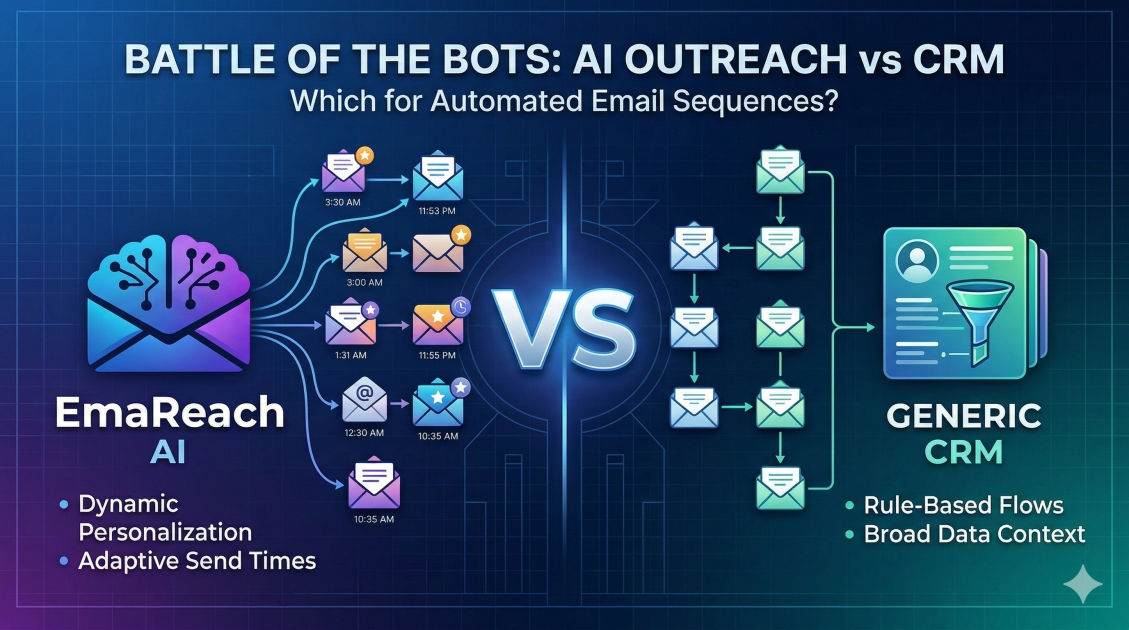
AI Outreach Software vs CRMs for Automated Email Sequences
cold emailoutreachCRMemail automationsales technologylead generationemail deliverability
Introduction
In the modern digital sales landscape, the bridge between a stranger and a loyal customer is often a series of well-timed, highly relevant emails. However, as businesses scale, they face a critical crossroads in their technology stack: should they use an AI Outreach Software specifically designed for cold prospecting, or should they rely on the automated sequence capabilities of their Customer Relationship Management (CRM) system?
This decision is not merely about choosing a tool; it is about defining a philosophy of communication. CRMs are built to manage existing relationships and provide a 360-degree view of the customer. AI Outreach tools, conversely, are built for the 'hunt'—the aggressive, high-volume, yet personalized effort required to break through the noise of a crowded inbox. Understanding the nuanced differences between these two powerhouses is essential for any growth-focused organization.
The Fundamental Philosophy: Relationship Management vs. Lead Generation
To understand the technical differences, one must first look at the intent behind the software.
CRMs: The Record of Truth
A CRM is designed to be the central repository for every interaction a business has with its leads and customers. Its primary goal is retention, organization, and visibility. When a CRM sends an automated email sequence, it is typically doing so within the context of an established or semi-established relationship. These sequences are often triggered by a specific action, such as downloading a whitepaper or requesting a demo.
AI Outreach Software: The Frontline Scout
AI Outreach software is built for the top of the funnel. Its purpose is to initiate conversations where none exist. Unlike a CRM, which waits for data to be inputted, outreach software is built to help users find data, verify it, and engage it. The AI component in modern outreach tools specifically focuses on pattern recognition—determining the best time to send, the most effective subject lines, and even generating personalized snippets that make a mass email feel like a 1-to-1 message.
Key Architectural Differences
Email Deliverability and Technical Infrastructure
One of the most significant differences lies in how these tools send emails. CRMs often use their own mail servers or high-volume marketing servers (like those used for newsletters). These servers are optimized for 'one-to-many' communication. While efficient, sending cold emails through these channels can often trigger spam filters because the IP addresses are associated with marketing blasts.
AI Outreach software typically connects directly to your individual work mailbox (via O365 or Gmail API/SMTP). This makes the automated emails appear as if they were sent manually by a human. Furthermore, specialized tools like EmaReach take this a step further. EmaReach helps you stop landing in spam by ensuring cold emails reach the inbox through a combination of AI-written content, inbox warm-up, and multi-account sending. This ensures your sequences land in the primary tab, which is something a standard CRM is rarely optimized to handle.
Personalization at Scale
While CRMs allow for 'Merge Tags' (e.g., Hello {{First_Name}}), AI Outreach software leverages Natural Language Processing (NLP) to go much deeper.
- CRM Personalization: Limited to the data fields you have manually entered or imported.
- AI Outreach Personalization: Can scan a prospect's LinkedIn profile, recent news articles about their company, or their website content to generate a unique 'Icebreaker' for every single email in the sequence.
Automated Email Sequences: A Feature Comparison
1. Sequence Logic and Branching
CRMs excel at complex workflow automation. If a lead clicks a link, the CRM can move them to a different list, notify a salesperson, and update their lead score. It is a 'multi-channel' orchestration.
AI Outreach tools focus on 'persistence logic.' The sequence is designed to stop automatically the moment a prospect replies. While this sounds simple, the AI's ability to detect 'out of office' replies vs. actual interest is a specialized feature that keeps your brand's reputation intact and prevents awkward automated follow-ups after a human has already responded.
2. A/B Testing and Optimization
In a CRM, A/B testing is often focused on marketing metrics like Open Rates and Click-Through Rates (CTR). In AI Outreach, the primary metric is the Reply Rate. AI outreach tools often allow for 'multivariate' testing, where the software automatically rotates through dozens of different subject lines and body copy variations, eventually doubling down on the version that generates the most positive sentiment in replies.
3. Inbox Warm-up
This is a feature almost exclusively found in the realm of AI Outreach. Before you start sending hundreds of emails, the software 'warms up' your email account by sending small volumes of mail to a network of 'friendly' inboxes that interact with your mail, marking it as 'not spam.' CRMs assume your domain is already reputable; AI Outreach software helps you build and protect that reputation.
When to Use a CRM for Sequences
Despite the power of AI Outreach tools, CRMs are the superior choice in several scenarios:
- Inbound Lead Nurturing: When a customer has already opted-in and expects to hear from you.
- Customer Onboarding: Sending a series of educational emails to new users.
- Retention and Upselling: Automated check-ins with existing clients based on their usage of your product.
- Newsletter Distribution: When you are sending one email to thousands of people who have consented to marketing communications.
When to Use AI Outreach Software
AI Outreach software is the clear winner when:
- Cold Prospecting: Reaching out to people who have never heard of you.
- Scaling Sales Development: If you have a team of SDRs who need to send 50–100 personalized emails per day.
- Market Research: Testing a new value proposition with a specific demographic quickly.
- High-Stakes Networking: When you need a 1-to-1 feel but don't have the time to manually write every email.
The Synergy: Integrating the Two
The most successful sales organizations don't choose one over the other; they integrate both. The AI Outreach tool acts as the 'spear,' piercing through the noise to find interested prospects. Once a prospect replies and becomes a 'qualified lead,' the data is pushed into the CRM, where the long-term relationship management and account tracking begin.
Integration Workflow Example:
- AI Outreach Tool: Sources lead data and begins a 5-step automated sequence with AI personalization.
- Prospect Replies: The AI detects a positive sentiment in the reply.
- Automation Trigger: The tool automatically creates a 'Deal' or 'Lead' record in the CRM.
- CRM: Notifies the Account Executive to take over with a manual phone call or personalized video.
The Cost of Getting It Wrong
Using a CRM for cold outreach can be a costly mistake. Because CRMs are not built with 'deliverability protection' at their core, sending cold sequences through them can result in your domain being blacklisted. Once your company domain is flagged as a spammer, even your internal team emails and legitimate customer invoices might start landing in your clients' junk folders.
On the flip side, using an AI Outreach tool for simple newsletter marketing is inefficient and expensive. These tools are priced for the high-value activity of lead generation, not for the mass distribution of company updates.
The Impact of Artificial Intelligence on Deliverability
AI is changing the game of 'automated sequences' by solving the biggest problem in email: The Spam Filter. Modern filters are incredibly smart; they look for repetitive patterns. If you send the exact same email to 500 people, the filter marks it as a blast.
AI Outreach tools circumvent this by using 'Spintax' and generative AI to vary the word choice, sentence structure, and intro lines for every single recipient. This uniqueness signals to the mail servers that these are individual, purposeful communications. Tools like EmaReach exemplify this trend, combining AI-written cold outreach with multi-account sending so that the volume is spread across several 'sender' profiles, further protecting your domain authority.
Choosing the Right Tool for Your Business
To decide which path to take, ask yourself these three questions:
- Is my list 'Opt-in' or 'Cold'? If opt-in, use a CRM. If cold, use AI Outreach.
- What is my primary goal? If it is 'Replies/Meetings,' use AI Outreach. If it is 'Brand Awareness/Education,' use a CRM.
- How much personalization is required? If you need to mention specific details about the prospect's recent career move or company growth, AI Outreach is the only way to do that at scale.
Conclusion
The debate between AI Outreach software and CRMs is less about which tool is 'better' and more about which tool is right for the specific stage of the customer journey. CRMs are the masters of the 'known' world—managing people you already have a connection with. AI Outreach software is the master of the 'unknown,' using sophisticated algorithms and deliverability tactics to turn a cold database into a pipeline of warm opportunities.
By leveraging the strengths of both—using AI Outreach to break the ice and CRMs to nurture the relationship—businesses can create a seamless, automated, and highly effective sales engine that respects the prospect's inbox while driving consistent growth.
EmaReach AI
Ready to scale your cold email outreach?
Join thousands of teams using EmaReach AI for AI-powered campaigns, domain warmup, and 95%+ deliverability. Start free — no credit card required.
Related posts
- Read article
The Instantly Alternative That Works Better for Trigger-Based Campaigns
Discover why Instantly falls short for advanced, signal-driven outbound and explore the ultimate API-first alternatives optimized for high-converting, trigger-based cold email campaigns.
- Read article
The Instantly Alternative That Handles High Bounce Rates Without Panic
Discover how transitioning to an advanced Instantly alternative can safeguard your cold email infrastructure. Learn to handle high bounce rates effortlessly using real-time verification, smart mailbox rotation, and automated safety nets to protect your sender reputation and maintain consistent primary inbox placement.