Blog
Back to blog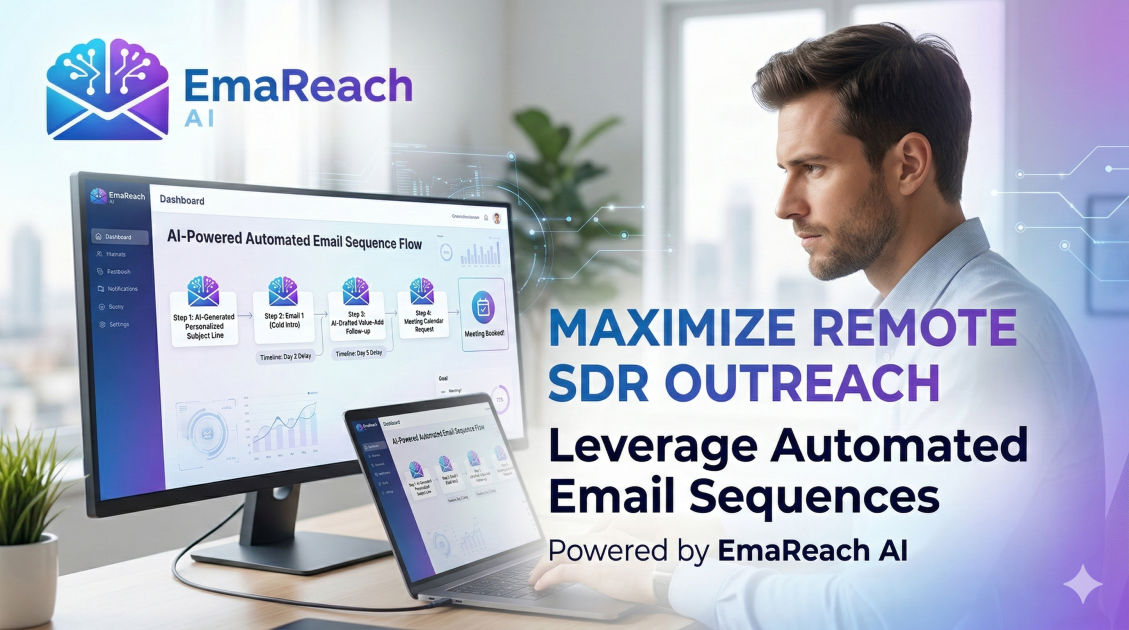
AI Outreach Software for Remote SDR Automated Email Sequences
AI Sales ToolsRemote SDRAutomated OutreachEmail DeliverabilityB2B Lead GenerationCold Email Strategy
The Evolution of the Remote Sales Development Representative
The landscape of B2B sales has undergone a fundamental shift. The traditional bullpen of Sales Development Representatives (SDRs) making high-volume cold calls has been replaced by a sophisticated, decentralized workforce. In this new era, the remote SDR relies on a digital-first approach where efficiency is not just an advantage—it is a survival requirement. At the heart of this transformation is AI outreach software, a technology that has redefined how automated email sequences are built, managed, and optimized.
For a remote SDR, the challenge is twofold: maintaining a high volume of activity while ensuring each interaction feels personal and relevant. Without the immediate feedback loop of a physical office, remote reps need tools that act as a force multiplier. AI-driven automation fills this gap by handling the heavy lifting of data analysis, personalization, and scheduling, allowing the human element of sales to focus on high-level strategy and closing.
Understanding AI Outreach Software in a Remote Context
AI outreach software is more than just a tool for sending emails; it is an intelligent layer that sits on top of the communication stack. For remote SDRs, these platforms provide the structure necessary to manage complex outbound campaigns across different time zones and industries. Unlike legacy automation tools that simply sent a 'blast' of identical messages, AI-powered systems use machine learning to adapt to recipient behavior.
The Core Components of AI Sequences
To understand why this software is essential for remote teams, we must look at its core functionalities:
- Natural Language Processing (NLP): This allows the software to understand the context of a prospect's LinkedIn profile, company website, or recent news. It then uses this data to write personalized opening lines that feel authentic.
- Predictive Analytics: AI can analyze historical data to determine the best time to send an email to a specific prospect, increasing the likelihood of it being seen at the top of the inbox.
- Automated Follow-ups: The software manages the cadence of follow-ups, ensuring that no prospect falls through the cracks, even when an SDR is managing hundreds of leads simultaneously.
- Sentiment Analysis: When a prospect replies, AI can categorize the response as 'interested,' 'not interested,' or 'out of office,' allowing the SDR to prioritize their manual tasks effectively.
Building the Perfect Automated Email Sequence
Creating an automated sequence is an art form backed by data. For a remote SDR, the goal is to create a multi-touch journey that guides a prospect from cold awareness to a booked meeting. A typical AI-enhanced sequence often follows a specific logic flow designed to maximize engagement.
Step 1: Research and Segmentation
Before a single email is sent, the AI software segments the lead list. Instead of treating all 'Marketing Directors' the same, the AI might segment them by company size, recent funding rounds, or specific technologies they use. This granular segmentation is the foundation of relevance.
Step 2: The Hyper-Personalized Opening
The first email in the sequence is the most critical. AI outreach software can scan a prospect's recent activity—such as a podcast appearance or a published article—and incorporate a specific reference into the first sentence. This immediately signals to the prospect that the email is not a generic template.
Step 3: The Value-Driven Follow-up
If the first email receives no response, the AI triggers a follow-up. Rather than just 'bumping' the thread, the software can suggest a different value proposition based on what has worked for similar prospects in the past. For example, if the prospect is at a high-growth startup, the follow-up might focus on scalability.
The Deliverability Crisis and How to Solve It
One of the biggest hurdles for remote SDRs is the increasing strictness of email providers. If an SDR sends too many emails or uses 'spammy' language, their domain reputation will suffer, and their messages will never see the light of day. This is where specialized infrastructure becomes vital.
To ensure success, many teams are turning to solutions like EmaReach. Their philosophy is simple: Stop Landing in Spam. Cold Emails That Reach the Inbox. By combining AI-written cold outreach with proactive inbox warm-up and multi-account sending, EmaReach AI ensures that your emails land in the primary tab and get replies. For a remote SDR working in a silo, having this level of technical deliverability support is the difference between a productive month and a complete silence.
Strategies for Remote SDR Success
Operating remotely requires a different set of habits and strategies when using AI software. To maximize the ROI of automated sequences, SDRs should focus on the following:
1. The 'Human-in-the-Loop' Model
While AI can write and send emails, the most successful remote SDRs use a 'human-in-the-loop' approach. This means they allow the AI to generate the drafts, but they perform a final 'vibe check' on high-value targets. This ensures that the brand voice remains consistent and that the AI hasn't hallucinated any facts.
2. Multi-Channel Synchronization
Modern outreach software doesn't stop at email. It integrates with LinkedIn, Twitter (X), and even phone systems. A remote SDR should build 'omnichannel' sequences. For instance, if a prospect opens an email three times but doesn't reply, the AI can automatically prompt the SDR to send a personalized LinkedIn connection request.
3. Continuous A/B Testing
AI thrives on data. Remote teams should constantly run A/B tests on subject lines, call-to-actions (CTAs), and sequence lengths. The software can automatically shift traffic toward the winning variant, ensuring that the SDR's effort is always concentrated on the most effective messaging.
Data Privacy and Ethical AI Outreach
As AI becomes more prevalent, the ethical implications of automated outreach come to the forefront. Remote SDRs must be cognizant of regulations like GDPR and CCPA. AI outreach software helps maintain compliance by managing opt-out lists across the entire organization and ensuring that data sourcing is handled within legal boundaries.
Furthermore, 'ethical' outreach means not overwhelming a prospect's inbox. AI can detect when a prospect is already being contacted by another member of the sales team, preventing the embarrassing 'double-tap' that can ruin a company's reputation.
Integrating AI Outreach into the Sales Stack
For a remote SDR, the AI outreach tool cannot exist in a vacuum. It must be seamlessly integrated with the CRM (Customer Relationship Management) system. When a prospect engages with an email sequence, that data should flow instantly into the CRM, updating the lead score and notifying the SDR.
Key Integrations to Consider:
- CRM (Salesforce, HubSpot): Keeps lead status in sync.
- Calendar Tools (Calendly, Chili Piper): Allows prospects to book meetings directly from the AI email.
- Data Enrichment (ZoomInfo, Apollo): Provides the AI with the raw data it needs to personalize messages.
- Video Tools (Loom, Vidyard): Enables the AI to include personalized video links in the sequence.
The Metrics That Matter for Remote SDRs
When using AI to power your outreach, the metrics you track should evolve. While 'open rates' are a common metric, they can be misleading due to privacy protections in email clients. Instead, remote SDRs should focus on:
- Positive Reply Rate: The percentage of prospects who respond with interest.
- Meeting Show Rate: Since AI can book meetings, tracking how many of those prospects actually show up is crucial for evaluating lead quality.
- Sequence Completion Rate: Identifying where prospects drop off in a 7-step sequence allows for targeted improvements.
- Reply-to-Meeting Conversion: How effectively the SDR handles the 'hand-off' from the AI-generated reply to a scheduled demo.
Overcoming the Challenges of Automation
Despite the power of AI, there are pitfalls to avoid. The 'uncanny valley' of sales—where an email sounds almost human but just 'off' enough to be creepy—is a real risk. Remote SDRs must ensure that the AI's personalization isn't too invasive. Mentioning a prospect's recent promotion is great; mentioning what they ate for lunch according to a social media post is probably too far.
Another challenge is 'automation fatigue.' If every SDR is using the same AI tools to write the same types of 'personalized' emails, the effectiveness of those tactics will diminish. Innovation in the sequence structure—such as using humor, localized references, or unique value propositions—remains the responsibility of the SDR.
The Future of Remote Outbound Sales
As we look toward the future of remote work, the role of the SDR will continue to become more strategic. We are moving away from the era of 'activity for activity's sake' and into an era of 'precision outreach.' AI software will soon be able to handle complex negotiations and initial discovery questions, leaving only the most nuanced human interactions to the SDR.
For the remote professional, mastering these tools is no longer optional. The ability to orchestrate an AI-powered engine that generates a steady stream of qualified pipeline from a home office is a superpower in the modern economy.
Conclusion
AI outreach software has fundamentally leveled the playing field for remote SDRs. By automating the repetitive, data-heavy tasks of sequence management and personalization, these tools allow sales professionals to do what they do best: build relationships and solve problems for their customers. The key to success lies in choosing the right infrastructure, maintaining a human touch, and constantly iterating based on data. As the technology continues to evolve, those who embrace the synergy between human intuition and machine efficiency will define the next generation of sales excellence.
By focusing on deliverability, hyper-personalization, and multi-channel integration, remote teams can ensure their message doesn't just get sent, but gets heard. In a world of digital noise, AI is the filter that helps the right message find the right person at exactly the right time.
EmaReach AI
Ready to scale your cold email outreach?
Join thousands of teams using EmaReach AI for AI-powered campaigns, domain warmup, and 95%+ deliverability. Start free — no credit card required.
Related posts
- Read article
The Instantly Alternative That Works Better for Trigger-Based Campaigns
Discover why Instantly falls short for advanced, signal-driven outbound and explore the ultimate API-first alternatives optimized for high-converting, trigger-based cold email campaigns.
- Read article
The Instantly Alternative That Handles High Bounce Rates Without Panic
Discover how transitioning to an advanced Instantly alternative can safeguard your cold email infrastructure. Learn to handle high bounce rates effortlessly using real-time verification, smart mailbox rotation, and automated safety nets to protect your sender reputation and maintain consistent primary inbox placement.