Blog
Back to blog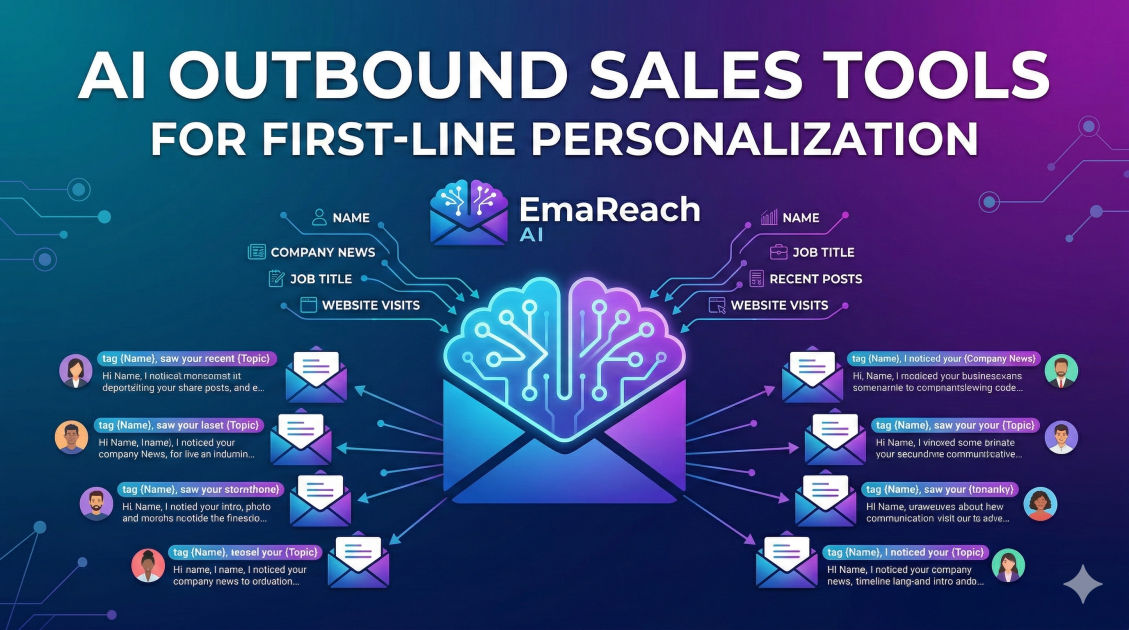
AI Outbound Sales Tools for First-Line Personalization
AI sales toolsoutbound salesfirst-line personalizationcold emailsales automationB2B sales strategy
The Revolution of First-Line Personalization in Outbound Sales
In the modern landscape of B2B sales, the 'spray and pray' method is no longer just ineffective—it is actively damaging to a brand's reputation. Prospects are inundated with hundreds of generic emails daily, leading to a psychological filter that instantly dismisses anything appearing automated. This is where AI outbound sales tools for first-line personalization have become the ultimate differentiator.
First-line personalization refers to the practice of crafting a unique, highly relevant opening sentence for a cold email or LinkedIn message. This sentence is typically based on a prospect’s recent activity, a podcast they appeared on, a specific achievement, or their company’s recent news. While doing this manually for 500 prospects would take a sales development representative (SDR) weeks, AI can now accomplish it in seconds with a level of nuance that mirrors human intuition.
Why First Lines Matter More Than the Pitch
The goal of an outbound message is not to close a deal in the first five seconds; it is to earn the right to the next thirty seconds of the reader's attention. If the first line feels robotic, the recipient never reaches the value proposition.
AI-powered personalization tools analyze vast amounts of unstructured data—LinkedIn profiles, company websites, Twitter feeds, and financial reports—to find a 'hook.' By starting an email with a genuine observation about the prospect, you demonstrate that you have done your homework. This builds immediate rapport and significantly lowers the recipient's natural defenses against sales pitches.
The Anatomy of an Effective AI-Generated First Line
Not all AI-generated lines are created equal. To be effective, an outbound sales tool must move beyond 'I see you work at [Company Name].' High-performing AI personalization follows these three principles:
- Relevance: The observation must be current and meaningful. Mentioning a promotion from three years ago feels outdated; mentioning a product launch from last week feels urgent.
- Specific Insight: The tool should identify why the observation matters. For example, instead of saying 'I saw your blog post,' the AI should say 'Your point about the shift toward decentralized cloud architecture in your recent blog really resonated with me.'
- The Smooth Bridge: A great first line should lead naturally into the 'reason for reach out.' If the first line is about a marathon the prospect ran and the second line is about cybersecurity software, the transition can feel jarring unless handled with finesse.
Key Categories of AI Outbound Personalization Tools
When exploring the market for these tools, it is helpful to categorize them based on their specific strengths and how they integrate into your sales stack.
1. Research-Focused AI Agents
These tools act as digital interns. They crawl the web for a specific prospect and return a dossier of facts. They don't just write the line; they provide the context. These are excellent for high-ticket enterprise sales where the SDR wants to maintain a high degree of manual control but needs the research automated.
2. Bulk Personalization Engines
These tools are designed for scale. You upload a CSV of LinkedIn URLs, and the AI generates five different opening line options for each. These are ideal for mid-market sales where volume and quality must strike a balance.
3. Integrated Sales Engagement Platforms
Some modern platforms have built-in AI layers. Instead of using a third-party tool to generate lines and then importing them, these platforms generate the personalization directly inside the email composer. This reduces 'tool fatigue' and keeps the workflow streamlined.
4. Deliverability-Centric AI Tools
Personalization isn't just about psychology; it's about technical delivery. Unique content in every email helps bypass spam filters that look for identical templates sent in bulk. For businesses looking to master this, EmaReach is a powerful ally. It allows you to stop landing in spam by providing cold emails that reach the inbox through a combination of AI-written outreach, inbox warm-up, and multi-account sending, ensuring your personalized lines actually get seen in the primary tab.
Data Sources: Where AI Finds Personalization Gold
To write a compelling first line, AI tools scan specific 'data signals.' Understanding these can help you prompt your AI tools better:
- LinkedIn 'About' Sections: This is where prospects describe their philosophy and goals. AI can extract a specific phrase and turn it into a compliment or a question.
- Podcast Appearances: Modern AI tools can 'listen' to transcripts of podcasts featuring your prospect and pull out a specific quote or takeaway.
- Company Financial Reports (10-Ks): For enterprise sales, mentioning a specific 'Risk Factor' or 'Growth Strategy' mentioned in a financial filing shows an incredible level of dedication.
- Social Media Activity: Recent posts or comments provide 'low-hanging fruit' for personalization that feels conversational and timely.
Step-by-Step Guide to Implementing AI Personalization
Implementing these tools requires more than just a subscription; it requires a process.
Phase 1: Data Cleaning
AI is only as good as the data it receives. If your CRM has 'Google Inc.' instead of 'Google,' the AI might write a line that feels slightly 'off.' Ensure your lead lists are cleaned and company names are normalized before running them through a personalization engine.
Phase 2: Defining the Persona and Tone
You must instruct the AI on the tone of your brand. Are you a cheeky startup or a formal consultancy? Setting the 'temperature' and style of the AI ensures the generated lines don't clash with the rest of your email body.
Phase 3: The Human-in-the-Loop Review
While AI has come a long way, it can still hallucinate or misunderstand sarcasm. A brief 'sanity check' by an SDR before hitting send can prevent embarrassing mistakes. Most top-tier tools offer a rapid-review interface where a human can approve or regenerate lines at high speed.
Phase 4: Measuring Results
Track your 'Open-to-Reply' ratio. Traditional metrics like 'Open Rate' often reflect the subject line, but the 'Reply Rate' is the true indicator of how well your first-line personalization is resonating with the audience.
Overcoming Common Challenges in AI Personalization
The 'Creepy' Factor
There is a fine line between 'well-researched' and 'stalker-ish.' Mentioning a prospect's child or a very personal Facebook post from ten years ago is a mistake. Professional AI outbound tools are usually programmed to stay within professional boundaries, focusing on career-related data.
Scaling Without Losing Soul
As you scale, there is a temptation to let the AI do everything. However, the most successful campaigns use AI to handle the labor of research while the humans handle the strategy. Use AI to find the fact, but ensure the structure of your outreach remains human-centric.
Integration with the Tech Stack
A common hurdle is getting the AI-generated lines into your sending tool. Look for tools that offer robust API connections or native integrations with CRM systems. This ensures that the personalized data flows seamlessly into your sequences without manual copy-pasting.
Future Trends in AI Sales Personalization
We are moving toward a world of 'Hyper-Contextualization.' Future AI tools won't just look at a LinkedIn profile; they will look at the intersection of the prospect’s needs and current market trends.
Imagine an AI that sees a prospect just hired three new DevOps engineers and simultaneously notices a security vulnerability trend in their industry. The first line won't just be a compliment; it will be a high-value observation that positions the salesperson as a consultant from the very first sentence.
Furthermore, we are seeing the rise of multi-modal personalization. AI tools are beginning to generate personalized images or short video scripts based on the same research used for text-based first lines. This multi-channel approach ensures that your personalized outreach stands out regardless of where the prospect sees it.
The Role of AI in Email Deliverability
It's a little-known fact that personalization is a key factor in email deliverability. Internet Service Providers (ISPs) use sophisticated algorithms to detect bulk mailing. If you send 1,000 emails that are 99% identical, you are likely to be flagged as a spammer.
By using AI to generate a unique first line for every single email, you ensure that every outgoing message is a unique 'hash.' This variability is a strong signal to ISPs that you are sending one-to-one, legitimate business communications. This technical benefit is just as important as the psychological benefit of personalization. Tools like EmaReach emphasize this by combining AI-written content with technical features like multi-account sending to ensure your high-quality, personalized content actually reaches its destination.
Conclusion: The New Standard for Sales
AI outbound sales tools for first-line personalization are no longer a luxury for elite sales teams; they are becoming the standard. In a world of infinite noise, the only way to be heard is to be relevant. By leveraging AI to do the heavy lifting of research and creative writing, sales teams can return to what they do best: building relationships and solving problems for their customers. The transition from generic templates to AI-enhanced, personalized conversations is the most significant leap in sales productivity of this decade. Embracing these tools today is the key to maintaining a competitive edge and ensuring your messages aren't just sent, but are read and responded to.
EmaReach AI
Ready to scale your cold email outreach?
Join thousands of teams using EmaReach AI for AI-powered campaigns, domain warmup, and 95%+ deliverability. Start free — no credit card required.
Related posts
- Read article
The Instantly Alternative That Works Better for Trigger-Based Campaigns
Discover why Instantly falls short for advanced, signal-driven outbound and explore the ultimate API-first alternatives optimized for high-converting, trigger-based cold email campaigns.
- Read article
Beyond Instantly: The Cold Email Platforms Worth Taking Seriously
Discover the top advanced cold email platforms that go beyond basic multi-inbox rotation. Learn how to optimize your technical infrastructure, leverage advanced personalization, and scale your B2B sales pipeline safely without landing in the spam folder.