Blog
Back to blog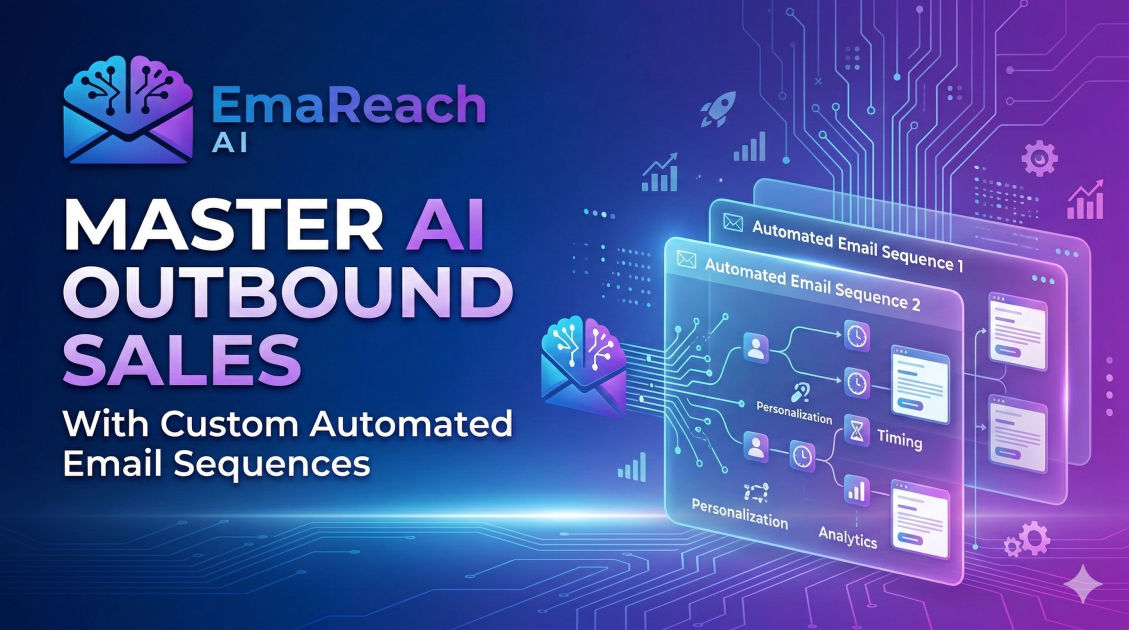
AI Outbound Sales Tools for Custom Automated Email Sequences
AI Sales ToolsOutbound SalesEmail AutomationCold OutreachSales TechnologyLead GenerationEmail Deliverability
The Revolution of AI in Outbound Sales
Outbound sales has undergone a fundamental transformation. Gone are the days of manual 'spray and pray' tactics where sales development representatives (SDRs) spent hours crafting individual emails or, worse, sending generic templates to thousands of uninterested prospects. The emergence of Artificial Intelligence (AI) has introduced a new era of precision, scale, and personalization.
AI outbound sales tools are no longer just a luxury; they are a necessity for teams looking to remain competitive. These tools leverage machine learning, natural language processing (NLP), and large language models (LLMs) to automate the most tedious parts of the sales funnel while maintaining—and often exceeding—the quality of human-written communication. By integrating AI into custom automated email sequences, businesses can reach more prospects with messages that feel uniquely tailored to each recipient.
Understanding Custom Automated Email Sequences
A custom automated email sequence is a series of pre-scheduled messages sent to a prospect based on specific triggers or intervals. Traditionally, these were static. However, with AI, these sequences become dynamic. They can adapt based on a prospect’s industry, recent news, job title, or even their engagement with previous emails.
The Core Components of AI-Driven Sequences
- Data Enrichment: AI tools scan the web to find verified contact information and deep insights about a prospect.
- Hyper-Personalization: AI generates unique opening lines or snippets based on the prospect's LinkedIn profile or company website.
- Smart Scheduling: Algorithms determine the best time to send an email to maximize open rates.
- Automated Follow-ups: AI handles the persistence required in sales, nudging prospects who haven't replied with contextually relevant messages.
Key Features of Top AI Outbound Sales Tools
When evaluating AI tools for your outbound strategy, it is essential to look for features that go beyond simple automation. The goal is to build a bridge between efficiency and authenticity.
Generative AI for Copywriting
One of the most powerful features of modern tools is the ability to write copy that doesn't sound like a machine. By using advanced LLMs, these tools can analyze your value proposition and the prospect's pain points to weave together a compelling narrative. This reduces the time spent on drafting and allows for rapid A/B testing of different messaging angles.
Intent Recognition and Lead Scoring
Not all prospects are created equal. AI tools can analyze intent signals—such as someone visiting your pricing page or a company receiving a new round of funding—to prioritize who should enter a sequence first. Lead scoring ensures that your most sophisticated automated sequences are directed at the leads most likely to convert.
Deliverability and Inbox Health
An automated sequence is useless if it lands in the spam folder. High-end AI tools include features for domain warm-up and deliverability monitoring. This is where specialized platforms like EmaReach shine. EmaReach: Stop Landing in Spam. Cold Emails That Reach the Inbox. By combining AI-written cold outreach with inbox warm-up and multi-account sending, EmaReach ensures your emails land in the primary tab and get replies, effectively safeguarding your sender reputation while scaling your volume.
How to Build an AI-Powered Outbound Workflow
Transitioning to an AI-powered workflow requires a strategic approach. It isn't just about turning on a tool; it's about orchestrating a system.
Step 1: Defining Your Ideal Customer Profile (ICP)
Before deploying AI, you must tell it who to look for. Use AI to analyze your existing successful customers and identify common traits. This data forms the 'brain' of your outbound engine.
Step 2: Sourcing and Cleaning Data
Use AI-driven prospecting tools to build your list. These tools can filter by technology stack, hiring trends, and specific keywords in job descriptions. Once the list is built, AI verification tools ensure that email addresses are valid, preventing hard bounces that damage your domain health.
Step 3: Crafting the Variable Logic
Instead of one static template, create a structure with 'variable hooks.' For example:
- Hook 1: A mention of a recent podcast the prospect appeared on.
- Hook 2: A comment on a specific challenge their industry is facing.
- Hook 3: A reference to a mutual connection or shared technology.
AI fills these variables in real-time for every single recipient in the sequence.
Step 4: Setting Up the Sequence Logic
A typical AI sequence might look like this:
- Day 1: Highly personalized introductory email.
- Day 3: Follow-up adding a specific piece of value (like a case study relevant to their niche).
- Day 7: Multi-channel touchpoint (e.g., an automated LinkedIn connection request).
- Day 12: The 'break-up' or 'circle back' email.
The Role of Sentiment Analysis in Automation
One of the most sophisticated applications of AI in outbound sales is sentiment analysis. When a prospect replies, AI can categorize the response: Is it a 'not interested,' a 'check back in six months,' or a 'let's book a call'?
Based on this analysis, the tool can automatically pause the sequence, move the prospect to a long-term nurture track, or notify a sales rep to take immediate action. This prevents the embarrassing mistake of sending an automated follow-up to someone who has already said they want to talk.
Overcoming the Challenges of Automated Outreach
While AI offers immense power, it also presents challenges that sales leaders must navigate carefully.
Maintaining Brand Voice
There is a risk that AI-generated content can feel disjointed from your brand’s actual voice. To combat this, ensure your AI tools are trained on your existing successful collateral. Most advanced tools allow you to upload 'brand guidelines' or past winning emails to serve as a stylistic North Star.
Avoiding the 'Uncanny Valley'
Sometimes AI can be too specific in a way that feels creepy. For example, mentioning a very personal detail from a social media post might put a prospect on edge. The key is to keep personalization professional and relevant to the business context.
Scaling Without Sacrificing Quality
As it becomes easier to send thousands of emails, the temptation to focus on quantity over quality increases. However, the market responds to quality. AI should be used to make your best quality outreach scalable, not to make your mediocre outreach more frequent.
Integrating Multi-Channel Outreach
Custom automated sequences shouldn't be limited to email. The most effective AI outbound tools integrate with LinkedIn, Twitter (X), and even direct mail.
By syncing these channels, your AI can ensure that if a prospect engages with a LinkedIn post, the next email in the sequence acknowledges that interaction. This 'omni-channel' approach creates a cohesive brand experience that builds trust much faster than a single-channel approach.
Technical Considerations for Scaling
When scaling your sequences, technical infrastructure is paramount. This includes:
- SPF, DKIM, and DMARC: Ensuring your DNS records are correctly configured to authenticate your emails.
- Subdomain Strategy: Using secondary domains for outbound to protect your primary corporate domain.
- Rotation of Senders: Spreading the volume across multiple email accounts to stay within provider limits.
Tools that manage these technical hurdles automatically allow sales teams to focus on strategy rather than IT troubleshooting.
The Future of AI Outbound Tools
Looking ahead, we can expect AI to become even more predictive. Imagine a tool that doesn't just write an email, but predicts the exact objection a prospect will have and addresses it proactively in the first touchpoint. We are also seeing the rise of 'Autonomous Sales Agents'—AI entities that can research, reach out, and book meetings entirely on their own, only involving a human for the actual closing call.
Furthermore, the integration of video AI is becoming more prevalent. Automated sequences can now include personalized video messages where the AI generates a screen share of the prospect's website while a synthetic (yet incredibly realistic) voice explains the value proposition.
Measuring the Success of Your AI Sequences
To optimize your tools, you must track the right metrics. Beyond open and click rates, focus on:
- Positive Reply Rate: The percentage of replies that lead to a meeting or further interest.
- Meeting Conversion Rate: How many of those replies actually end up on the calendar.
- Revenue per Sequence: The total value of deals closed originating from a specific automated flow.
AI tools provide the dashboards necessary to drill down into these numbers, allowing you to iterate on your messaging in real-time. If one 'hook' isn't performing, you can swap it out across all active sequences instantly.
Conclusion
AI outbound sales tools have redefined the boundaries of what is possible in business development. By combining the scale of automation with the nuance of human-like personalization, these tools allow sales teams to build meaningful connections at an unprecedented pace. Implementing a custom automated email sequence powered by AI is no longer a futuristic concept—it is the standard for any organization serious about growth. Whether it is through hyper-personalized copywriting, intelligent lead scoring, or ensuring high deliverability with platforms like EmaReach, the fusion of AI and outbound sales is the ultimate engine for modern revenue generation.
EmaReach AI
Ready to scale your cold email outreach?
Join thousands of teams using EmaReach AI for AI-powered campaigns, domain warmup, and 95%+ deliverability. Start free — no credit card required.
Related posts
- Read article
The Instantly Alternative That Works Better for Trigger-Based Campaigns
Discover why Instantly falls short for advanced, signal-driven outbound and explore the ultimate API-first alternatives optimized for high-converting, trigger-based cold email campaigns.
- Read article
The Instantly Alternative That Handles High Bounce Rates Without Panic
Discover how transitioning to an advanced Instantly alternative can safeguard your cold email infrastructure. Learn to handle high bounce rates effortlessly using real-time verification, smart mailbox rotation, and automated safety nets to protect your sender reputation and maintain consistent primary inbox placement.