Blog
Back to blog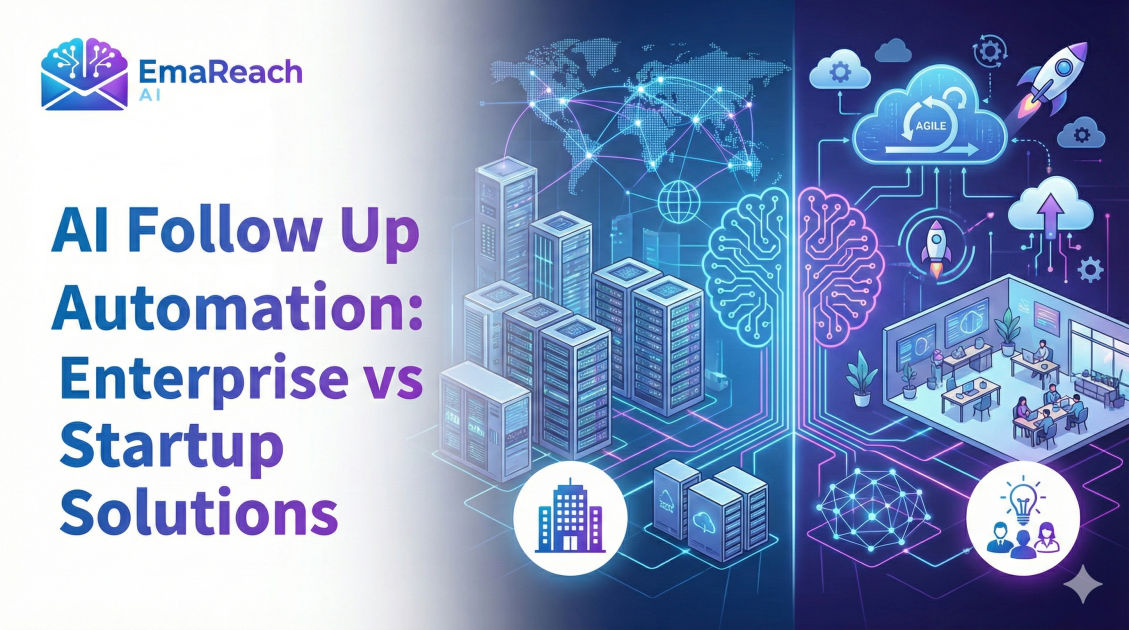
AI Follow Up Automation: Enterprise vs Startup Solutions
AI AutomationSales OutreachEnterprise SoftwareStartup GrowthEmail DeliverabilityLead ManagementB2B Sales
Introduction
In the modern sales landscape, the fortune is truly in the follow-up. Statistics consistently show that it takes multiple touchpoints to convert a lead into a customer, yet a staggering number of opportunities fall through the cracks due to human fatigue or simple oversight. Enter Artificial Intelligence (AI). AI follow-up automation has moved from a futuristic luxury to a fundamental necessity for businesses of all sizes. However, the way a lean startup utilizes AI for follow-ups differs vastly from how a global enterprise scales its outreach.
While the core objective—driving engagement and closing deals—remains the same, the constraints, data environments, and technical requirements vary significantly. Startups value speed, flexibility, and cost-effectiveness. Enterprises prioritize security, integration, and brand consistency. This article explores the nuances of AI follow-up automation, comparing the approaches and solutions tailored for these two distinct business stages.
The Evolution of the Follow-Up
Historically, following up was a manual, repetitive task. Sales representatives would spend hours drafting emails, leaving voicemails, and setting calendar reminders. Then came basic automation: drip campaigns that sent the same generic message to everyone on a list at set intervals. While efficient, these lacked the personal touch required to build genuine rapport.
AI has revolutionized this process by introducing contextual intelligence. Instead of just sending an email on 'Day 3,' AI analyzes the lead's previous interactions, their company profile, and even the sentiment of their last reply to generate a response that feels human. For companies looking to ensure these AI-driven messages actually reach their destination, services like EmaReach help users stop landing in spam by combining AI-written cold outreach with inbox warm-up, ensuring emails land in the primary tab.
Startup Solutions: Agility and Hyper-Personalization
For a startup, every lead is precious. With limited resources and a small sales team (often consisting of the founders themselves), startups need AI that acts as a force multiplier.
Speed to Lead
Startups thrive on speed. AI follow-up tools for startups are designed for rapid deployment. These solutions often focus on 'Speed to Lead,' automatically responding to inquiries within seconds. Because startups are often in the process of finding product-market fit, their AI tools need to be easily tweakable to test different messaging angles on the fly.
Lean Tech Stacks
Startup-focused AI tools usually offer 'all-in-one' functionality. They might combine a CRM, an email sequencer, and an AI writer in a single interface. This reduces the overhead of managing multiple subscriptions and ensures that the AI has access to all lead data without complex API integrations.
Creative Autonomy
In a startup environment, there is more room for experimentation. AI can be used to generate bold, creative follow-ups that might be too 'risky' for a corporate brand. This allows startups to stand out in a crowded inbox by leveraging AI to research a prospect’s recent social media activity or a podcast they appeared on, weaving those details into the follow-up automatically.
Enterprise Solutions: Security, Scale, and Governance
Large-scale enterprises face a different set of challenges. When you have thousands of sales reps and millions of customers, the primary concerns shift toward risk management and system harmony.
Robust Integration
Enterprises rarely buy 'all-in-one' tools. They have established ecosystems—Salesforce, SAP, Microsoft Dynamics—and any AI follow-up solution must integrate seamlessly into these workflows. Enterprise AI doesn't just send emails; it updates records, triggers task assignments for other departments, and syncs with complex lead-scoring models.
Brand Safety and Compliance
An enterprise cannot afford a 'hallucinating' AI that makes unauthorized promises or uses off-brand language. Enterprise-grade AI follow-up solutions include rigorous guardrails. This includes 'Human-in-the-loop' (HITL) features where the AI drafts the follow-up, but a human must approve it before it is sent. Furthermore, these tools must comply with global data privacy regulations like GDPR and CCPA, offering enterprise-level encryption and data residency options.
Advanced Analytics and Attribution
While a startup might look at open rates, an enterprise needs to see how AI follow-ups impact the entire lifecycle. Enterprise solutions provide deep-dive analytics into sentiment trends across different regions, the performance of AI vs. human-written drafts, and precise ROI calculations that account for long, multi-stakeholder sales cycles.
Key Functional Differences
To better understand the divide, we can look at specific functionalities within the AI follow-up ecosystem.
| Feature | Startup Approach | Enterprise Approach |
|---|---|---|
| Data Sources | Social media, website forms, manual entry. | CRM, Data Lakes, ERP, Legacy systems. |
| Customization | High individual flexibility for the user. | Standardized templates with dynamic AI variables. |
| Scalability | Scaling from 10 to 1,000 leads/month. | Scaling from 10,000 to 1,000,000+ leads/month. |
| Onboarding | Self-serve, immediate start. | Custom implementation, security audits, training. |
| Cost Model | Per-user seats or tiered monthly plans. | Annual contracts, volume-based pricing, custom SLAs. |
The Role of Large Language Models (LLMs)
Both startups and enterprises leverage LLMs like GPT or Claude, but their implementation differs. Startups often use these models 'out of the box' through third-party apps. Enterprises, however, are increasingly moving toward Private LLMs or 'Fine-Tuned' models. By training an AI on their own successful historical sales data, an enterprise creates a follow-up engine that perfectly mimics their top-performing reps while keeping sensitive data within their own firewall.
Strategic Implementation: How to Choose
Choosing the right path depends on your current infrastructure and future growth projections.
When to Choose Startup-Oriented Solutions
- You need to be up and running within 24 hours.
- Your sales process is still evolving and needs frequent changes.
- You have a small team where everyone wears multiple hats.
- You prioritize 'scrappiness' and high-velocity testing over rigid process.
When to Move to Enterprise-Grade Solutions
- You have strict legal and compliance requirements.
- Your lead volume is so high that manual oversight is impossible without structured automation.
- You need the AI to 'speak' to a complex internal tech stack.
- You require dedicated support and a Service Level Agreement (SLA) for uptime and performance.
Overcoming the 'Spam' Hurdle
Regardless of company size, the biggest threat to AI follow-up automation is the spam filter. As AI makes it easier to send more emails, email providers have become more sophisticated in blocking automated outreach. This is where deliverability becomes the core of the strategy.
Sophisticated users know that sending volume must be balanced with reputation management. For those engaging in high-volume cold outreach, utilizing a platform like EmaReach ensures that AI-written emails actually reach the primary tab. By focusing on multi-account sending and inbox warm-up, businesses can ensure their automated follow-ups don't just exist in a vacuum but actually get seen and replied to.
The Importance of Multi-Channel Follow-Up
Modern AI follow-up isn't limited to email. The most effective strategies utilize a multi-channel approach, orchestrated by AI.
- Email: The primary channel for formal business communication.
- LinkedIn/Social: AI can track when a prospect posts or changes jobs, triggering a timely follow-up.
- SMS: High-urgency follow-ups, particularly for B2C or high-touch B2B services.
- Voice: AI-generated 'voice clones' or intelligent dialers that assist reps in navigating phone trees.
Startups might use a simple tool to sync LinkedIn and Email. Enterprises use sophisticated 'Sequencing Engines' that decide the best channel based on where the prospect is most active.
Future Trends in AI Follow-Up
As we look forward, several trends are set to define the next era of automation:
Hyper-Contextualization through 'Intent' Data
Instead of following up because time has passed, AI will follow up because it detected 'intent.' If a prospect revisits your pricing page or downloads a whitepaper, the AI will immediately craft a follow-up that references that specific behavior, providing value exactly when the prospect is thinking about the solution.
Visual and Video Follow-Ups
We are seeing the rise of AI-generated video follow-ups. A rep can record one video, and the AI will dynamically change the audio and background for each prospect, saying their name and mentioning their company. This level of personalization at scale was previously impossible.
Autonomous Sales Agents
We are moving from 'tools' to 'agents.' Instead of a human setting up a sequence, they will give the AI an objective: 'Book 10 meetings with CTOs in the fintech space.' The AI will then identify the leads, conduct the initial outreach, and handle all the follow-ups autonomously until a meeting is booked.
Ethical Considerations and the Human Touch
With great power comes great responsibility. The goal of AI follow-up is to enhance human relationships, not replace them. There is a 'uncanny valley' of automation where a message feels just 'fake' enough to be off-putting. The most successful implementations—whether in a 5-person startup or a Fortune 500 company—are those that use AI to handle the administrative burden of follow-ups so that when a human does jump in, they have the time and energy to be truly present and helpful.
Transparency is also becoming a key factor. In some industries, disclosing that an AI assisted in the communication is becoming a standard practice, building trust through honesty rather than trying to 'trick' the recipient.
Conclusion
AI follow-up automation is no longer a choice; it is a competitive requirement. For startups, it provides the agility to compete with the giants. For enterprises, it provides the scale and consistency needed to manage global operations. By understanding the specific needs of your organization—be it the rapid-fire experimentation of a new venture or the structured, secure environment of a corporation—you can implement an AI strategy that ensures no lead is ever forgotten and every conversation has the potential to become a lasting partnership.
EmaReach AI
Ready to scale your cold email outreach?
Join thousands of teams using EmaReach AI for AI-powered campaigns, domain warmup, and 95%+ deliverability. Start free — no credit card required.
Related posts
- Read article
The Instantly Alternative That Works Better for Trigger-Based Campaigns
Discover why Instantly falls short for advanced, signal-driven outbound and explore the ultimate API-first alternatives optimized for high-converting, trigger-based cold email campaigns.
- Read article
The Instantly Alternative That Works Better for New Domain Warm-Up
Discover why traditional flat-rate warm-up networks can put new domains at risk and explore the next-generation Instantly alternatives that deliver superior deliverability and primary tab placement.