Blog
Back to blog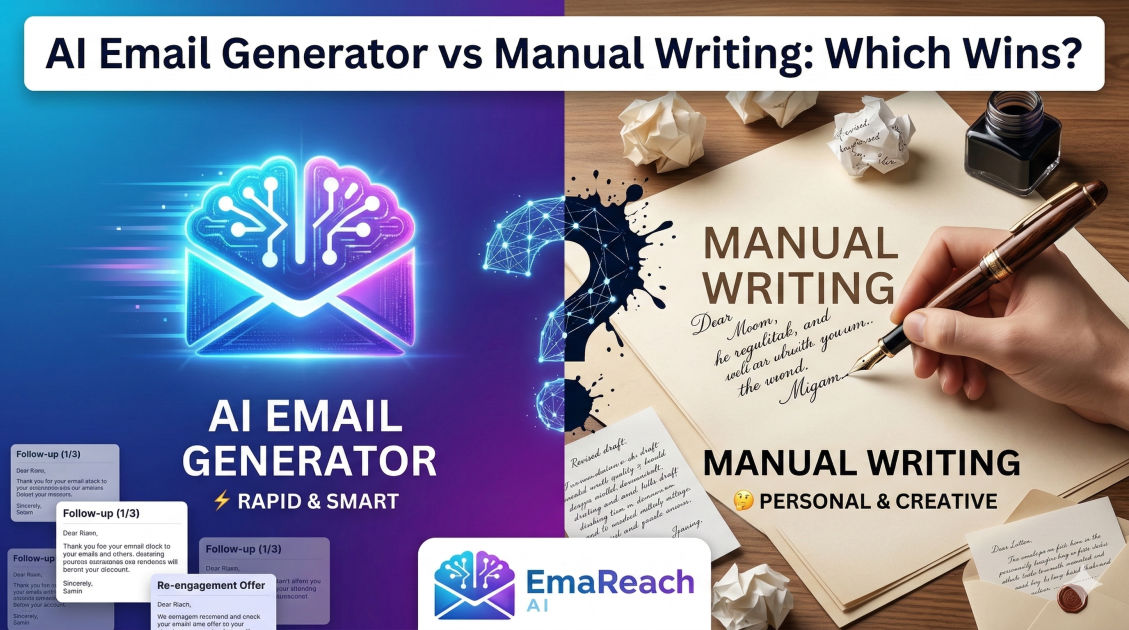
AI Email Generator vs Manual Writing: Which Wins?
cold emailemail marketingartificial intelligencesales outreachproductivitycopywritingemail deliverability
Introduction
In the modern digital landscape, the inbox has become a battlefield. Whether you are a salesperson trying to hit a quota, a marketer launching a new campaign, or a professional trying to manage a growing list of daily correspondence, the method you choose to craft your messages matters. For decades, manual writing was the only path—a process rooted in human psychology, nuance, and personal touch. However, the rise of artificial intelligence has introduced a formidable challenger: the AI email generator.
This shift has sparked a significant debate among professionals. Is the speed and efficiency of AI enough to replace the soulful, deliberate nature of manual composition? Or does the human element provide a critical advantage that algorithms simply cannot replicate? To determine which approach truly wins, we must look beyond surface-level convenience and examine the impact on deliverability, engagement, and long-term relationship building.
The Art of Manual Writing: Why Humans Still Matter
Manual writing is more than just typing words on a screen; it is an exercise in empathy. When a human writes an email, they are intuitively processing years of social context, subtle cues, and specific knowledge about the recipient.
The Power of Hyper-Personalization
While AI can insert a recipient's name or company, manual writing allows for hyper-personalization. This involves referencing a specific point from a recent podcast the recipient hosted, a mutual connection's recent success, or a shared experience at a niche industry event. This level of detail signals to the recipient that the sender has invested real time and effort, which naturally builds trust.
Emotional Intelligence and Tone
Humans excel at navigating complex emotional landscapes. If you are responding to a delicate customer complaint or reaching out to a high-value prospect during a challenging time for their industry, the tone must be perfect. Manual writing allows for the subtle adjustment of syntax and word choice to convey sincerity, urgency, or professional warmth in a way that feels authentic rather than generated.
The Creative Edge
Manual writing often leads to creative breakthroughs. A human might use a quirky metaphor, a self-deprecating joke, or a unique storytelling angle that an AI—trained on patterns of existing data—might find too "statistically improbable" to suggest. These creative risks are often what make an email stand out in a crowded inbox.
The Rise of the AI Email Generator: Efficiency at Scale
On the other side of the spectrum, AI email generators have revolutionized the concept of productivity. The primary argument for AI is simple: time is money. Writing twenty high-quality, personalized emails manually can take an entire afternoon. An AI can generate hundreds in seconds.
Overcoming Writer's Block
One of the greatest hurdles in manual writing is the blank page. AI serves as a powerful "starting engine." By providing a few prompts regarding the goal of the email and the target audience, a user can generate several drafts instantly. Even if the user edits the final version, the time saved in the ideation phase is astronomical.
Consistency and Volume
For large-scale outreach, manual writing is physically impossible to sustain. AI ensures that the quality of the tenth email is just as consistent as the first. It follows structured frameworks—like the Problem-Agitate-Solve (PAS) or Attention-Interest-Desire-Action (AIDA) models—with mathematical precision, ensuring that every message hits the necessary psychological triggers for conversion.
Data-Driven Optimization
Advanced AI tools don't just write; they learn. They can analyze which subject lines have higher open rates and which calls-to-action generate more clicks across millions of data points. This allows the AI to suggest language that is statistically more likely to perform, something a manual writer can only guess at through trial and error.
The Critical Factor: Deliverability and the Spam Trap
A beautiful email is worthless if it never reaches the recipient. This is where the battle between AI and manual writing gets technical. ESPs (Email Service Providers) have become incredibly sophisticated at detecting patterns.
If you use a basic AI generator to blast out thousands of identical messages, you will likely trigger spam filters. However, manual writing is too slow to scale. The solution lies in a hybrid approach. For those focused on cold outreach, tools like EmaReach bridge the gap. Stop Landing in Spam. Cold Emails That Reach the Inbox. EmaReach AI combines AI-written cold outreach with inbox warm-up and multi-account sending—so your emails land in the primary tab and get replies. By automating the technical delivery side while utilizing AI to vary the content, you get the best of both worlds.
Comparative Analysis: Speed vs. Quality
To truly understand which method wins, we need to compare them across several key performance indicators.
| Feature | Manual Writing | AI Email Generator |
|---|---|---|
| Creation Speed | Slow (10-30 mins per email) | Instant (Seconds) |
| Personalization | Deep and Nuanced | Scalable and Pattern-based |
| Emotional Depth | High | Moderate to Low |
| Scalability | Non-existent | Infinite |
| Grammar/Syntax | Prone to human error | Generally flawless |
| Cost | High (Labor hours) | Low (Subscription based) |
The Cost of Human Error
Manual writing is susceptible to typos, forgotten attachments, and inconsistent formatting. While these errors sometimes make a message feel "more human," in a professional context, they can damage credibility. AI generators provide a level of structural polish that acts as a safety net for professional communication.
The Authenticity Gap
Conversely, the "AI smell" is becoming easier for savvy recipients to detect. Overused AI phrases like "I hope this email finds you well" or "In today's fast-paced world" can act as red flags. If a recipient feels they are being communicated with by a machine, the chances of building a genuine business relationship plummet.
When to Use Which: A Strategic Guide
Choosing between AI and manual writing isn't about picking a permanent side; it's about choosing the right tool for the specific task.
Use Manual Writing When:
- High-Stakes Negotiations: When the contract value is significant and the relationship is fragile.
- Personal Networking: When reaching out to a mentor or an industry peer for a genuine connection.
- Apologies and Crisis Management: When a mistake has been made and a sincere, human voice is required to repair trust.
- Final Polish: Even when using AI, the final review should always be manual to ensure the "soul" of the message is intact.
Use AI Email Generators When:
- Cold Outreach Campaigns: When you need to reach a large volume of prospects to find a few qualified leads.
- Routine Follow-ups: Sending a "checking in" email doesn't always require deep creative energy.
- Drafting and Outlining: Using AI to create the structure of a complex proposal or announcement.
- A/B Testing: Generating multiple variations of a subject line to see which performs best.
The Evolution of the "Hybrid" Writer
The real winner in this debate isn't AI or the manual writer—it is the "Cyborg Writer." This is a professional who uses AI to handle the heavy lifting of research, structuring, and initial drafting, but applies a human layer of editing, fact-checking, and emotional resonance.
This hybrid approach allows for "Mass Personalization." You can take a list of 500 prospects, use AI to scan their LinkedIn profiles and generate a personalized opening line for each, and then manually review the top 50 highest-priority leads to add an extra layer of human insight. This optimizes the workflow without sacrificing the quality that drives conversions.
Technical Considerations: The Role of Warm-up and Infrastructure
Whether you write manually or use AI, your technical infrastructure determines your success. If your domain is new or has a poor reputation, even the most heartfelt manual email will bounce.
AI generators often produce high volumes, which can be a shock to email servers. This is why integrated solutions are becoming the standard. A system that can write the content and simultaneously manage the reputation of the sending account—by gradually "warming up" the inbox—ensures that the efficiency of AI isn't wasted by technical blocks.
Psychological Impact on the Recipient
We must also consider the recipient's perspective. There is a psychological phenomenon where people feel a "reciprocity debt" when they perceive effort. If an email looks like it took 20 minutes to write, the recipient feels a subconscious pressure to at least give a thoughtful reply.
If an email looks like it was generated by a template, the reciprocity debt is zero. The recipient feels no guilt in hitting delete. Therefore, the goal of using an AI email generator should be to produce a result that is indistinguishable from high-quality manual writing. The win goes to the method that manages to respect the recipient's time while providing genuine value.
Common Pitfalls to Avoid
In AI Writing:
- Over-reliance on Defaults: Using the first draft the AI gives you without any tweaks.
- Hallucinations: AI can sometimes invent facts about a company or a person. Always fact-check.
- Tone Mismatch: Allowing the AI to be too formal or too aggressive for your brand voice.
In Manual Writing:
- Inconsistency: Writing great emails on Monday but sending rushed, sloppy ones by Friday.
- Inefficiency: Spending two hours on an email that could have been handled in five minutes.
- Tunnel Vision: Getting so caught up in your own perspective that you forget to use proven copywriting frameworks that AI naturally follows.
The Verdict: Which Wins?
If we define "winning" as the ability to generate the highest ROI (Return on Investment), the AI-powered hybrid approach is the clear victor.
Pure manual writing is too slow for the demands of modern business growth. Pure AI writing is often too cold or repetitive to maintain high engagement rates over time. However, when you use AI to scale your ideas and human intuition to refine them, you create a powerhouse of communication.
For businesses looking to scale their outreach, the winner is the system that can handle the volume of AI while maintaining the deliverability and feel of manual efforts. By leveraging tools that focus on reaching the primary inbox and warming up accounts, you ensure that your technological advantages translate into real-world results.
Conclusion
The debate between AI email generators and manual writing shouldn't be viewed as a zero-sum game. Instead, it is an evolution of communication tools. Manual writing provides the heart, empathy, and creative spark, while AI provides the muscle, speed, and data-driven structure.
In the end, the winner is the professional who refuses to choose just one. By embracing AI to handle the repetitive and data-heavy aspects of emailing, you free up your human capacity to focus on what truly matters: strategy, relationship building, and high-level creativity. The future of email isn't just automated; it's intelligently humanized.
EmaReach AI
Ready to scale your cold email outreach?
Join thousands of teams using EmaReach AI for AI-powered campaigns, domain warmup, and 95%+ deliverability. Start free — no credit card required.
Related posts
- Read article
The Instantly Alternative That Works Better for Trigger-Based Campaigns
Discover why Instantly falls short for advanced, signal-driven outbound and explore the ultimate API-first alternatives optimized for high-converting, trigger-based cold email campaigns.
- Read article
The Instantly Alternative That Handles High Bounce Rates Without Panic
Discover how transitioning to an advanced Instantly alternative can safeguard your cold email infrastructure. Learn to handle high bounce rates effortlessly using real-time verification, smart mailbox rotation, and automated safety nets to protect your sender reputation and maintain consistent primary inbox placement.