Blog
Back to blog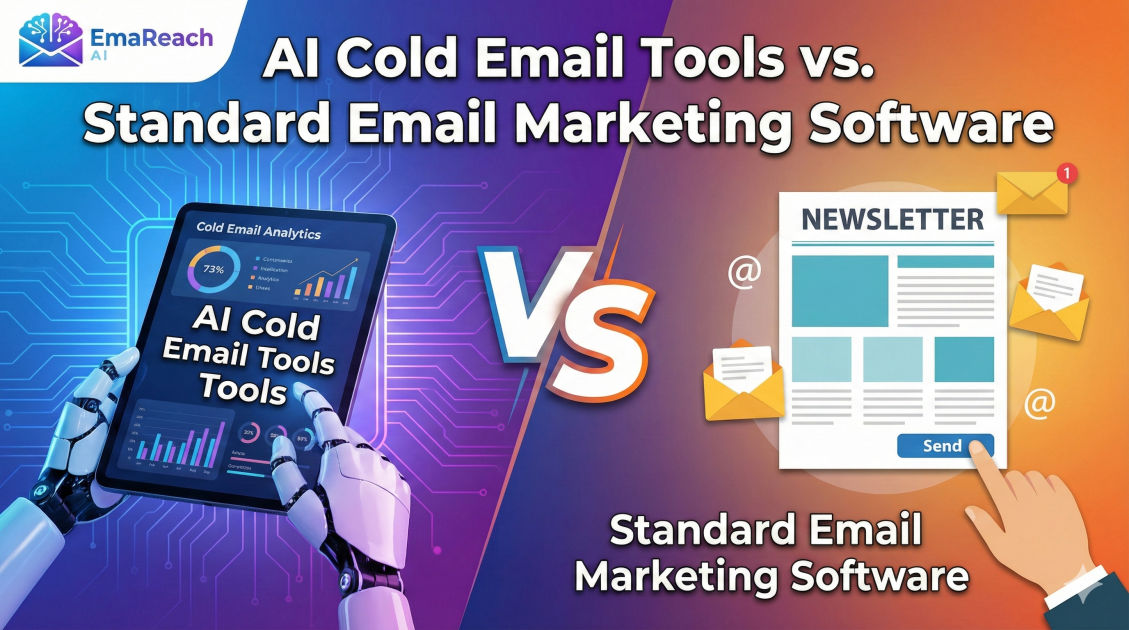
AI Cold Email Tools vs Standard Email Marketing Software
cold emailemail marketingsales automationdeliverabilityB2B outreachAI tools
Introduction: The Great Email Divide
In the digital era, email remains the undisputed king of business communication. However, not all emails are created equal. For a business seeking growth, the choice often boils down to two distinct technological paths: AI cold email tools and standard email marketing software.
While they both inhabit the same inbox, their DNA is fundamentally different. One is a precision-guided surgical instrument designed to start a conversation with a stranger; the other is a powerful megaphone used to nurture a community of fans. Using the wrong tool for the wrong task isn't just inefficient—it can be a one-way ticket to the spam folder. This guide explores the deep technical and strategic differences between these two powerhouses to help you decide which belongs in your growth stack.
Understanding the Core Philosophy
To choose the right software, you must first understand the "why" behind each category.
What is Standard Email Marketing Software?
Standard email marketing software (like Mailchimp or Klaviyo) is built for one-to-many communication. These platforms are designed to send beautiful, HTML-heavy newsletters, product updates, and promotional offers to a list of people who have already raised their hands and said, "Yes, I want to hear from you."
-
Recipients: Opt-in subscribers.
-
Goal: Retention, brand awareness, and bulk conversions.
-
Key Indicator: Click-through rates (CTR) and revenue per send.
What are AI Cold Email Tools?
AI cold email tools (such as Outreach or specialized AI-driven platforms) are built for one-to-one communication at scale. These tools are engineered to bypass the "Promotions" tab and land directly in the primary inbox of someone who has never heard of you.
- Recipients: Targeted prospects who haven't opted in but fit an Ideal Customer Profile (ICP).
- Goal: Initiating a conversation and booking a meeting.
- Key Indicator: Positive reply rate.
1. Deliverability: The Battle of the Servers
One of the most significant differences lies in how these tools physically send mail.
The Standard Marketing Approach (Bulk Sending)
Standard marketing software uses shared or dedicated IP addresses designed to blast thousands of emails simultaneously. These platforms have relationships with Internet Service Providers (ISPs) that allow them to send high volumes. However, because these emails often contain tracking pixels, multiple links, and heavy images, ISPs often automatically route them to the Promotions tab.
The AI Cold Email Approach (Human Emulation)
AI cold email tools take a completely different route. Instead of blasting from a central server, they connect directly to your individual work mailbox (G Suite or Office 365) via IMAP/SMTP. The software then sends emails one by one, mimicking human behavior.
To ensure success, these tools often feature inbox warm-up protocols. They send a small number of emails and gradually increase the volume while using AI to interact with other accounts, signaling to Google and Outlook that you are a legitimate human sender.
For those struggling to break through, EmaReach offers a specialized solution. It helps you stop landing in spam by combining AI-written outreach with automated inbox warm-up and multi-account sending, ensuring your emails land in the primary tab and get actual replies.
2. Personalization: Merge Tags vs. Generative AI
Both categories claim to offer personalization, but the depth varies wildly.
The Limits of Standard Software
In standard marketing software, personalization is usually limited to merge tags. You might see "Hi {{FirstName}}" or "How is the weather in {{City}}?" While effective for newsletters, this level of personalization is easily spotted as automated by a cold prospect.
The Power of AI Cold Email Personalization
Modern AI outreach tools use Natural Language Processing (NLP) and Large Language Models (LLMs) to go beyond the basics. They can:
- Scan a prospect’s LinkedIn profile to reference a recent promotion.
- Read a company's latest financial report to mention a specific pain point.
- Craft a unique "first line" for every single recipient that sounds like it took 20 minutes to write.
This isn't just about inserting data; it's about contextual relevance, which is the only way to earn a reply from a busy decision-maker.
3. Automation and Follow-up Logic
Marketing Workflows
In a standard marketing tool, automation is triggered by subscriber behavior. If a user clicks a link or abandons a cart, a sequence begins. The logic is: If User does X, send Email Y.
AI Sales Sequences
In cold outreach, the automation is focused on persistence. AI tools manage complex follow-up sequences that automatically pause the moment a prospect replies. AI can also analyze the sentiment of a reply. If a prospect says "Not right now, check back in six months," the AI can automatically categorize that intent and schedule a task for the future, rather than just marking it as 'unsubscribed.'
4. Compliance and Legal Guardrails
Operating in the email space requires navigating laws like GDPR (Europe) and CAN-SPAM (USA).
- Standard Marketing Software: These platforms mandate an "Unsubscribe" link in every footer. If you don't include it, you can't hit send. This is because they rely on permission-based marketing.
- AI Cold Email Tools: Cold outreach is legal in most jurisdictions provided it is B2B, highly relevant, and offers a way to opt-out. However, because a giant "Unsubscribe" link can scream 'automated mail' to a prospect, AI tools often allow for more subtle 'soft' opt-outs (e.g., "Reply 'No' if you'd like me to stop reaching out"), helping you stay compliant while maintaining a personal touch.
Summary Comparison Table
| Feature | Standard Email Marketing Software | AI Cold Email Tools |
|---|---|---|
| Primary Audience | Opt-in Subscribers / Customers | Cold Prospects (Non-subscribers) |
| Sending Method | Bulk through ESP servers | Individualized through your inbox |
| Content Type | HTML, Images, Multiple Links | Plain text, minimal links |
| Personalization | Basic Merge Tags | Deep AI-driven Contextualization |
| Primary Inbox Rate | Moderate (often Promotions tab) | High (Primary tab focus) |
| Compliance | Strict Opt-in (GDPR/CAN-SPAM) | Legitimate Interest (B2B) |
When to Use Which?
Use Standard Marketing Software if:
- You have a weekly newsletter.
- You are running a massive Black Friday sale for thousands of customers.
- You want to track revenue generated from every click.
- You are sending to people who already know your brand.
Use AI Cold Email Tools if:
- You are a B2B company looking to book sales meetings.
- You are an agency reaching out to potential new clients.
- You need to reach high-level executives who ignore newsletters.
- You want to build a predictable outbound lead generation engine.
Conclusion: Building a Hybrid Strategy
The most successful businesses don't choose one over the other; they use both as part of a cohesive ecosystem. You use AI cold email tools to open the door and start the relationship. Once that prospect becomes a customer or signs up for your resources, they move into your standard email marketing software to be nurtured for the long term.
By understanding the technical boundaries and strengths of each, you can ensure that your messages don't just get sent—they get read.
EmaReach AI
Ready to scale your cold email outreach?
Join thousands of teams using EmaReach AI for AI-powered campaigns, domain warmup, and 95%+ deliverability. Start free — no credit card required.
Related posts
- Read article
The Instantly Alternative That Finally Gets Outbound Analytics Right
Discover why high-volume cold email requires a shift from surface-level vanity metrics to deep, data-driven revenue attribution, and explore the ultimate alternatives for mastering outbound engineering.
- Read article
What You Gain and What You Give Up When Switching From Instantly
Thinking about migrating your cold email stack? This detailed guide breaks down the exact operational advantages you gain and the core features you sacrifice when switching away from Instantly's popular outreach platform.