Blog
Back to blog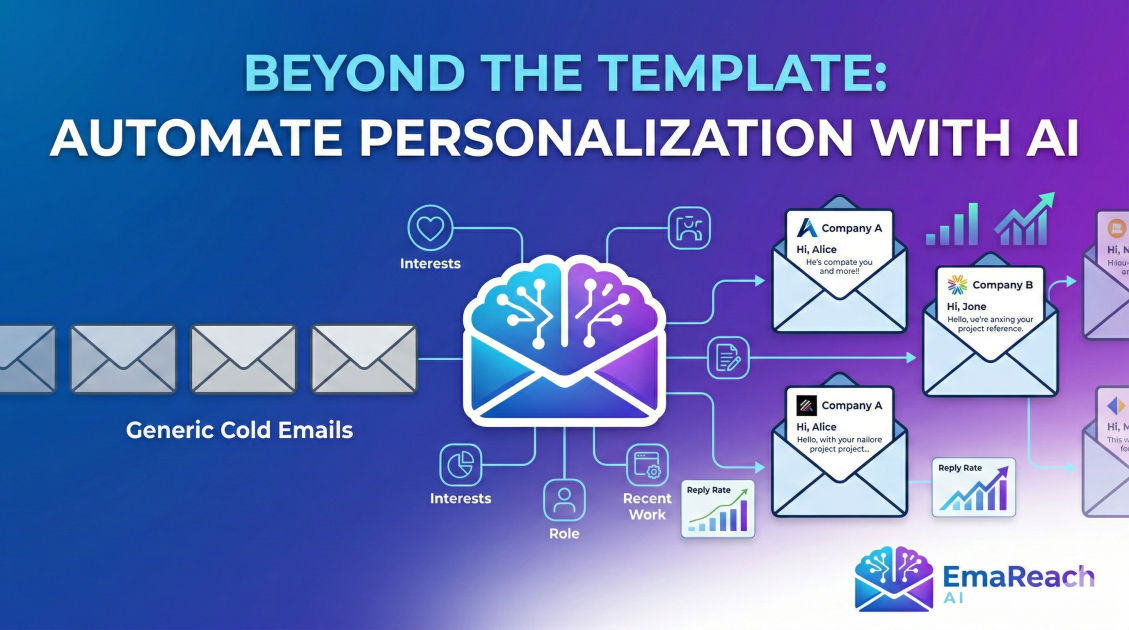
AI Cold Email Tools That Automate Personalization
cold emailAI personalizationsales automationlead generationoutreach toolsemail deliverability
Introduction to the New Era of Cold Outreach
Cold email has long been a staple of B2B lead generation, but the landscape has shifted dramatically. Gone are the days when a simple mail merge—swapping out a name and a company—was enough to capture attention. Inboxes are more crowded than ever, and decision-makers have developed a keen sense for detecting automated templates. This is where Artificial Intelligence (AI) has stepped in to bridge the gap between scale and authenticity.
AI cold email tools that automate personalization are no longer just a luxury; they are a necessity for any sales team or entrepreneur looking to break through the noise. These tools use Large Language Models (LLMs) and machine learning algorithms to research prospects, understand their professional background, and draft messages that feel like they were written by a human after hours of research. In this guide, we will explore the technology behind these tools, the features that matter most, and how to implement them to see a tangible lift in your reply rates.
The Problem with Traditional Cold Emailing
Traditional cold emailing relied on volume. The logic was simple: if you send 1,000 emails and get a 1% response rate, you have 10 leads. However, this high-volume, low-quality approach led to several critical issues:
- Burned Domains: Sending high volumes of unengaging content triggers spam filters.
- Brand Damage: Prospects find generic emails annoying, which can hurt your company’s reputation.
- Low Conversion: Even if you reach the inbox, a generic message rarely compels a busy executive to take action.
AI solves these problems by allowing for hyper-personalization at scale. Instead of choosing between quality and quantity, AI tools allow you to have both.
How AI Automates Personalization
To understand how these tools work, we need to look at the underlying processes they automate. Personalization used to require a SDR (Sales Development Representative) to visit a prospect's LinkedIn profile, read their recent posts, check their company website, and find a 'hook.' AI now does this in seconds.
Data Scraping and Research
Modern AI outreach tools connect to various data sources. They can scrape LinkedIn profiles, Twitter feeds, company blogs, and even financial reports. The AI then synthesizes this data to find relevant talking points. For example, it might notice that a prospect recently spoke at a conference about sustainable supply chains and use that as the opening line of an email.
Natural Language Generation (NLG)
Once the research is complete, the AI uses NLG to draft the content. Unlike a template where you fill in the blanks, AI generates unique sentences. It understands context, tone, and intent. It can be instructed to be 'professional yet witty' or 'direct and concise,' matching the brand voice of the sender.
Intent Recognition
Advanced AI tools don't just personalize the first line; they personalize the offer. By analyzing a company's recent news—such as a new funding round or a hiring spree—the AI can pivot the value proposition to address the prospect's current most likely pain points.
Key Features of AI Personalization Tools
When evaluating AI cold email tools, it is important to look beyond the marketing hype. The best tools offer a combination of deep research, seamless integration, and deliverability protection.
1. LinkedIn Insight Integration
Since LinkedIn is the primary hub for professional data, tools that can deep-scan profiles are invaluable. They look for shared experiences, recent promotions, or specific keywords in a prospect's 'About' section to create a connection.
2. Website and Case Study Analysis
Some high-end tools can 'read' a prospect’s website. They can identify the technology stack the company uses or the specific services they offer, allowing the AI to suggest exactly how your product fits into their existing ecosystem.
3. Dynamic Snippets
Instead of rewriting the entire email, some tools generate 'Personalization Snippets.' These are 1-2 sentences that you can insert into your existing high-performing sequences. This gives you the control of a proven framework with the added boost of AI-generated relevance.
4. Deliverability and Warm-up
Even the best-written email is useless if it lands in the spam folder. This is where specialized platforms like EmaReach provide a critical advantage. EmaReach combines AI-written cold outreach with essential inbox warm-up and multi-account sending. This ensures that your highly personalized emails actually reach the primary tab and get seen by the intended recipient.
The Role of 'Icebreakers' in AI Outreach
The 'Icebreaker' is the first sentence of your cold email. Its only job is to prove you aren't a bot (ironically) and that you've done your homework. AI tools are exceptionally good at generating these.
Example of a manual icebreaker: "I saw you work at ABC Corp and wanted to reach out." Example of an AI-generated icebreaker: "I caught your recent podcast appearance on 'The Future of Fintech'—your point about decentralized credit scoring was incredibly insightful, especially given ABC Corp's recent expansion into the European market."
The difference is night and day. The second example immediately builds rapport and increases the likelihood of the prospect reading the rest of the email.
Integrating AI into Your Sales Workflow
Adopting AI cold email tools isn't about replacing your sales team; it's about making them more efficient. Here is how a typical AI-enhanced workflow looks:
- Lead Sourcing: Export a list of targeted leads from a database.
- AI Research: Upload the list to an AI tool that scans for recent news and social activity.
- Drafting: The AI generates personalized opening lines or entire email drafts for each lead.
- Human Review: A salesperson spends 30 seconds reviewing the AI's work to ensure accuracy and 'vibe' alignment.
- Automated Sending: The emails are sent through a platform that handles deliverability, like EmaReach, to ensure they bypass filters.
Best Practices for AI-Personalized Emails
While AI is powerful, it is not foolproof. To get the best results, follow these guidelines:
Keep it Relevant, Not Just Personal
Personalization for the sake of personalization can feel creepy. Mentioning a prospect's dog might be too much. Mentioning their recent company milestone is professional and relevant. Always tie the personalized hook back to why you are emailing them.
Training the Model
Many AI tools allow you to provide 'Few-Shot' examples. This means giving the AI 5-10 examples of emails you’ve written in the past that you loved. The AI will then mimic your specific style, vocabulary, and structure.
Monitoring Deliverability
AI-generated content is sometimes scrutinized by spam filters if it appears too repetitive across different accounts. Using a multi-account sending strategy and an inbox warm-up service is vital. By distributing the load and keeping the sender reputation high, you ensure that the AI's hard work doesn't go to waste in the 'Promotions' tab.
Measuring the Success of AI Personalization
To justify the investment in AI tools, you need to track the right metrics. You will likely see changes in the following areas:
- Open Rates: While subject lines mostly drive opens, personalized snippets appearing in the email preview can significantly boost this number.
- Reply Rates: This is where AI shines. Genuine-looking personalization often doubles or triples reply rates compared to generic templates.
- Meeting Booked Rate: High-quality replies lead to high-quality meetings. Because the AI helps qualify the relevance of the lead, the meetings you do book are often more likely to convert into deals.
The Ethical Considerations of AI in Outreach
As we use AI to automate human-like interactions, ethics come into play. It is important to remain transparent and provide value. The goal of AI personalization should be to facilitate a better connection, not to deceive the prospect. Ensure that the claims made by the AI are factually accurate; nothing kills a deal faster than an AI 'hallucinating' a fact about a prospect's company that isn't true.
Future Trends in AI Outreach
The technology is moving toward 'Hyper-Contextualization.' We are moving beyond just social media posts. Future AI tools will likely analyze video content, webinar transcripts, and even public code repositories to understand a prospect’s specific technical challenges before an email is even drafted.
Furthermore, the integration between AI email tools and CRM systems will become more seamless. AI will not only write the email but also decide the optimal time to send it based on when the prospect has historically engaged with similar content.
Conclusion
AI cold email tools have fundamentally changed the rules of outbound sales. By automating the research and drafting process, they allow businesses to scale their outreach without sacrificing the personal touch that builds trust. However, the tool is only as good as the strategy behind it. Combining AI-driven personalization with a robust deliverability framework—such as the one provided by EmaReach—is the ultimate formula for modern sales success. As you implement these tools, focus on relevance, maintain a human-in-the-loop for quality control, and always prioritize the prospect's experience. The future of cold email is not just automated; it is intelligently personalized.
EmaReach AI
Ready to scale your cold email outreach?
Join thousands of teams using EmaReach AI for AI-powered campaigns, domain warmup, and 95%+ deliverability. Start free — no credit card required.
Related posts
- Read article
The Instantly Alternative That Works Better for Trigger-Based Campaigns
Discover why Instantly falls short for advanced, signal-driven outbound and explore the ultimate API-first alternatives optimized for high-converting, trigger-based cold email campaigns.
- Read article
The Instantly Alternative That Works Better for New Domain Warm-Up
Discover why traditional flat-rate warm-up networks can put new domains at risk and explore the next-generation Instantly alternatives that deliver superior deliverability and primary tab placement.