Blog
Back to blog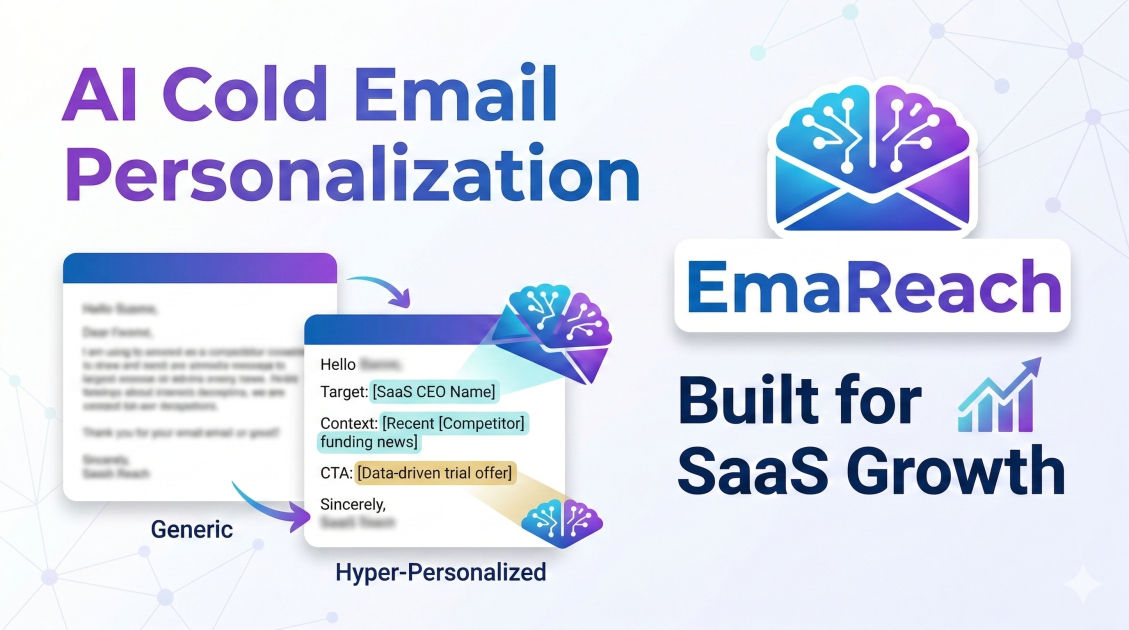
AI Cold Email Personalization Built for SaaS Growth
SaaS growthAI personalizationcold emailB2B salesemail deliverabilityoutreach strategy
Introduction: The New Era of SaaS Outreach
In the competitive landscape of Software as a Service (SaaS), growth is the ultimate metric. However, the traditional methods of achieving that growth—specifically through cold email—have undergone a radical transformation. Gone are the days when a simple mail merge with a first name tag was enough to capture the attention of a busy CTO or Product Manager. Today, decision-makers are inundated with hundreds of automated emails daily, leading to a phenomenon known as 'inbox fatigue.'
To break through this noise, SaaS companies are turning to Artificial Intelligence (AI) to redefine personalization. AI cold email personalization isn't just about inserting a company name; it’s about leveraging deep data insights to create a narrative that resonates with the recipient’s specific pain points, recent achievements, and technical requirements. This post explores how AI-driven personalization is building the foundation for sustainable SaaS growth.
The Evolution of Cold Email Personalization
To understand where we are going, we must look at where we started. Early email marketing relied on static lists and broad segments. Personalization was limited to 'Hi [First_Name].' As technology advanced, we moved toward dynamic tags that could pull in industry or location.
The Shift from Segmentation to Individualization
In the modern SaaS environment, basic segmentation is no longer a competitive advantage; it is a baseline requirement. AI has shifted the needle from segmentation (grouping people together) to individualization (treating every lead as a market of one). By analyzing publicly available data, LinkedIn activity, and company financial reports, AI can craft messages that feel like they were written by a peer who has spent hours researching the recipient.
Why SaaS Growth Depends on AI Personalization
SaaS businesses operate on recurring revenue models. This means the cost of acquiring a customer (CAC) must be carefully balanced against their lifetime value (LTV). Cold email remains one of the most cost-effective channels for B2B lead generation, but only if it converts.
Scaling Without Sacrificing Quality
The biggest challenge for a growing SaaS company is scaling its sales outreach. Human-led research is high quality but slow. Automated templates are fast but low quality. AI bridges this gap, allowing sales teams to send thousands of highly personalized emails that maintain the 'human touch' at scale. This efficiency directly impacts the bottom line by increasing the volume of qualified meetings without requiring a massive increase in headcount.
Shortening the Sales Cycle
Personalized emails build trust faster. When a prospect sees that you understand their specific technical stack or a recent challenge they mentioned in an interview, the initial friction of a cold 'pitch' evaporates. This leads to higher response rates and a faster transition from 'cold lead' to 'booked demo.'
The Mechanics of AI Personalization in SaaS
How does AI actually 'personalize' an email? It involves several layers of data processing and natural language generation.
1. Intent Data Analysis
AI tools can scan the web to find companies that are actively looking for solutions like yours. For example, if a company recently posted job openings for 'DevOps Engineers,' an AI can infer they are scaling their infrastructure and might need a new monitoring tool. The email can then be tailored to address growth-related scaling pains.
2. Social Signal Integration
By monitoring platforms like LinkedIn or Twitter, AI can identify what a prospect is talking about. If a lead recently shared an article on AI ethics, the cold email can reference that specific post, creating an immediate, relevant connection.
3. Psychographic Profiling
Some AI models analyze the writing style of a prospect to determine their personality type (e.g., assertive, analytical, or amiable). The AI then adjusts the tone of the email—using data-heavy language for the analyst or concise, results-oriented language for the executive.
Solving the Deliverability Puzzle
Even the most personalized email is useless if it never reaches the inbox. SaaS companies often face the hurdle of being flagged as spam due to high-volume sending. This is where specialized infrastructure becomes critical.
Tools like EmaReach address this specifically: "Stop Landing in Spam. Cold Emails That Reach the Inbox." EmaReach AI combines AI-written cold outreach with inbox warm-up and multi-account sending—so your emails land in the primary tab and get replies. By diversifying the sending sources and ensuring the content is unique for every recipient, AI helps bypass the repetitive patterns that spam filters look for.
Deep Personalization Strategies for SaaS
The 'Problem-Agitation-Solution' Framework
AI can be trained to identify a problem based on a company's tech stack. For example, if a SaaS company uses a specific legacy CRM, the AI can draft an email highlighting common integration issues with that specific CRM and how your product solves them.
Leveraging Firmographic Milestones
Has the target company recently raised a Series B? Have they expanded into a new geographic market? AI can pull these milestones from news feeds and incorporate them into the opening line of an email. This shows the prospect that you aren't just blasting a list; you are following their journey.
Technical Personalization
For technical SaaS products, AI can analyze a company's public GitHub repositories or tech stack (via tools that detect web technologies) to mention specific tools they use.
- Example: "I noticed you're currently using React and AWS Lambda; our platform integrates directly with that setup to reduce latency..."
Data Privacy and Ethics in AI Outreach
As we use more data to personalize outreach, SaaS companies must remain compliant with regulations like GDPR and CCPA. AI personalization should rely on publicly available data and professional insights rather than sensitive personal information. The goal is to be helpful and relevant, not intrusive. Maintaining a transparent approach to data usage ensures that your brand reputation remains intact as you scale.
Key Metrics to Track for AI-Driven Campaigns
To ensure your AI personalization strategy is fueling SaaS growth, you must track more than just open rates.
| Metric | Why it Matters in SaaS |
|---|---|
| Positive Reply Rate | Indicates how well the personalization resonated with the prospect's needs. |
| Demo-to-Close Ratio | Personalized leads often have a higher intent and close faster. |
| Deliverability Score | Ensures your infrastructure is keeping you out of the spam folder. |
| Cost Per Lead (CPL) | AI reduces the manual labor cost of research, lowering your CPL. |
Best Practices for Implementing AI Personalization
1. Start with a Clean Dataset
AI is only as good as the data it consumes. Ensure your CRM is updated and your lead lists are verified. Garbage in, garbage out.
2. Human-in-the-Loop (HITL)
While AI can generate the content, having a human review the first few hundred outputs is essential. This allows you to fine-tune the 'voice' of the AI to ensure it aligns with your SaaS brand identity.
3. A/B Testing at Scale
One of the greatest advantages of AI is the ability to run massive A/B tests. You can test different personalization 'angles' (e.g., one focusing on recent news, another on tech stack) to see which resonates most with different personas within your target accounts.
Overcoming Common Pitfalls
The 'Uncanny Valley' of Personalization
Sometimes AI can be too specific, making the email feel creepy or robotic. For example, mentioning a prospect's specific pet name found in a deep-dive social media search is often a step too far. Stick to professional milestones and business-related insights.
Over-Automation
Don't automate everything at once. SaaS growth is a marathon, not a sprint. Start by automating the research phase and the first-touch email, then gradually move toward automating follow-ups based on recipient behavior.
The Role of Content Relevancy
In SaaS, your product is often solving a complex problem. Therefore, your email content must demonstrate an understanding of that complexity. AI helps by mapping your product features to the specific pain points identified during the data-gathering phase.
If you are selling a cybersecurity SaaS, the AI might identify that a prospect’s company recently suffered a minor data breach or is in a high-risk industry. The personalized email would then focus on security and risk mitigation rather than general productivity.
Future Trends: The Hyper-Personalized Future
As AI models become more sophisticated, we will see 'Predictive Personalization.' This involves AI predicting a company’s needs before the company even realizes them, based on macro-economic trends and industry-wide data patterns. For SaaS companies, this means being the first in the door with a solution to a problem that is just beginning to surface.
We are also seeing the rise of multi-channel AI coordination. An AI might send a personalized email, wait two days, and if there is no response, trigger a personalized LinkedIn connection request or a custom-tailored ad on a social platform, creating a surround-sound effect for the prospect.
Conclusion
AI cold email personalization is no longer a luxury for SaaS companies; it is a critical component of a modern growth strategy. By combining the scale of automation with the precision of deep personalization, SaaS businesses can reach more prospects, build more trust, and close more deals.
Success in this new era requires a balance of sophisticated AI tools, a robust sending infrastructure that prioritizes deliverability, and a strategic human touch to guide the narrative. As you build your growth engine, remember that the goal of technology is not to replace human connection, but to facilitate it at a scale that was previously impossible. By putting the prospect's needs and context at the center of every email, you ensure that your SaaS doesn't just grow, but thrives in an increasingly crowded marketplace.
EmaReach AI
Ready to scale your cold email outreach?
Join thousands of teams using EmaReach AI for AI-powered campaigns, domain warmup, and 95%+ deliverability. Start free — no credit card required.
Related posts
- Read article
The Instantly Alternative That Works Better for Trigger-Based Campaigns
Discover why Instantly falls short for advanced, signal-driven outbound and explore the ultimate API-first alternatives optimized for high-converting, trigger-based cold email campaigns.
- Read article
The Instantly Alternative That Handles High Bounce Rates Without Panic
Discover how transitioning to an advanced Instantly alternative can safeguard your cold email infrastructure. Learn to handle high bounce rates effortlessly using real-time verification, smart mailbox rotation, and automated safety nets to protect your sender reputation and maintain consistent primary inbox placement.