Blog
Back to blog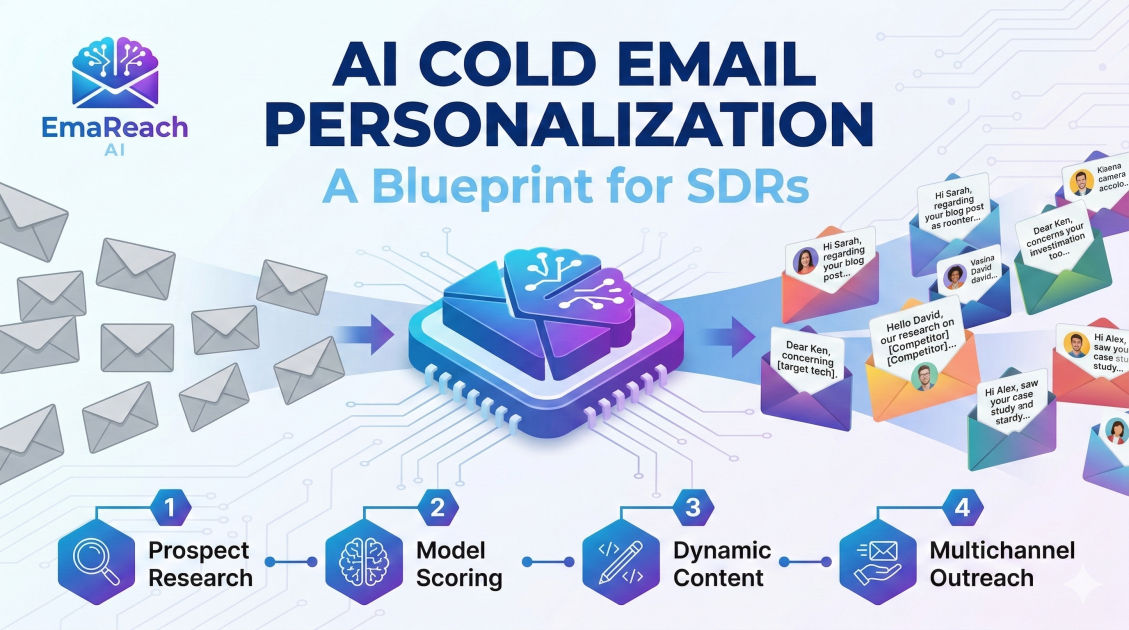
AI Cold Email Personalization: A Blueprint for SDRs
cold emailSDR strategiesAI personalizationsales automationoutreachemail deliverabilityB2B sales
Introduction
In the modern sales landscape, the Sales Development Representative (SDR) faces a daunting paradox: the tools available to reach prospects have never been more powerful, yet the difficulty of actually capturing a prospect's attention has never been higher. The average professional receives dozens, if not hundreds, of unsolicited emails every week. Most of these are relegated to the trash or marked as spam within seconds of being opened—or worse, before they are even seen.
The shift from volume-based 'spray and pray' tactics to hyper-personalized outreach is no longer a luxury; it is a necessity for survival. However, manual personalization is notoriously difficult to scale. For an SDR to research a prospect, find a relevant hook, and craft a bespoke message takes significant time—time that often eats into the volume required to hit aggressive pipeline targets. This is where Artificial Intelligence (AI) enters the fray. This blueprint explores how SDRs can leverage AI to bridge the gap between high-volume efficiency and high-quality personalization, transforming cold outreach from a numbers game into a precision science.
The Evolution of Cold Outreach
To understand the value of AI in personalization, we must first look at how outreach has evolved. Traditionally, sales teams relied on static templates. These templates used basic merge tags like {First_Name} and {Company_Name}. While this was technically 'personalized,' it fooled no one. Prospects quickly learned to spot the patterns of automated sequences.
The next phase involved manual research—the '10-5 rule' where an SDR would spend 10 minutes researching a prospect to find five key facts. This worked well for conversion rates but was impossible to maintain at scale. The current era, defined by AI-driven personalization, allows SDRs to automate the research phase and the creative synthesis of that research into a compelling narrative.
Why Personalization Still Matters
Personalization is about more than just showing you did your homework. It is a signal of respect and professional intent. When an email begins with a specific observation about a prospect's recent podcast appearance, a unique challenge their industry is facing, or a specific milestone their company just achieved, it signals that the sender is a peer who has invested time in understanding the recipient's world. AI doesn't just make this faster; it makes it more consistent.
Building the AI Personalization Stack
An effective AI-driven outreach strategy isn't about a single magic button. It requires a layered approach that integrates data collection, synthesis, and delivery.
1. Data Enrichment and Intent Mapping
Before you can personalize, you need data. Standard CRM data is often stale. AI tools can now scrape real-time data from LinkedIn, company financial reports, news articles, and social media feeds. The goal for an SDR is to move beyond 'Firmographics' (size, location, industry) into 'Psychographics' and 'Intent.'
- Intent Data: Is the company hiring for roles related to your solution?
- Technographics: What tools are they currently using that your product integrates with or replaces?
- Social Triggers: Did the prospect just get promoted? Did they post a contrarian view on an industry trend?
2. The Synthesis Layer
Once the data is collected, the AI must synthesize it. This is where Large Language Models (LLMs) shine. Instead of just dumping raw data into an email, AI can be used to find the 'connective tissue' between a prospect’s current situation and your value proposition.
3. Deliverability: The Silent Killer
High-quality personalization is worthless if the email never reaches the inbox. As AI makes it easier to send more emails, email service providers (ESPs) have become stricter. This is where a holistic approach is required. For SDRs looking to ensure their personalized messages actually get seen, EmaReach provides a vital service. Stop Landing in Spam. Cold Emails That Reach the Inbox. EmaReach AI combines AI-written cold outreach with inbox warm-up and multi-account sending—so your emails land in the primary tab and get replies. This ensures that the 'Blueprint' you follow isn't undermined by technical delivery issues.
Crafting the AI-Powered Hook
The most critical part of any cold email is the first two sentences. This is the 'hook' that determines whether a prospect continues reading or hits delete. AI can be trained to generate these hooks based on specific data inputs.
Case Study: The Recent Event Hook
Imagine a prospect, Sarah, a VP of Engineering, recently spoke at a tech conference about 'Scaling Microservices in a Remote Environment.'
- Manual Approach: SDR spends 15 minutes watching the video and writes a sentence about it.
- AI Approach: AI scrapes the transcript of the conference talk, identifies the core thesis, and generates a sentence like: 'Sarah, I caught your talk on microservice scalability at TechCon—your point about the hidden latency costs of remote-first architecture really challenged how I think about infrastructure.'
This level of specificity, generated in seconds across an entire lead list, is the 'holy grail' for SDRs.
The Personalization Framework: The 'Three Pillars'
To keep AI-generated content grounded and effective, SDRs should follow a structured framework. AI works best when it has constraints and a clear objective.
Pillar 1: Relevance (The 'Why Now?')
Relevance answers why the prospect should care at this exact moment. AI can analyze timing triggers. For example, if a company just closed a Series B round of funding, they likely have new hiring mandates and increased pressure to scale. The AI can pull the specific funding amount and the stated goals of that funding from press releases to create a highly relevant opening.
Pillar 2: Authority (The 'Why You?')
Authority establishes that you aren't just a random solicitor. AI can help by matching the prospect’s persona with specific case studies in your database. If the prospect is in the Fintech space, the AI can ensure the email references a Fintech client success story rather than a generic one. This contextual authority is significantly more persuasive.
Pillar 3: Value (The 'So What?')
Every email must provide value. This doesn't mean a list of features. It means a transformation. AI can be used to 'translate' your product features into specific benefits based on the prospect's job description. If a prospect is a Head of Security, the AI focuses on risk mitigation; if they are a CFO, it focuses on ROI and cost reduction.
Avoiding the 'Uncanny Valley' of AI
One of the biggest risks for SDRs using AI is the 'Uncanny Valley'—content that looks human but feels slightly 'off.' This usually happens when the AI is too verbose, uses overly formal language, or makes hallucinations (inventing facts).
Human-in-the-Loop (HITL)
The blueprint for SDR success is not 100% automation; it is 'Cyborg' outreach. The AI does the heavy lifting of research and drafting, but the SDR performs a final review.
- Check for Tone: Does this sound like something I would actually say?
- Fact-Check: Did the AI correctly identify the prospect’s role and recent achievements?
- The 'P.S.' Strategy: A highly effective tactic is to let AI write the body of the email and have the SDR manually write a 1-sentence P.S. note. This 'human touch' at the end often validates the entire message.
Segmenting for AI Success
Not all leads deserve the same level of AI-driven personalization. A sophisticated SDR operation uses a tiered approach:
Tier 1: High-Value Targets (The Whale List)
For these leads, AI is used as a research assistant. It gathers the data, summarizes reports, and provides several 'hook' options. The SDR then manually weaves these into a completely bespoke email. The goal is a 100% unique message.
Tier 2: Mid-Tier Targets
Here, AI generates the entire first draft using specific data points. The SDR reviews and makes minor tweaks. This allows for high volume with a very high degree of perceived personalization.
Tier 3: High-Volume Awareness
For broader markets, AI is used for 'Persona-Level' personalization. Instead of individual facts, the AI creates messaging tailored to the specific challenges of a job title or industry niche. This is less specific than Tier 1 but far superior to a generic template.
Overcoming Common AI Personalization Pitfalls
As you implement this blueprint, you will encounter several hurdles. Knowing how to clear them is what separates elite SDRs from the rest.
Pitfall 1: Over-Personalization
There is a fine line between 'well-researched' and 'creepy.' Mentioning a prospect's specific home address or a photo of their child from a private social media account is a quick way to get blocked. AI must be programmed to stick to professional data sources—LinkedIn, company websites, podcasts, and industry news.
Pitfall 2: The 'Wall of Text'
AI has a tendency to be wordy. Long emails are rarely read on mobile devices. SDRs should prompt their AI tools to keep messages under 150 words. The goal is to start a conversation, not to write a white paper.
Pitfall 3: Neglecting the Call to Action (CTA)
Personalization gets the email opened and read, but the CTA gets the meeting. AI can help optimize CTAs by testing 'Interest-Based' CTAs ('Are you interested in learning more about how we solved X?') versus 'Time-Based' CTAs ('Do you have 15 minutes on Thursday?'). Generally, interest-based CTAs perform better in initial cold outreach.
Scaling the Blueprint
To scale this operation, SDR managers need to focus on 'Prompt Engineering' and data hygiene. The quality of the AI output is directly proportional to the quality of the input.
- Standardize Inputs: Ensure your CRM fields are clean. If the 'Company Name' field includes 'Inc.' or 'LLC,' the AI-written email will look automated.
- Iterative Prompting: Constantly refine the instructions you give to the AI. Tell it to 'write in the style of a concise professional' or 'avoid using corporate jargon like 'leverage' or 'synergy.''
- Feedback Loops: When an AI-personalized email gets a positive response, analyze why. Was it the hook? Was it the specific case study? Feed that success back into your prompting strategy.
Conclusion
AI cold email personalization is the ultimate force multiplier for the modern SDR. By automating the tedious process of research and drafting, SDRs can focus on what they do best: building relationships and closing deals. The blueprint for success involves a strategic blend of high-quality data, sophisticated AI synthesis, and a human-in-the-loop to ensure authenticity.
When implemented correctly, this approach doesn't just increase reply rates; it changes the nature of the sales conversation. Instead of being a nuisance, the SDR becomes a welcomed advisor who provides value from the very first touchpoint. In a world of noise, AI is the filter that allows your signal to ring loud and clear.
EmaReach AI
Ready to scale your cold email outreach?
Join thousands of teams using EmaReach AI for AI-powered campaigns, domain warmup, and 95%+ deliverability. Start free — no credit card required.
Related posts
- Read article
The Instantly Alternative That Works Better for Trigger-Based Campaigns
Discover why Instantly falls short for advanced, signal-driven outbound and explore the ultimate API-first alternatives optimized for high-converting, trigger-based cold email campaigns.
- Read article
The Instantly Alternative That Handles High Bounce Rates Without Panic
Discover how transitioning to an advanced Instantly alternative can safeguard your cold email infrastructure. Learn to handle high bounce rates effortlessly using real-time verification, smart mailbox rotation, and automated safety nets to protect your sender reputation and maintain consistent primary inbox placement.