Blog
Back to blog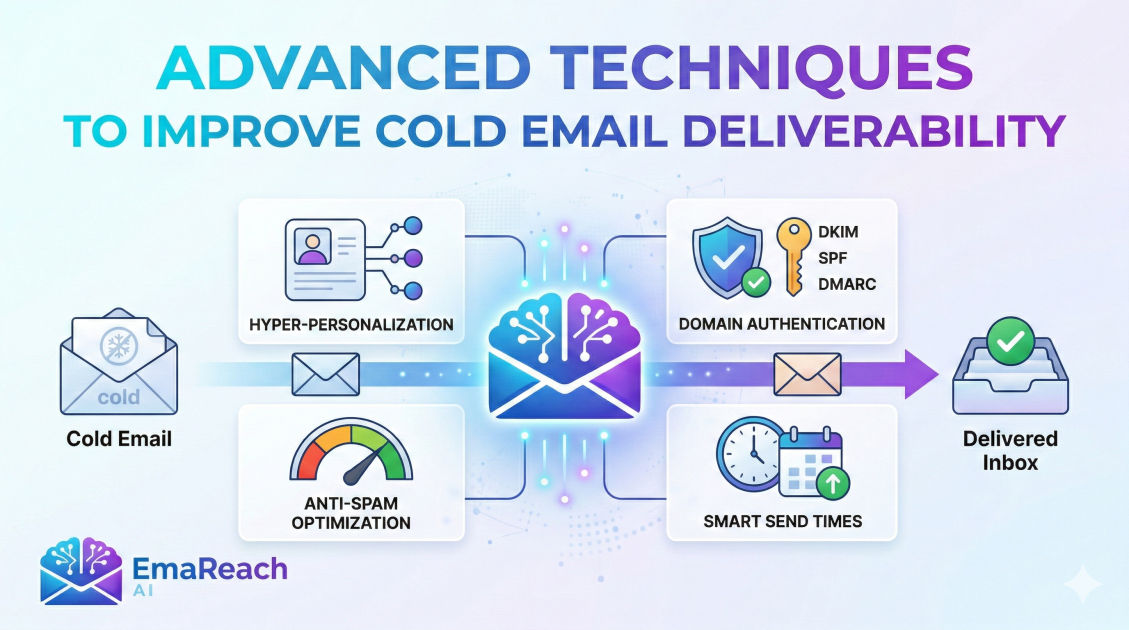
Advanced Techniques to Improve Cold Email Deliverability
cold emailemail deliverabilitysales outreachemail marketinglead generationinbox placement
Introduction to Modern Email Deliverability
In the current landscape of digital communication, the bridge between a sent email and a read email is narrower than ever. Cold email outreach remains one of the most effective ways to generate leads and build professional relationships, but its success is entirely dependent on one critical factor: deliverability. If your carefully crafted message never reaches the primary inbox, your ROI is zero.
Advanced deliverability is no longer just about avoiding 'spammy' words like 'free' or 'guarantee.' It is a multi-layered technical and strategic discipline that involves server reputation, cryptographic authentication, behavioral patterns, and engagement signals. This guide explores the sophisticated techniques required to ensure your outreach scales without hitting the brick wall of spam filters.
The Technical Foundation: Beyond Basic Authentication
Before sending a single email, your technical infrastructure must be bulletproof. Mail Transfer Agents (MTAs) and receiving servers use specific protocols to verify that you are who you say you are.
SPF, DKIM, and DMARC: The Holy Trinity
While most senders know about these, advanced practitioners understand the nuances of their configuration.
- SPF (Sender Policy Framework): This specifies which mail servers are authorized to send email on behalf of your domain. An advanced tip is to ensure you don't exceed the 10-lookup limit, which can cause SPF failure even if your record is technically correct.
- DKIM (DomainKeys Identified Mail): This adds a digital signature to your emails. For high-volume outreach, using 2048-bit keys is now the standard for better security and higher trust scores from providers like Google and Outlook.
- DMARC (Domain-based Message Authentication, Reporting, and Conformance): Most senders stop at a 'p=none' policy. To truly protect your deliverability, you should move toward a 'p=quarantine' or 'p=reject' policy. This signals to receiving servers that you take your domain security seriously, which significantly boosts your sender reputation.
Custom Tracking Domains
By default, many outreach platforms use shared tracking domains for open and click tracking. If another user on that shared domain sends spam, your deliverability suffers. Advanced senders always set up a Custom Tracking Domain. This aligns your tracking links with your sending domain, ensuring that the reputation of your links matches the reputation of your 'From' address.
The Architecture of Sending: Inbox Rotation and Volume Management
One of the biggest red flags for spam filters is a sudden spike in volume from a single IP or mailbox.
Decentralized Sending (The 'Power in Numbers' Strategy)
Instead of sending 500 emails a day from one account, advanced deliverability specialists distribute that volume across 10 or 20 different accounts (e.g., john@company.com, j.smith@company.com, john.s@company.com). This is often referred to as 'Inbox Rotation.' By keeping the volume per mailbox low—typically under 50 emails per day—each account mimics the behavior of a natural human user, making it much harder for automated filters to flag the activity as bulk mailing.
The Critical Role of Warm-Up
An inbox must be 'warmed' before it can handle outbound campaigns. This involves a gradual increase in sending volume paired with a high engagement rate. Tools like EmaReach are essential here. EmaReach AI combines AI-written cold outreach with inbox warm-up and multi-account sending—so your emails land in the primary tab and get replies. This automated interaction builds a positive history with ISPs, signaling that your emails are wanted by recipients.
Content Optimization: Defeating Heuristic Filters
Modern spam filters use machine learning to analyze the 'DNA' of an email. If your content looks like a template used by thousands of others, it will be suppressed.
Advanced Personalization via Liquid Syntax
Basic tags like {{first_name}} are no longer enough. Advanced techniques involve using 'Spintex' or Liquid Syntax to vary the actual structure of the sentences.
- Example:
{Hi|Hello|Hey} {{first_name}}, I {noticed|saw|came across} your profile on LinkedIn.
This creates thousands of unique versions of the same message, preventing 'content fingerprinting' where filters identify and block a specific string of text across multiple accounts.
Plain Text vs. HTML
While HTML allows for beautiful designs, it also increases the 'spam weight' of an email. For cold outreach, a 'plain-text look' is statistically superior for deliverability. This means removing unnecessary code, excessive styling, and heavy images. If you must use links, keep them to a minimum; a single link is far safer than three or four.
Data Hygiene and List Management
Your deliverability is only as good as your data. Sending emails to non-existent addresses (Hard Bounces) is the fastest way to destroy a sender reputation.
Real-Time Verification
Don't rely on data that is more than a few weeks old. Advanced workflows include a real-time verification step immediately before an email is sent. This checks for:
- SMTP Validation: Ensuring the mailbox actually exists.
- Catch-all Detection: Identifying domains that accept all mail, which are riskier to send to.
- Spam Trap Identification: Avoiding 'honeypot' addresses designed to catch scrapers.
Monitoring Blacklists and Postmaster Tools
Regularly checking your domain against major blacklists (like Spamhaus or Barracuda) is a baseline requirement. However, advanced users leverage Google Postmaster Tools. This provides direct data from Google regarding your IP reputation, domain reputation, encryption rates, and spam complaint rates. If your domain reputation drops from 'High' to 'Medium,' you know you need to pause and pivot before you are permanently blocked.
Behavioral Psychology and Engagement Signals
Deliverability isn't just a technical game; it's an engagement game. ISPs prioritize mail that people interact with.
The 'Reply-First' Strategy
The most powerful signal to an ISP that your email is legitimate is a reply. Advanced campaigns often optimize for the 'easy win'—asking a simple, low-friction question that encourages a quick response. Once a recipient replies to your email, your future emails to them (and others on the same server) are much more likely to bypass filters.
Managing Opt-Outs Professionally
While the law requires an opt-out mechanism, 'Unsubscribe' links can sometimes trigger spam filters. An advanced alternative is using a text-based opt-out: 'If you'd rather not hear from me, just let me know.' This encourages a 'reply' (a positive signal) rather than a 'spam report' or a link click (which can be a neutral or negative signal depending on the filter's sophistication).
Navigating the Technical Nuances of Different Providers
Different ESPs (Email Service Providers) have different 'personalities' and thresholds.
Google (Gmail/Workspace)
Google is highly sensitive to 'velocity.' Sudden bursts of activity are penalized. They also heavily weigh the reputation of the sending IP. Using Google Workspace accounts for sending to other Google users often results in better deliverability due to the internal nature of the traffic.
Microsoft (Outlook/Office 365)
Microsoft filters are notoriously aggressive and often use 'EOP' (Exchange Online Protection). They rely heavily on your 'SCL' (Spam Confidence Level) score. One advanced tactic for Microsoft is ensuring your 'From' name and 'Display' name match your authenticated domain perfectly, as discrepancies here are a major red flag for their filters.
Advanced Infrastructure: IP Warming vs. Domain Authority
For high-volume senders, the choice between a Shared IP and a Dedicated IP is pivotal.
- Shared IPs: You benefit from the 'warm' status of the IP but are at the mercy of other senders' behaviors.
- Dedicated IPs: You have total control, but you must manually warm the IP, which can take months of careful volume scaling.
For most cold emailers, using multiple 'niche' domains (e.g., company-outreach.com instead of company.com) on reputable shared environments is the safest way to protect the main corporate domain while maintaining high deliverability.
Conclusion: The Continuous Cycle of Deliverability
Advanced email deliverability is not a 'set it and forget it' task. It is a continuous cycle of monitoring, testing, and refining. By implementing robust authentication protocols, utilizing decentralized sending through inbox rotation, maintaining pristine data hygiene, and leveraging tools like EmaReach to maintain a healthy engagement profile, you can ensure that your cold outreach remains a viable and profitable channel.
Success in the inbox requires a commitment to quality over quantity. As filters become more intelligent, the only way to stay ahead is to adopt these advanced technical and strategic standards, treating every email sent as a reflection of your domain's long-term reputation.
EmaReach AI
Ready to scale your cold email outreach?
Join thousands of teams using EmaReach AI for AI-powered campaigns, domain warmup, and 95%+ deliverability. Start free — no credit card required.
Related posts
- Read article
The Instantly Alternative That Works Better for Trigger-Based Campaigns
Discover why Instantly falls short for advanced, signal-driven outbound and explore the ultimate API-first alternatives optimized for high-converting, trigger-based cold email campaigns.
- Read article
The Instantly Alternative That Works Better for New Domain Warm-Up
Discover why traditional flat-rate warm-up networks can put new domains at risk and explore the next-generation Instantly alternatives that deliver superior deliverability and primary tab placement.