Blog
Back to blog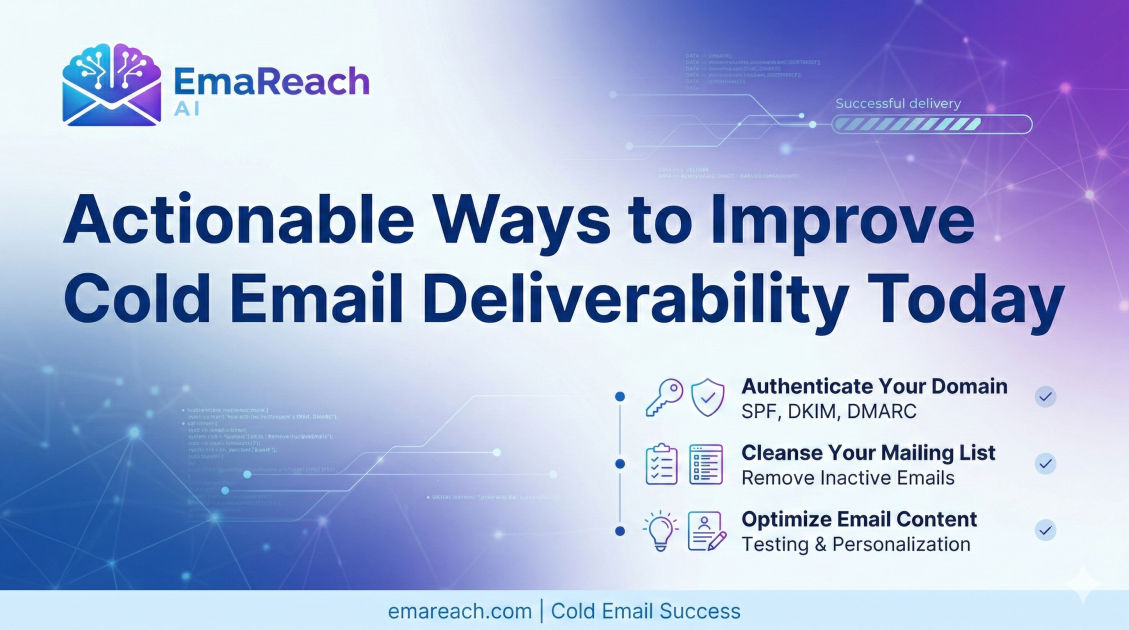
Actionable Ways to Improve Cold Email Deliverability Today
cold emailemail deliverabilityoutreach strategyemail marketinglead generationsender reputation
Introduction
In the world of outbound sales, your message is only as good as its delivery. You could spend hours crafting the perfect pitch, researching your prospect’s pain points, and polishing your call to action, but if that email lands in the spam folder, it effectively does not exist. Cold email deliverability is the technical and behavioral foundation of every successful outreach campaign.
Deliverability isn't a one-time setup; it is a continuous process of maintaining sender reputation, adhering to technical protocols, and providing value to the recipient. As inbox providers become increasingly sophisticated in their filtering algorithms, staying out of the 'Promotions' or 'Spam' tabs requires a strategic approach. This guide provides a comprehensive roadmap of actionable steps you can take right now to ensure your emails reach the primary inbox.
The Technical Foundation: Authenticating Your Domain
Before you send a single outreach email, you must prove to Mail Transfer Agents (MTAs) that you are who you say you are. This is handled through three primary authentication records. Without these, your domain is a prime target for spoofing, and inbox providers like Google and Outlook will likely flag your messages as suspicious.
SPF (Sender Policy Framework)
SPF is a DNS record that lists the specific IP addresses and domains authorized to send emails on your behalf. When an email reaches a server, the server checks the SPF record. If the sending IP isn't on the list, the email is often rejected or flagged.
DKIM (DomainKeys Identified Mail)
DKIM adds a digital signature to your emails. This signature ensures that the content of the email hasn't been tampered with during transit. It creates a cryptographic link between your domain and the message, significantly boosting your sender credibility.
DMARC (Domain-based Message Authentication, Reporting, and Conformance)
DMARC sits on top of SPF and DKIM. It tells the receiving server what to do if an email fails authentication—whether to do nothing, quarantine it, or reject it entirely. Having a DMARC policy (even a 'p=none' policy initially) is a critical signal to providers that you take your domain security seriously.
Custom Tracking Domains
Most cold email platforms use a shared tracking pixel to monitor open rates. If another user on that shared pixel sends spam, your deliverability can suffer by association. Setting up a Custom Tracking Domain (CTD) allows you to use your own domain for tracking links, keeping your reputation isolated and clean.
The Infrastructure Strategy: Protecting Your Primary Domain
One of the most common mistakes in cold outreach is sending high-volume campaigns from your primary company domain (e.g., yourname@company.com). If your deliverability takes a hit due to a high spam complaint rate, your entire company’s internal and external communication could be crippled.
Use Secondary Domains
Create 'lookalike' domains specifically for outreach (e.g., company-labs.com or getcompany.com). This compartmentalizes your risk. If a secondary domain gets blacklisted, your primary business operations remain unaffected.
Limit Volume Per Inbox
Sending 500 emails a day from a single account is a fast track to the spam folder. Human beings don't send 500 individual emails in a day. To mimic human behavior, limit your sending volume to 30–50 emails per day per inbox. If you need to send 500 emails, use 10 different inboxes across multiple domains.
Warm Up Your Inboxes
New domains have no reputation, which makes them suspicious to providers. 'Warming up' involves gradually increasing the volume of emails sent and received to build a history of positive engagement. Tools like EmaReach can automate this process. EmaReach AI combines AI-written cold outreach with inbox warm-up and multi-account sending, ensuring your emails land in the primary tab and get replies by simulating natural conversation patterns.
List Hygiene: The Silent Killer of Deliverability
Your bounce rate is one of the most heavily weighted factors in sender reputation. A high bounce rate signals to providers that you are using a stale or 'guessed' list, which is a hallmark of a spammer.
Verify Every Email Address
Never import a list directly into your sending tool without running it through a verification service. These services check if the mailbox actually exists without sending a physical email. Aim for a bounce rate of less than 2%.
Remove Role-Based Addresses
Avoid sending to addresses like info@, sales@, or admin@. These are often monitored by multiple people or act as 'catch-all' buckets. They rarely lead to high engagement and often result in higher complaint rates.
Monitor for Spam Traps
Spam traps are email addresses that are no longer in use but are monitored by providers to catch illegitimate senders. Regular list cleaning helps identify and remove these dangerous entries before they can damage your reputation.
Crafting Content That Bypasses Filters
Inbox providers don't just look at who is sending the email; they look at what is inside it. Modern AI filters scan for 'spammy' characteristics in real-time.
Avoid Spam Trigger Words
Words like 'Free,' 'Guarantee,' 'Investment,' 'Urgent,' and excessive use of dollar signs can trigger aggressive filters. While one or two might not hurt, a dense concentration of these terms is a red flag.
Optimize the Text-to-HTML Ratio
Heavy HTML, complex layouts, and excessive images are typical of newsletters and marketing blasts, not personal business correspondence. For cold outreach, stick to plain text or very simple HTML. This mimics the appearance of a one-to-one email sent from a personal Gmail or Outlook account.
Limit Links and Attachments
Links are a common vector for malware, so filters are naturally suspicious of them. Avoid putting links in your first touchpoint if possible. If you must include one, ensure it is a clean, non-shortened URL (avoid bit.ly or similar). Never include attachments in a first cold email; they are a major deliverability risk.
Personalization at Scale
Static templates are easy for filters to identify. If you send the exact same message to 1,000 people, providers will flag it as a mass blast. Use dynamic tags to personalize not just the name, but the company, a recent news event, or a specific pain point. This creates unique 'fingerprints' for each email, making them look unique to automated scanners.
The Power of Engagement Metrics
Deliverability is no longer just about avoiding the negative; it’s about proving the positive. Providers look at how recipients interact with your emails.
Open Rates vs. Reply Rates
While open rates are a popular metric, they are becoming less reliable due to privacy protections. Reply rates are the ultimate signal of quality. When a recipient replies to your email, it tells the provider that your content is valuable. This builds 'domain authority' in the eyes of the mail server.
The 'Mark as Not Spam' Factor
If a user moves your email from the spam folder to the inbox, it is a massive boost to your reputation. This is why the 'warm-up' phase is so critical—it uses a network of accounts to interact with your emails, marking them as important and replying to them to signal high quality to the algorithms.
Handling Unsubscribes Gracefully
It is better for a prospect to unsubscribe than to mark your email as spam. Make it easy for them. While a clear unsubscribe link is a legal requirement in many jurisdictions (like GDPR or CAN-SPAM), you can also use a 'text-based' opt-out, such as: "If you're not the right person for this, just let me know and I'll stop reaching out."
Monitoring and Maintenance
Deliverability is a moving target. You must regularly monitor your technical health to catch issues before they escalate.
Check Blacklists Regularly
Use public tools to see if your IP or domain has been added to any major blacklists (like Spamhaus or Barracuda). If you find yourself listed, stop all sending immediately and investigate the cause—usually a spike in complaints or a sudden volume increase.
Review Google Postmaster Tools
If you send a significant volume to Gmail users, Google Postmaster Tools is an essential resource. It provides direct data from Google on your domain’s reputation, spam rate, and encryption success.
Rotation of Copy
Even a high-performing script can eventually 'wear out.' If your reply rates start to dip, it might be because the specific phrasing has been flagged across various filters. Refresh your copy every few weeks to keep the content 'fresh' for the algorithms.
Conclusion
Mastering cold email deliverability is a blend of technical precision and human-centric communication. By establishing a robust technical foundation with SPF, DKIM, and DMARC, protecting your main domain with secondary sending accounts, and maintaining impeccable list hygiene, you create an environment where your outreach can thrive.
Remember that the goal of cold email is to start a conversation, not to broadcast a message. The more your emails look, feel, and act like genuine one-to-one communications, the more likely they are to bypass the gates of the spam filter. Deliverability isn't just about the 'send' button—it's about the preparation, the strategy, and the ongoing commitment to sending high-quality, relevant content to the right people. Start implementing these actionable steps today to reclaim your place in the primary inbox.
EmaReach AI
Ready to scale your cold email outreach?
Join thousands of teams using EmaReach AI for AI-powered campaigns, domain warmup, and 95%+ deliverability. Start free — no credit card required.
Related posts
- Read article
The Instantly Alternative That Finally Gets Outbound Analytics Right
Discover why high-volume cold email requires a shift from surface-level vanity metrics to deep, data-driven revenue attribution, and explore the ultimate alternatives for mastering outbound engineering.
- Read article
What You Gain and What You Give Up When Switching From Instantly
Thinking about migrating your cold email stack? This detailed guide breaks down the exact operational advantages you gain and the core features you sacrifice when switching away from Instantly's popular outreach platform.