Blog
Back to blog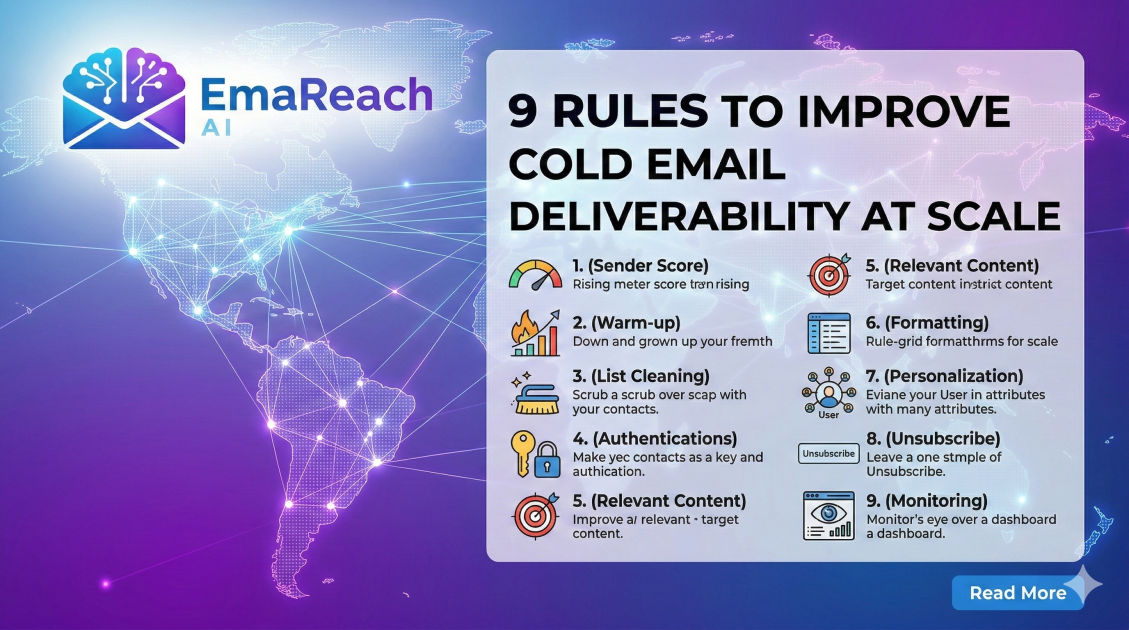
9 Rules to Improve Cold Email Deliverability at Scale
cold emaildeliverabilityemail marketinglead generationsales outreachinbox placement
Introduction
In the world of B2B sales and digital marketing, cold email remains one of the most effective channels for generating high-quality leads. However, as the volume of global email traffic increases, so do the defenses of major email service providers (ESPs). Scaling your outreach isn't as simple as clicking 'send' on a larger list. Without a rigorous focus on deliverability, your carefully crafted messages will end up in the spam folder, invisible to your prospects.
Cold email deliverability is the science of ensuring your emails land in the primary inbox rather than the promotions tab or, worse, the spam folder. When you move from sending fifty emails a day to five thousand, the complexity of maintaining a high sender reputation grows exponentially. This guide outlines nine fundamental rules to ensure your emails reach their destination consistently, even at significant scale.
1. Implement Professional Technical Authentication
Technical authentication is the foundation of email deliverability. It serves as your digital passport, proving to receiving servers that you are who you say you are and that your message hasn't been tampered with in transit.
SPF (Sender Policy Framework)
SPF is a DNS record that lists the IP addresses and domains authorized to send emails on behalf of your domain. Without a proper SPF record, receiving servers have no way of verifying the source of your email, making it highly likely they will flag it as spoofing.
DKIM (DomainKeys Identified Mail)
DKIM adds a digital signature to your emails. This signature is linked to your domain name and is verified by the recipient's server using a public key found in your DNS records. It ensures that the content of the email remains unchanged from the moment it was sent.
DMARC (Domain-based Message Authentication, Reporting, and Conformance)
DMARC ties SPF and DKIM together. It tells receiving servers what to do if an email fails authentication—whether to do nothing, quarantine the email, or reject it entirely. For high-volume senders, having a 'p=quarantine' or 'p=reject' policy is essential for building a long-term reputation.
2. Use Secondary Domains for Outreach
One of the most critical rules for scaling is never to use your primary company domain for cold outreach. If your primary domain (e.g., company.com) gets flagged for spam, it won't just affect your sales team; it will stop your transactional emails, internal communications, and billing notifications from reaching their targets.
The Strategy of 'Look-alike' Domains
Instead, purchase secondary domains that are similar to your main brand. For example, if your domain is acme.com, you might buy getacme.com, tryacme.com, or acme-labs.com. This creates a safety buffer. If one domain's reputation suffers due to a high volume of reports, your core business operations remain untouched.
Diversification Across Providers
When scaling significantly, it is wise to spread these secondary domains across different ESPs (e.g., Google Workspace and Microsoft 365). This reduces the risk of a single provider's algorithm-wide update silencing your entire outreach operation overnight.
3. Master the Art of Domain Warming
A new domain has no reputation. If you suddenly start sending 500 emails a day from a domain registered yesterday, ESPs will instantly flag this as suspicious 'burner' behavior typical of spammers.
Incremental Volume Scaling
Domain warming is the process of gradually increasing your sending volume over several weeks. Start with 5-10 emails per day and slowly ramp up. This mimics organic human behavior.
Positive Engagement Signals
To accelerate this process, you need positive engagement. This means your emails need to be opened, replied to, and marked as 'not spam' if they land in the wrong folder. Tools like EmaReach can automate this, combining AI-written outreach with inbox warm-up to ensure your accounts are primed for high-volume sending without triggering red flags.
4. Prioritize Lead List Hygiene and Verification
Your deliverability is only as good as your data. High bounce rates are one of the fastest ways to destroy a sender's reputation. If more than 2% of your emails bounce, ESPs will begin to treat your domain with extreme skepticism.
Real-time Verification
Never assume a list you bought or scraped is clean. People change jobs, companies shut down, and email formats evolve. Use a multi-step verification process to check for:
- Hard Bounces: Invalid email addresses that do not exist.
- Catch-all Servers: Domains that accept all mail initially but may bounce later.
- Spam Traps: 'Honey pot' email addresses used by security firms to catch unauthorized bulk senders.
Regular Scrubbing
If you are running long-term campaigns, re-verify your lists every 30 to 60 days. Stale data is a silent killer of deliverability at scale.
5. Optimize Content and Avoid Spam Triggers
Modern spam filters use sophisticated Natural Language Processing (NLP) to analyze the intent of your email. While the 'spam keywords' list of the past is less rigid now, certain patterns still trigger alarms.
Avoiding 'Salesy' Language
Words like 'Free,' 'Guarantee,' 'Cash,' 'Act Now,' and excessive use of exclamation marks or capital letters are basic triggers. Beyond keywords, avoid excessive HTML, heavy imagery, or multiple tracking links. A plain-text or minimalist HTML email almost always performs better for deliverability than a flashy marketing newsletter.
Personalization at Scale
Generic templates are easily identified by ESPs. To scale effectively, you must use dynamic variables that go beyond just the 'First Name.' Mentioning the prospect’s company, a recent news event, or a specific pain point unique to their industry makes the email look like a one-to-one communication. This is where EmaReach excels, using AI to craft personalized outreach that lands in the primary tab and feels authentic to the recipient.
6. Monitor Your Sender Reputation and Blacklists
You cannot manage what you do not measure. Regularly monitoring your sender reputation is vital for catching issues before they become catastrophic.
Key Metrics to Track
- Sender Score: A number between 0 and 100 that represents your reputation.
- Spam Complaint Rate: This should ideally be below 0.1%.
- Inbox Placement Rate: How many of your successfully delivered emails actually reached the inbox vs. the spam folder.
Blacklist Checking
There are hundreds of public blacklists (like Spamhaus or SORBS). If your IP or domain appears on one of these, your deliverability will plummet. Set up automated alerts to notify you the moment a domain is flagged so you can pause your campaigns and begin the remediation process.
7. Manage Sending Frequency and Volume Limits
Sending too many emails too quickly is a hallmark of spam. Even if your domain is warmed up, 'blasting' 1,000 emails in a single minute will trigger rate-limiting and reputation hits.
Use an Outreach Cadence
Space your emails out throughout the day. Instead of sending in batches, use a tool that staggers the 'send' time, making the activity look like a human is typing and sending messages over an eight-hour window.
Daily Limits per Inbox
For optimal safety, limit each individual inbox to 30-50 cold emails per day. If you need to send 5,000 emails a day, do not try to do it from one account. Instead, use 100 different accounts across multiple domains. This horizontal scaling is much safer and more sustainable than vertical scaling.
8. Provide an Easy and Clear Way to Opt-Out
It may seem counterintuitive, but making it easy for people to stop receiving your emails actually improves your deliverability. If a prospect is annoyed by your emails and cannot find an easy way to unsubscribe, they will click the 'Report Spam' button.
Unsubscribe Links vs. Text-based Opt-outs
A 'Report Spam' click is significantly more damaging to your reputation than an 'Unsubscribe' click. You can use a traditional unsubscribe link, or a more conversational text-based approach like: 'If you’d rather not hear from me again, just let me know.' This encourages a reply rather than a spam report, and replies are a positive signal to ESPs.
9. Maintain a Healthy Reply-to-Sent Ratio
ESPs look at the balance of outgoing and incoming mail. If a domain sends 10,000 emails and receives zero replies, it is a clear sign of unsolicited bulk mailing.
The Feedback Loop
Encouraging engagement is not just good for sales; it’s good for your technical standing. Ask open-ended questions that require a simple response. The more conversations you start, the more the 'Big Three' (Google, Microsoft, and Yahoo) will trust your domain as a legitimate source of valuable communication.
By following these rules, you create a robust infrastructure that supports growth without sacrificing the integrity of your outreach. Scaling cold email is a marathon, not a sprint, and the winners are those who respect the rules of the inbox.
Conclusion
Improving cold email deliverability at scale requires a multi-faceted approach that combines technical precision, data integrity, and human-centric content strategies. From the initial setup of SPF, DKIM, and DMARC to the sophisticated use of AI-driven personalization and inbox warming, every step is a building block toward a high-authority sender reputation. By diversifying your domains, maintaining strict list hygiene, and monitoring your metrics closely, you can ensure that your message doesn't just get sent, but actually gets read. Remember, the goal of cold email is to start a conversation, and that conversation can only begin if you successfully navigate the journey to the primary inbox.
EmaReach AI
Ready to scale your cold email outreach?
Join thousands of teams using EmaReach AI for AI-powered campaigns, domain warmup, and 95%+ deliverability. Start free — no credit card required.
Related posts
- Read article
The Instantly Alternative That Works Better for Trigger-Based Campaigns
Discover why Instantly falls short for advanced, signal-driven outbound and explore the ultimate API-first alternatives optimized for high-converting, trigger-based cold email campaigns.
- Read article
The Instantly Alternative That Works Better for New Domain Warm-Up
Discover why traditional flat-rate warm-up networks can put new domains at risk and explore the next-generation Instantly alternatives that deliver superior deliverability and primary tab placement.