Blog
Back to blog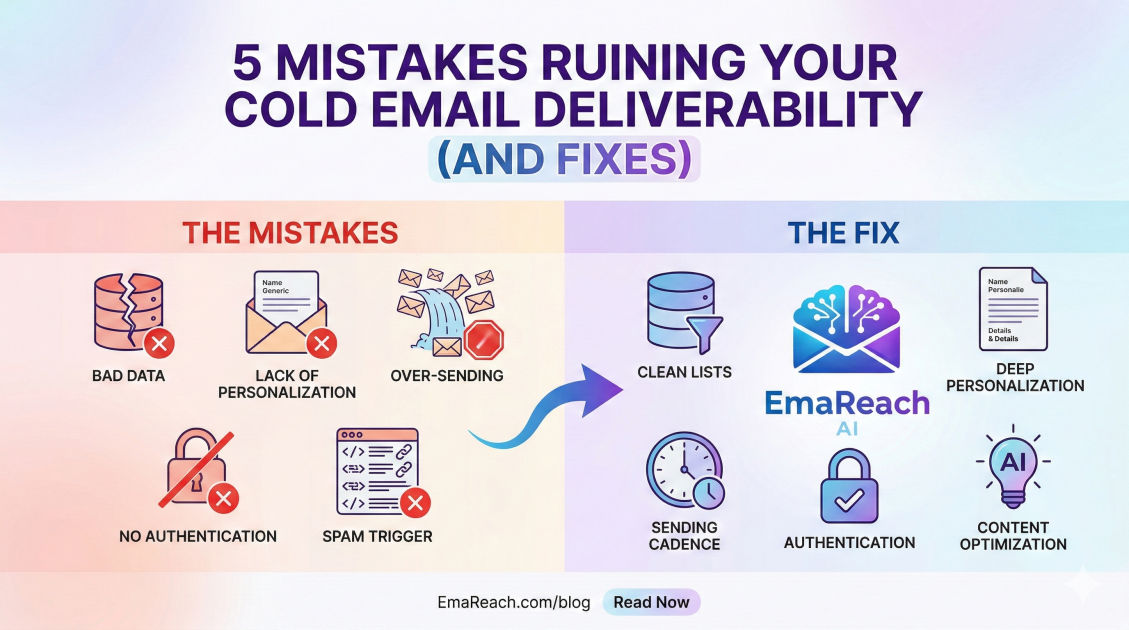
5 Mistakes Ruining Your Cold Email Deliverability (And Fixes)
cold emailemail deliverabilitysales outreachlead generationemail marketingB2B salesinbox placement
Introduction
In the world of B2B sales and digital marketing, cold email remains one of the most effective channels for generating high-quality leads and driving revenue. However, the landscape of email communication has shifted dramatically. Internet Service Providers (ISPs) and email hosting giants like Google and Outlook have implemented increasingly sophisticated filters to protect users from unsolicited noise and malicious content.
Today, sending a cold email isn't just about writing a catchy subject line; it’s about navigating a complex technical gauntlet. If your emails aren't reaching the inbox, your outreach strategy is dead on arrival. High bounce rates, low open rates, and the dreaded 'spam folder' are symptoms of underlying deliverability issues.
This guide explores the five most critical mistakes that ruin cold email deliverability and provides actionable fixes to ensure your messages land where they belong: the primary inbox.
1. Neglecting Technical Authentication Protocols
One of the most common—and fatal—mistakes in cold email outreach is failing to set up technical authentication. Think of authentication as a digital passport for your domain. Without it, receiving servers have no way of verifying that you are who you say you are, leading them to treat your messages with extreme suspicion.
The Mistake
Many sales professionals buy a new domain and immediately start sending emails without configuring SPF, DKIM, and DMARC records. To an ISP, an unauthenticated email looks exactly like a spoofing or phishing attempt. If you skip this step, you are essentially signaling to the world that your emails are untrustworthy.
The Fix
You must configure the following three records in your Domain Name System (DNS) settings:
- SPF (Sender Policy Framework): This is a text record that specifies which IP addresses and domains are authorized to send emails on behalf of your domain.
- DKIM (DomainKeys Identified Mail): This adds a digital signature to your emails, allowing the receiver to verify that the email was indeed sent from your domain and hasn't been tampered with in transit.
- DMARC (Domain-based Message Authentication, Reporting, and Conformance): This is a policy that tells receiving servers what to do if an email fails SPF or DKIM checks. Setting this to 'p=none' initially is fine, but eventually moving toward 'p=quarantine' or 'p=reject' significantly boosts your sender reputation.
By securing these protocols, you provide a layer of transparency that ISPs reward with better placement.
2. Using a Single Email Account for High-Volume Outreach
Scale is the goal of most outreach campaigns, but attempting to achieve that scale through a single email account is a recipe for disaster. Every email provider has daily sending limits, and more importantly, they monitor 'burst' activity.
The Mistake
Sending 200, 500, or 1,000 emails per day from one address (e.g., john@company.com) triggers red flags. Rapid spikes in volume are characteristic of bot behavior. Once your account is flagged for 'unusual activity,' your deliverability will plummet, and your entire domain reputation could be permanently damaged.
The Fix
To scale safely, you must utilize inbox rotation. Instead of sending 500 emails from one account, send 25 emails from 20 different accounts across multiple domains. This spreads the load and keeps the volume per account well within the 'human' range.
For businesses looking to automate this complex process, EmaReach provides an essential solution. Stop Landing in Spam. Cold Emails That Reach the Inbox. EmaReach AI combines AI-written cold outreach with inbox warm-up and multi-account sending—so your emails land in the primary tab and get replies. By distributing your volume across many optimized accounts, you protect your main domain while maintaining high outreach capacity.
3. Poor Lead List Hygiene and High Bounce Rates
Your deliverability is only as good as the data you feed it. Sending emails to invalid, inactive, or non-existent addresses is one of the quickest ways to get blacklisted.
The Mistake
Buying generic lead lists or using outdated databases leads to high hard bounce rates. A 'hard bounce' occurs when an email is sent to an address that doesn't exist. ISPs view a bounce rate higher than 2% as a sign of a spammer. Furthermore, many low-quality lists contain 'spam traps'—email addresses specifically designed by providers to catch people who use scraped or unverified data.
The Fix
Implement a rigorous verification process before any campaign goes live:
- Use Real-Time Verification: Run your list through a verification tool to identify and remove invalid, catch-all, and high-risk emails.
- Target Active Prospects: Focus on LinkedIn-verified data or signals that the prospect is currently active in their role.
- Regular Cleaning: If you have a long-term sequence, re-verify the list every few months, as professional emails decay at a rate of about 2% per month due to job changes.
Reducing your bounce rate to near zero is the strongest signal you can send to ISPs that you are a legitimate sender with high-quality data.
4. Lack of Inbox 'Warm-Up'
If you take a brand-new domain and start sending 50 cold emails a day, you will likely find yourself in the spam folder within a week. Domains need a 'reputation' before they are allowed to reach the inbox consistently.
The Mistake
'Cold' domains have no history. ISPs are inherently skeptical of new senders because spammers often burn through new domains quickly. If there is no history of positive engagement (opens, replies, marking as 'not spam'), the provider will default to filtering your messages.
The Fix
You must 'warm up' your email accounts. This involves a period of 2 to 4 weeks where you gradually increase the sending volume while ensuring high engagement rates.
Manual warm-up is nearly impossible to sustain, which is why automated warm-up services are vital. These services involve a network of accounts that interact with your emails—opening them, moving them from spam to the inbox, and replying. This activity builds a positive sender history, proving to Google and Outlook that your emails are wanted by recipients. Never start a cold outreach campaign on a domain that hasn't been properly warmed for at least 14 days.
5. Overusing Spam-Trigger Words and Poor Formatting
While technical settings are the foundation, the actual content of your email still plays a role in how filters perceive your intent. Content-based filtering is less aggressive than it used to be, but it still acts as a final hurdle.
The Mistake
Using 'salesy' language, excessive capitalization, or too many links can trigger algorithmic filters. Words like 'Free,' 'Buy Now,' 'Investment,' or 'Guaranteed' are classic triggers. Additionally, over-formatting your email with heavy HTML, multiple images, or tracking pixels that aren't properly configured can make your email look like a marketing blast rather than a 1-to-1 professional message.
The Fix
To keep your content deliverability-friendly, follow these best practices:
- Keep it Plain Text: Professional emails rarely look like colorful brochures. Stick to plain text or very simple HTML to mimic a standard business email.
- Limit Links: Try to use only one link per email (usually your calendar or a specific resource). Excessive links are a hallmark of phishing.
- Personalization is Key: AI-driven personalization helps ensure that every email is unique. When every message you send is slightly different, filters are less likely to mark your campaign as a 'template-based' spam attack.
- Optimize the Unsubscribe: Always include a clear way to opt-out. While it seems counterintuitive, making it easy to unsubscribe prevents people from marking your email as spam, which is far more damaging to your reputation.
Understanding the 'Sender Reputation' Ecosystem
Deliverability isn't a one-time setup; it is an ongoing management task. Your sender reputation is composed of two parts: IP Reputation and Domain Reputation.
IP Reputation
This relates to the specific server sending your email. If you use a common ESP (Email Service Provider), you are often on a shared IP. If other users on that IP send spam, your deliverability can suffer. Using dedicated IPs or reputable providers with strict anti-spam policies helps mitigate this risk.
Domain Reputation
This is the 'credit score' of your specific website domain. It follows you regardless of which IP you send from. Once a domain reputation is 'Bad,' it is extremely difficult to recover. This is why most professional outbound teams use 'satellite' domains (e.g., getcompany.com instead of company.com) to protect the primary corporate domain from any potential outreach fallout.
The Role of Engagement in Modern Deliverability
In the current era, the 'Reply Rate' is the king of deliverability metrics. ISPs have moved beyond just looking at bounces. They look at how people interact with your mail.
If you send 100 emails and 20 people reply, the ISP assumes your content is valuable. If you send 100 emails and 0 people reply, even if they don't mark you as spam, the ISP will eventually stop prioritizing your emails. This creates a virtuous cycle: better writing leads to more replies, which leads to better deliverability, which leads to more people seeing your emails.
Focusing on high-relevance, low-friction offers ensures that you keep your engagement metrics high enough to satisfy the watchful eyes of the major email providers.
Conclusion
Cold email deliverability is a multi-faceted discipline that requires a balance of technical precision, strategic volume management, and high-quality content. By fixing the five mistakes outlined above—authenticating your domain, rotating your inboxes, cleaning your data, warming up your accounts, and refining your content—you can transform your outreach from a shot in the dark into a reliable revenue-generating machine.
Remember that the goal of cold email is to start a conversation, not just to broadcast a message. When you respect the technical boundaries and the inbox of your prospect, the results will follow. Monitor your metrics weekly, stay updated on provider changes, and always prioritize the health of your sending infrastructure above raw volume.
EmaReach AI
Ready to scale your cold email outreach?
Join thousands of teams using EmaReach AI for AI-powered campaigns, domain warmup, and 95%+ deliverability. Start free — no credit card required.
Related posts
- Read article
The Instantly Alternative That Works Better for Trigger-Based Campaigns
Discover why Instantly falls short for advanced, signal-driven outbound and explore the ultimate API-first alternatives optimized for high-converting, trigger-based cold email campaigns.
- Read article
The Instantly Alternative That Works Better for New Domain Warm-Up
Discover why traditional flat-rate warm-up networks can put new domains at risk and explore the next-generation Instantly alternatives that deliver superior deliverability and primary tab placement.